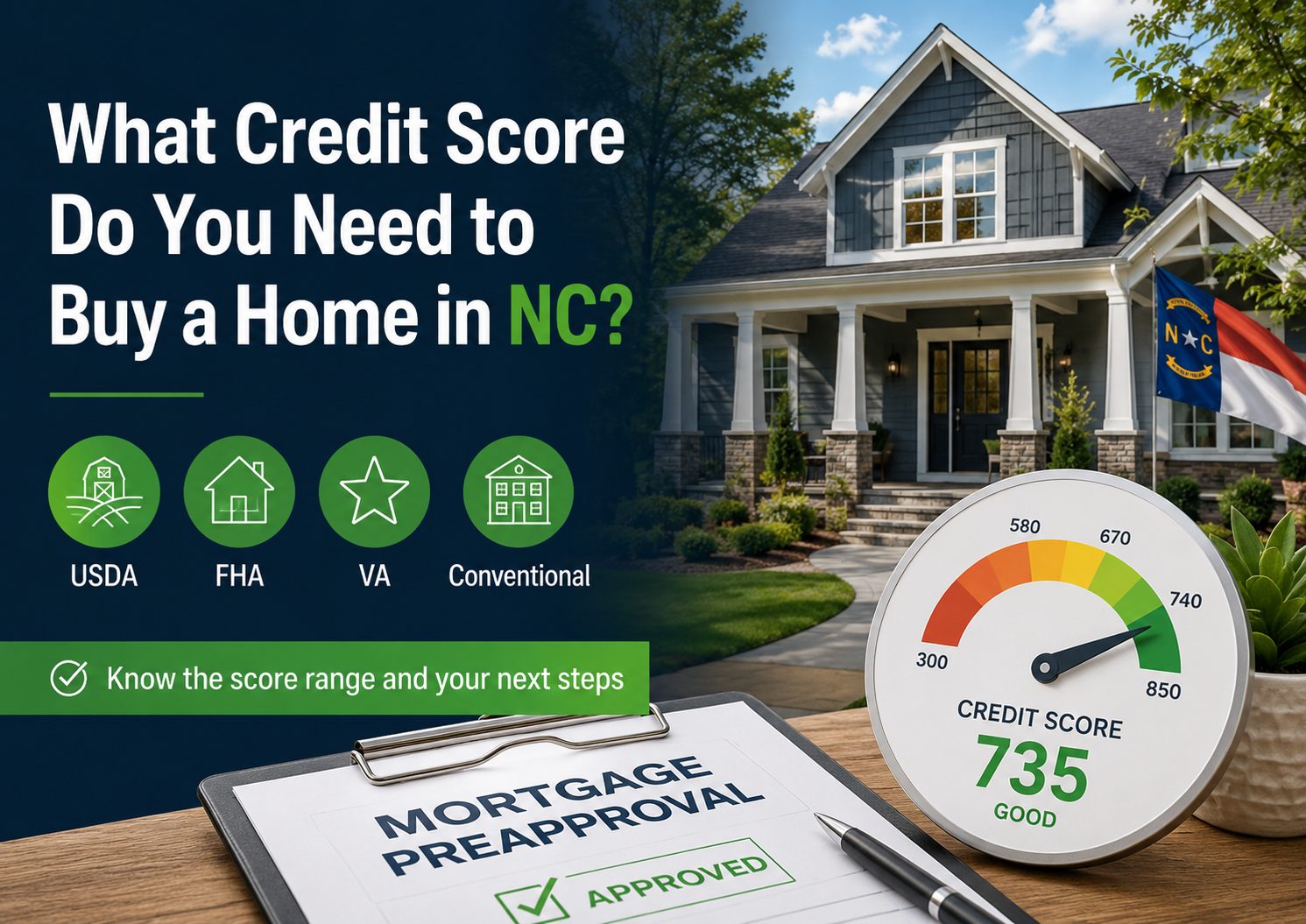
North Carolina homebuyer credit score graphic showing a gray house, loan program icons for USDA, FHA, VA, and conventional loans, a mortgage preapproval form, and a credit score gauge reading 735 with the message to know your score range and next steps.
USDA, FHA, VA, and conventional loans each have different credit score thresholds. Here's exactly where you need to be and how to get there faster than you think.
Credit Score Home Loans NC USDA FHA First Time Buyer Western NC
G

Ginny Mosteller | Western NC REALTOR®

Helping buyers in Haywood County understand their full picture, credit, loans, and all, before they start the search.

"Is my credit good enough to buy a house?" It is one of the first questions I get from almost every first time buyer I work with in Western NC. The honest answer is: it depends on the loan type. And in many cases, buyers are closer than they think, or just a few focused months away from qualifying for a program that changes everything, like a USDA zero down loan or NC down payment assistance. This guide breaks it all down, specific to North Carolina buyers.

1.First: Understand the Credit Score Ranges

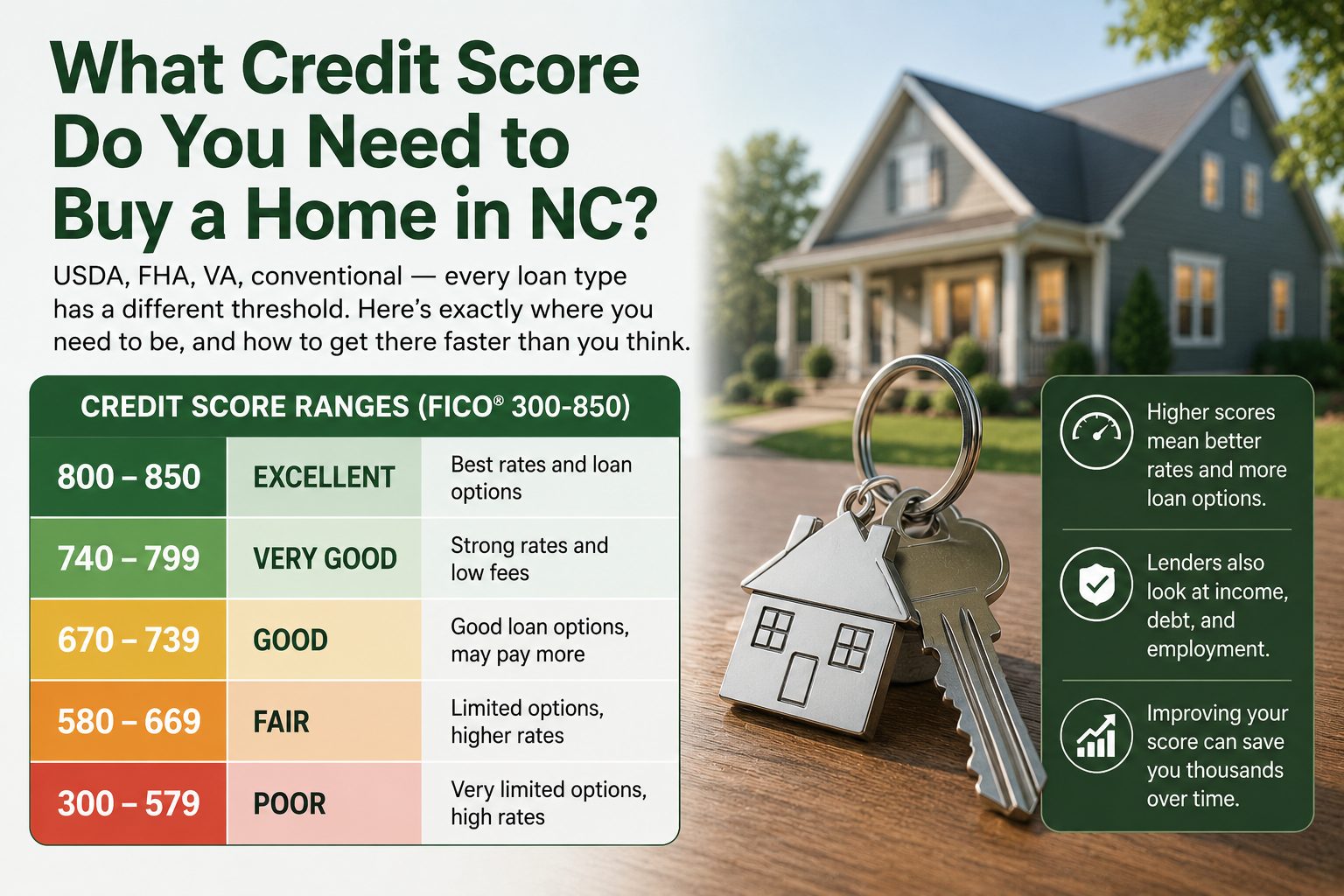
Credit scores in the U.S. are most commonly measured using the FICO® scoring model, which runs from 300 to 850. Lenders use your score, along with income, debt, and employment history, to decide whether to lend to you and at what interest rate.

Here's what each score range generally means for home buyers:

300 to 579 Poor
580 to 669 Fair
670 to 739 Good
740 to 799 Very Good
800 to 850 Exceptional
Most first-time buyers in Western NC fall somewhere in the 600 to 720 range. The good news: several powerful loan programs, including USDA and FHA, are specifically designed to work with scores in that range.

★ Real Talk

Your credit score is not a fixed number. It changes every month based on your behavior. I have watched buyers go from 608 to 645 in 60 days with the right moves, and that 37 point jump unlocked a USDA loan that saved them $40,000 in down payment they did not have.

Credit score range infographic for North Carolina homebuyers showing FICO score categories from poor to excellent, a house key on a table, and notes explaining how higher credit scores can mean better loan options, lower rates, and long term savings.

2.Minimum Credit Scores by Loan Type in NC

Different loan programs have different minimum requirements. Here's the full picture for North Carolina buyers:

Loan Type Min. Credit Score Down Payment NC Availability
USDA Guaranteed 640 most lenders 0% Rural eligible areas, Haywood County, Western NC
FHA Loan 580 with 3.5% down
500 with 10% down
3.5% or 10% Statewide, no location restriction
VA Loan No official min.
620+ typical lender req.
0% Eligible veterans, active duty, surviving spouses
Conventional 3% 620 to 640 3% Statewide, Fannie Freddie backed
NC Home Advantage Mortgage 640 As low as 3%
plus DPA
Statewide via NCHFA approved lenders
USDA Direct No official min.
typically 640+
0% Very low income buyers in eligible rural areas
Conventional 20%+ 620+ 20%+ Best rates, no PMI, statewide

💡 Pro Tip

The 640 threshold is the most important number for buyers in Western NC. It unlocks USDA zero down, the NC Home Advantage Mortgage DPA, and most conventional options. If you are at 630, you are one focused month away from a completely different set of options.

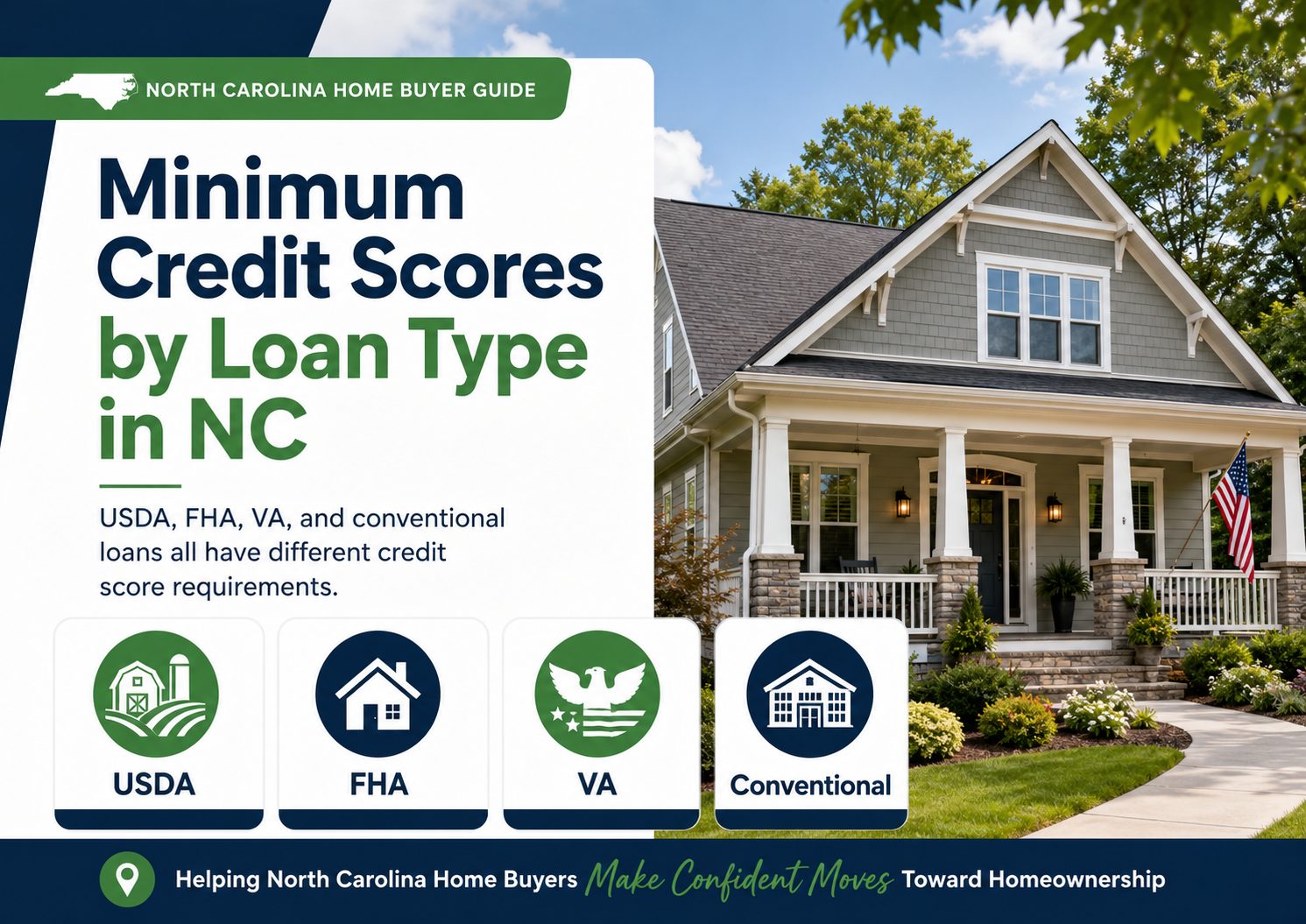
North Carolina homebuyer guide graphic showing a gray house and a list of minimum credit score requirements by loan type, including USDA, FHA, VA, and conventional loans, to help buyers compare financing options before applying.

3.What Your Score Means for Your Interest Rate

Your credit score doesn't just determine whether you qualify. It directly affects your interest rate and therefore your monthly payment for the life of the loan. Even a 40-point difference can cost or save you thousands.
Credit Score Range Estimated Rate Impact Monthly Payment on $350K 30 Year Extra Cost
760 to 850 Best available rate About $2,090 Baseline
700 to 759 +0.25 to 0.50% About $2,140 About $18,000 more
640 to 699 +0.50 to 1.00% About $2,190 to $2,240 About $36,000 to $54,000 more
580 to 639 +1.25 to 1.75% About $2,290 to $2,350 About $72,000 to $93,000 more

"I always tell buyers: spending 90 days improving your credit before you buy is not a delay, it is an investment. Going from 620 to 680 on a $350,000 loan can save you more than $50,000 over 30 years. That is real money." Ginny Mosteller

Real estate credit score graphic showing a home, mortgage loan paperwork, and interest rate gauge, explaining that a higher credit score can help buyers qualify for a lower mortgage rate and lower monthly payment.

4.What Actually Makes Up Your Credit Score

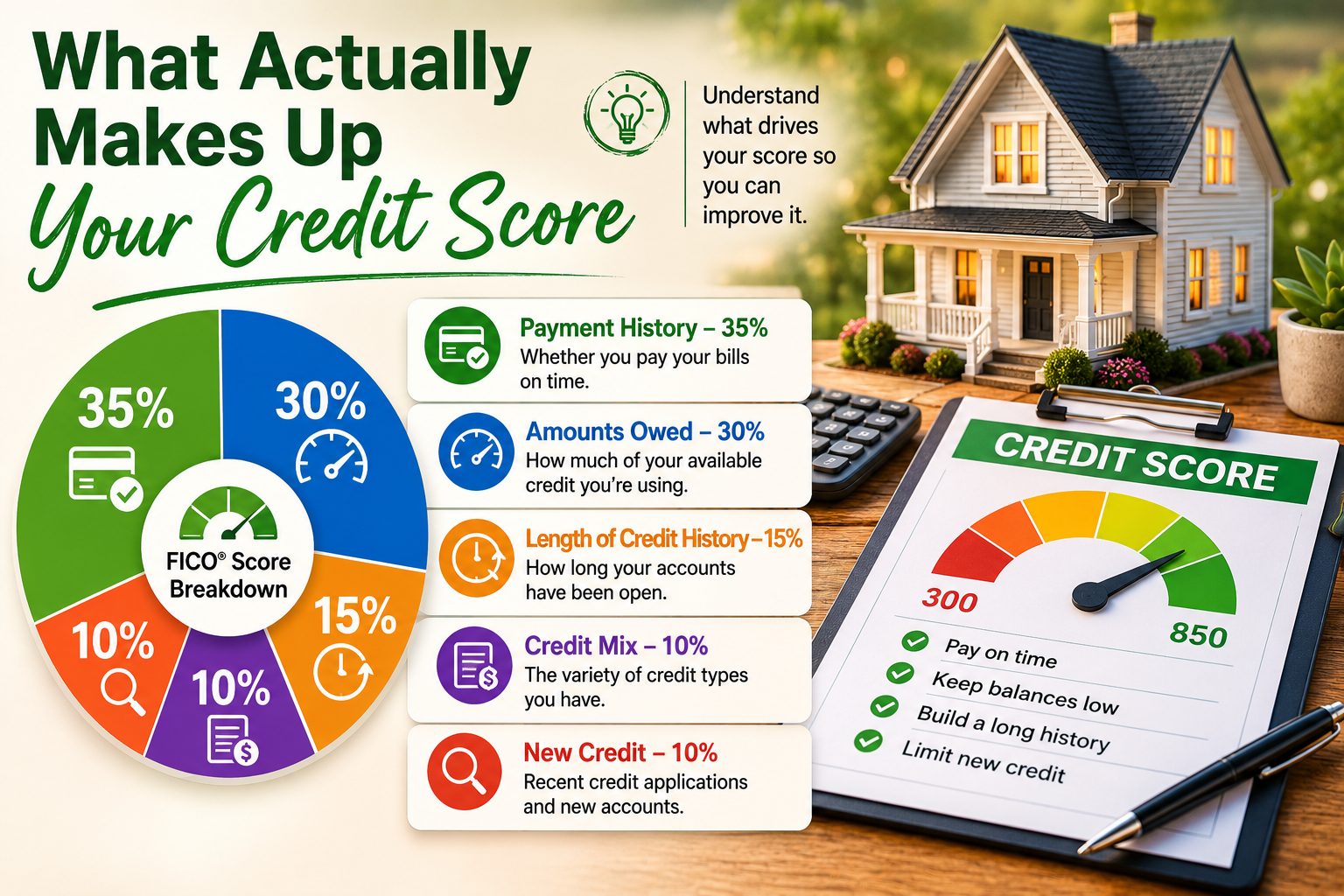
Before you can improve your score, you need to understand what drives it. FICO® scores are calculated using five factors, and knowing their weight helps you prioritize what to fix first:

  • Payment History 35% The single biggest factor. One missed payment can drop your score significantly. Pay everything on time, every time.
  • Credit Utilization 30% How much of your available revolving credit you are using. Aim to keep each card below 30%, ideally below 10%.
  • Length of Credit History 15% Older accounts help. Do not close old credit cards you are not using, the age helps your score.
  • Credit Mix 10% Having both revolving credit cards and installment loans, car or student loans, helps. Do not open new accounts just for this.
  • New Credit Inquiries 10% Hard pulls from new credit applications temporarily lower your score. Avoid applying for new credit in the 6 to 12 months before buying a home.

⚠ Watch Out

The top credit mistake I see buyers make before closing is opening a new credit card or taking out a car loan to build credit right before applying for a mortgage. New inquiries and new accounts can drop your score and trigger a lender review that delays or stops your closing. Freeze all new credit activity 6 months before you plan to apply.

Credit score breakdown infographic showing the five main factors that make up a FICO score, including payment history, amounts owed, length of credit history, credit mix, and new credit, alongside a credit score report, home model, and homebuying checklist.

5.How to Improve Your Credit Score Before Buying in NC

The good news: credit scores respond faster than most people expect when you take the right targeted actions. Here's the exact playbook I share with buyers who need a score boost before they're ready:

  1. Pull Your Free Credit Reports First Get your reports from all three bureaus, Equifax, Experian, and TransUnion, free at AnnualCreditReport.com. You are looking for errors, incorrect late payments, accounts you do not recognize, or collections that may be outdated.
  2. Dispute Any Errors Immediately You have the legal right to dispute inaccurate items on your credit report. Bureaus must investigate and respond within 30 days. Removing a false derogatory mark can raise your score 20 to 50 points. Use the dispute process at each bureau's website directly.
  3. Pay Down Credit Card Balances Aggressively This is the fastest lever available. If your cards are above 30% utilization, paying them down to below 10% can add 20 to 40 points to your score within one billing cycle. If you have $5,000 saved, it may serve you better as credit payoff than a down payment, especially if you are targeting a USDA loan.
  4. Do Not Close Old Accounts Closing a credit card reduces your available credit, raises utilization, and shortens your credit history. Keep old cards open and use them occasionally for small purchases you pay off immediately.
  5. Ask for a Credit Limit Increase If your card balances are fixed but your limits go up, your utilization ratio drops, which helps your score. Call your card issuer and request an increase. Most issuers will do this without a hard pull if you have been a good customer.
  6. Become an Authorized User Ask a family member with a long, clean credit history and low utilization to add you as an authorized user on one of their oldest cards. Their positive history can transfer to your report, sometimes adding 20 to 30 points within weeks.
  7. Set Up Autopay for Everything A single 30 day late payment can drop your score 60 to 100 points and stay on your report for 7 years. Set up autopay for the minimum on every account, then pay more manually. Never miss a due date again from this point forward.
  8. Freeze New Credit Applications Every hard inquiry from a new credit application can knock 5 to 10 points off your score. Stop applying for anything, new cards, car loans, or store credit, at least 6 months before your mortgage application.
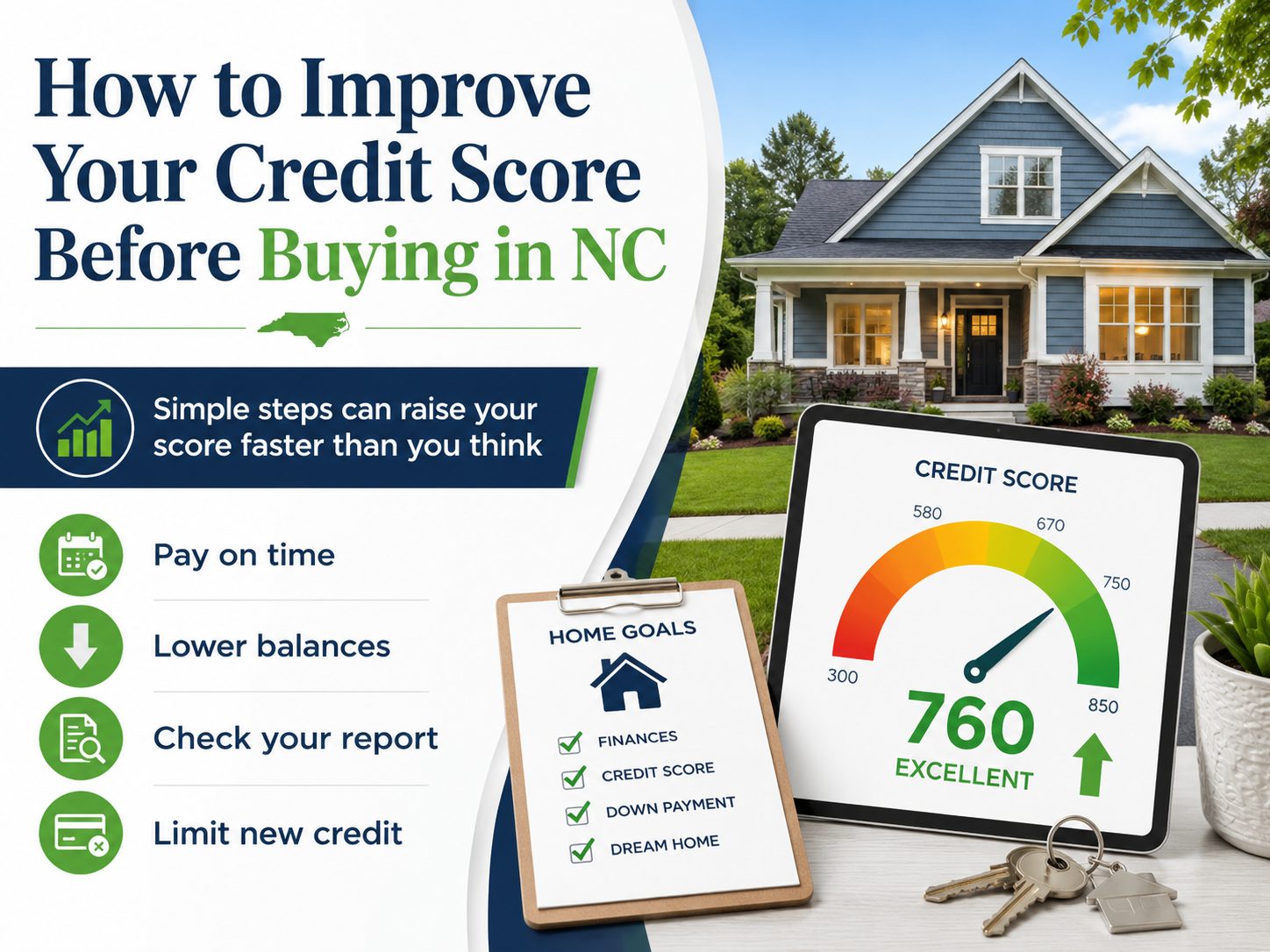
Credit score improvement graphic for North Carolina homebuyers showing a home, credit score gauge reading 760, house keys, and a checklist with steps like paying on time, lowering balances, checking your report, and limiting new credit before buying.

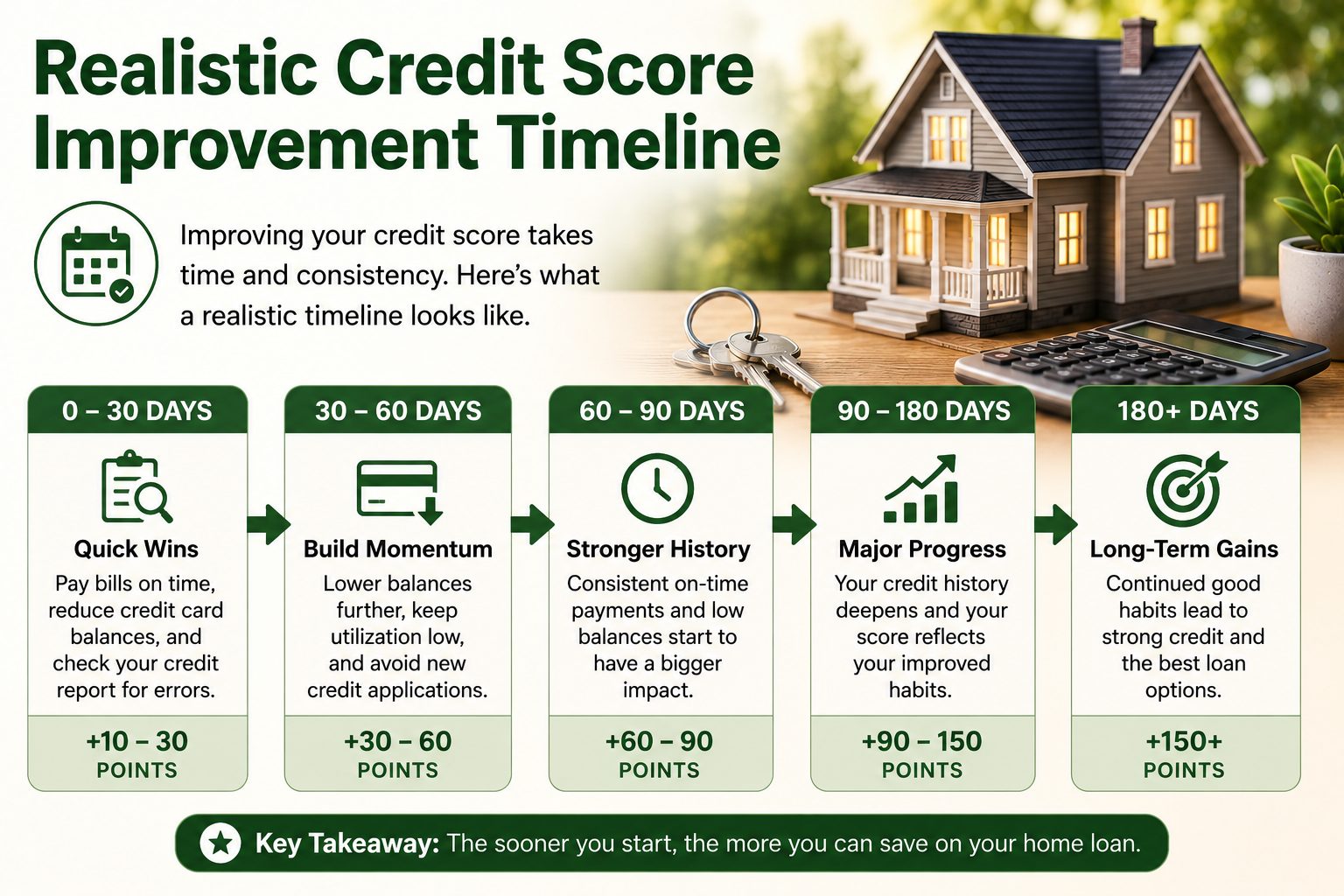
6.Realistic Credit Score Improvement Timeline

Here's a realistic picture of what you can achieve in different timeframes with consistent effort:

Within 30 Days

Pay down high utilization cards. Results show up within one billing cycle. Dispute obvious errors. Can gain 15 to 40 points depending on starting point.

Within 60 to 90 Days

Dispute resolutions complete. Authorized user additions register. Limit increases approved. Most buyers see a 30 to 60 point improvement with the full playbook applied.

Within 6 Months

Consistent on time payments compound. Old negative marks matter less as positive history builds. Buyers starting at 580 frequently reach 640+ with focused effort over 6 months.

Within 12 Months

For buyers recovering from major events, collection accounts, a missed payment, or high debt, a full 12 month rebuild plan can move scores from the 500s into qualifying range for USDA and FHA.

★ Real Talk

Six months of intentional credit work before buying a home is one of the most financially impactful things you can do. I regularly connect buyers with HUD approved housing counselors in NC who offer free one on one credit coaching for homebuyers, no cost, no catch.

Credit score improvement timeline infographic showing estimated progress from 0 to 180 plus days, with steps for quick wins, building momentum, stronger history, major progress, and long term gains, alongside a home model, keys, and calculator.

7.How Credit Score Connects to Every Other Loan Program

Your credit score is the gateway to every program we've covered in this series. Here's how it all connects:

  • 640+ USDA Loan eligible Zero down payment on homes in Western NC's rural eligible areas. Read: USDA Loans in Western NC, The 0% Down Option Most Buyers Miss
  • 640+ NC Home Advantage Mortgage eligible State backed mortgage with built in down payment assistance up to 3% of the loan.
  • 640+ NC 1st Home Advantage DPA eligible Up to $15,000 in down payment or closing cost help. Read: NC Down Payment Assistance for First Time Buyers
  • 580 to 639 FHA Loan eligible 3.5% down, statewide, while you continue improving toward 640.
  • 620+ Most conventional loans eligible Wider lender choice, PMI cancelable once you reach 20% equity.

💡 Pro Tip

Use the free mortgage calculators at Ginny Real Estate to model your estimated payment at different credit score tiers and loan types, so you can see exactly what is at stake and set a specific target to work toward.

What is the minimum credit score to buy a home in North Carolina?

It depends on the loan. FHA allows as low as 580 with 3.5% down. USDA and most conventional loans require 640. VA loans have no official minimum but most lenders want 620+. The NC Home Advantage Mortgage requires 640. Most buyers in Western NC will aim for 640 as their key threshold.

Can I buy a home in NC with a 580 credit score?

Yes, with an FHA loan. A 580 score qualifies you for 3.5% down FHA financing. USDA and most NC assistance programs require 640, so if you are between 580 to 639, FHA is your best immediate path while you build toward 640.

What credit score do I need for a USDA loan in NC?

Most USDA approved lenders in NC require a minimum of 640 for streamlined underwriting. Below 640 may qualify through manual review but requires a stronger overall profile. Since USDA is the most powerful zero down loan available in Western NC, reaching 640 is worth prioritizing.

How fast can I improve my credit score to buy a home?

Paying down high utilization credit card balances can show results within one billing cycle, usually around 30 days. Disputing errors, becoming an authorized user, and requesting limit increases can produce meaningful changes within 60 to 90 days. A committed 6 month effort can move most buyers from the 580s to 640+.

Does checking my credit score hurt it?

No. Checking your own credit, also called a soft pull, has zero impact on your score. Only hard inquiries from new credit applications cause a small temporary dip. You can and should monitor your score regularly, especially in the months leading up to a home purchase.

Should I pay off debt or save for a down payment?

In most cases in Western NC, paying down revolving debt is the better move, especially if you are targeting a USDA loan, which needs no down payment, or trying to cross the 640 threshold. Lower utilization raises your score and reduces your debt to income ratio, both of which help your application.

Ready to Talk Real Estate?

Have questions about what credit score you need to buy a home in North Carolina? Reach out anytime. I would be happy to help you understand which loan options may fit your situation, review how your credit score connects to USDA, FHA, VA, conventional financing, and NC down payment assistance, and connect you with a trusted local lender. From credit score thresholds and payment estimates to zero down options, buyer timelines, and homes in Western NC that may fit your budget, I can help you move forward with a clearer plan and more confidence.

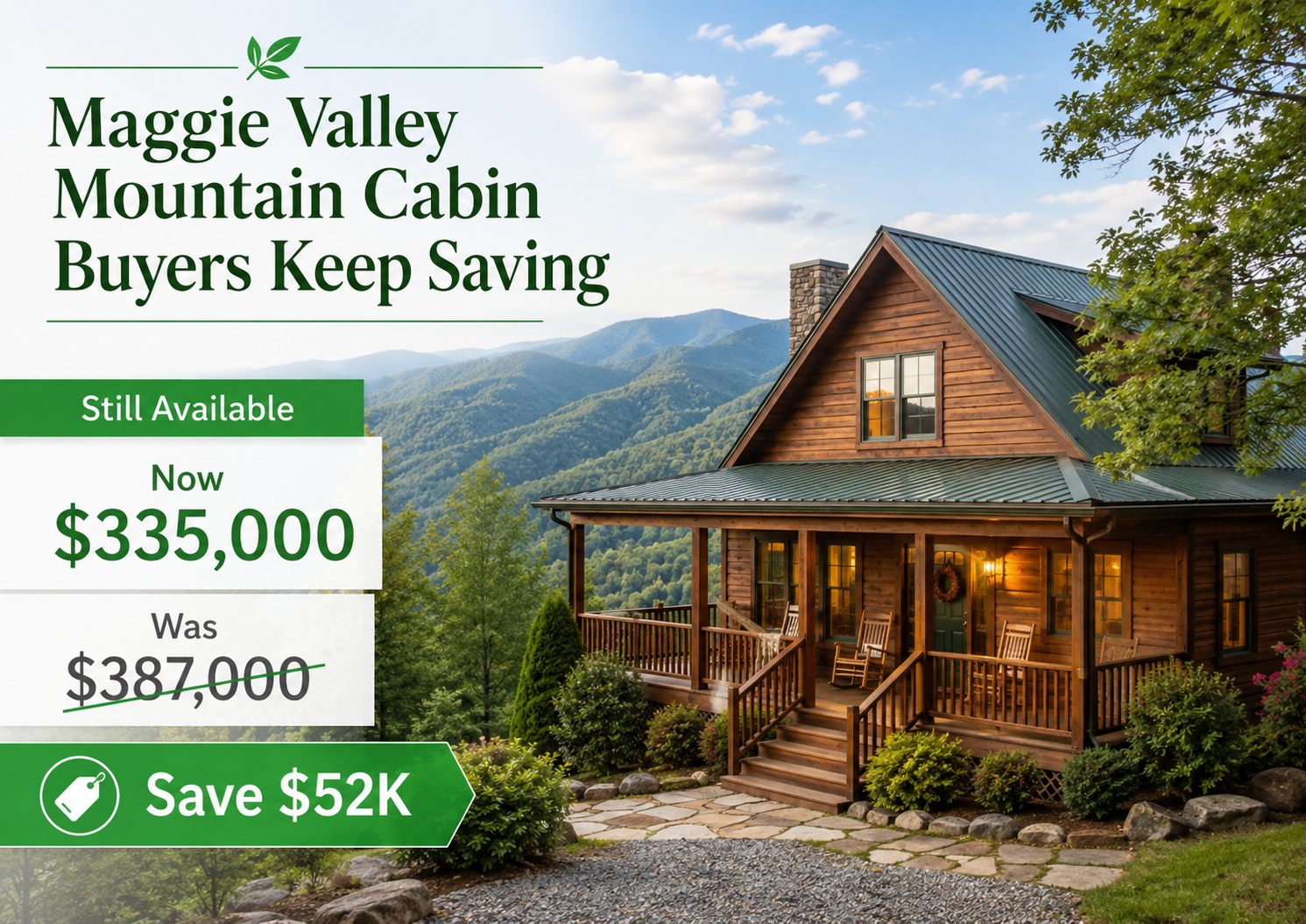
Promotional real estate graphic for a Maggie Valley mountain cabin showing a rustic cabin with mountain views, green pricing banners, and text highlighting that the property is still available at $335,000 after a $52,000 price reduction.
There is a specific kind of listing that shows up in the WNC mountain home market every now and then. It generates views. It gets saved. Buyers from Florida and Texas and Ohio add it to their favorites and then do nothing about it. And it just sits there, waiting for someone to make the move.

74 Link Cir in Maggie Valley NC is exactly that listing right now. And after a price reduction to $335,000, down a total of $52,000 from where it started, I want to make sure the right buyer actually reads this before someone else does.

I am Ginny Hyatt Mosteller. I grew up in Haywood County. I know Maggie Valley not from a map but from a lifetime. And when I look at this property, I see something that deserves more than a casual save. I see an opportunity.

Why This Matters Right Now

This property has been saved 36 times and viewed over 506 times online. The price has now been reduced to $335,000, the most aggressive price point this home has been listed at. In the WNC mountain market, properties at this price point with this much flexibility do not wait indefinitely. When the right buyer appears, this one moves.

36 people saved this cabin. Only one person gets to buy it. Right now, that person has not shown up yet. Maybe it is you.

Why 74 Link Cir in Maggie Valley NC Is Getting Attention

Before I walk you through what makes this property genuinely compelling, let me show you the price history because it tells a story that every serious buyer in this market needs to understand.

Price History: 74 Link Cir, Maggie Valley NC 28751

Date Event Price Change
March
2025
Originally listed $387,000 Starting price
April
2025
Price reduction $375,000 Down $12,000
May
2025
Price reduction $367,000 Down $8,000
July
2025
Listing removed,
relisted April 2026
$350,000 Down $17,000
May 15,
2026
Most recent price
reduction
$335,000 Down $15,000, Total
reduction $52,000

What this price history tells me as a local agent is simple: the seller is serious. The motivation is real. And at $335,000, this is now the most competitively priced opportunity in the Maggie Valley market for a buyer who understands what this property offers and what this community is.

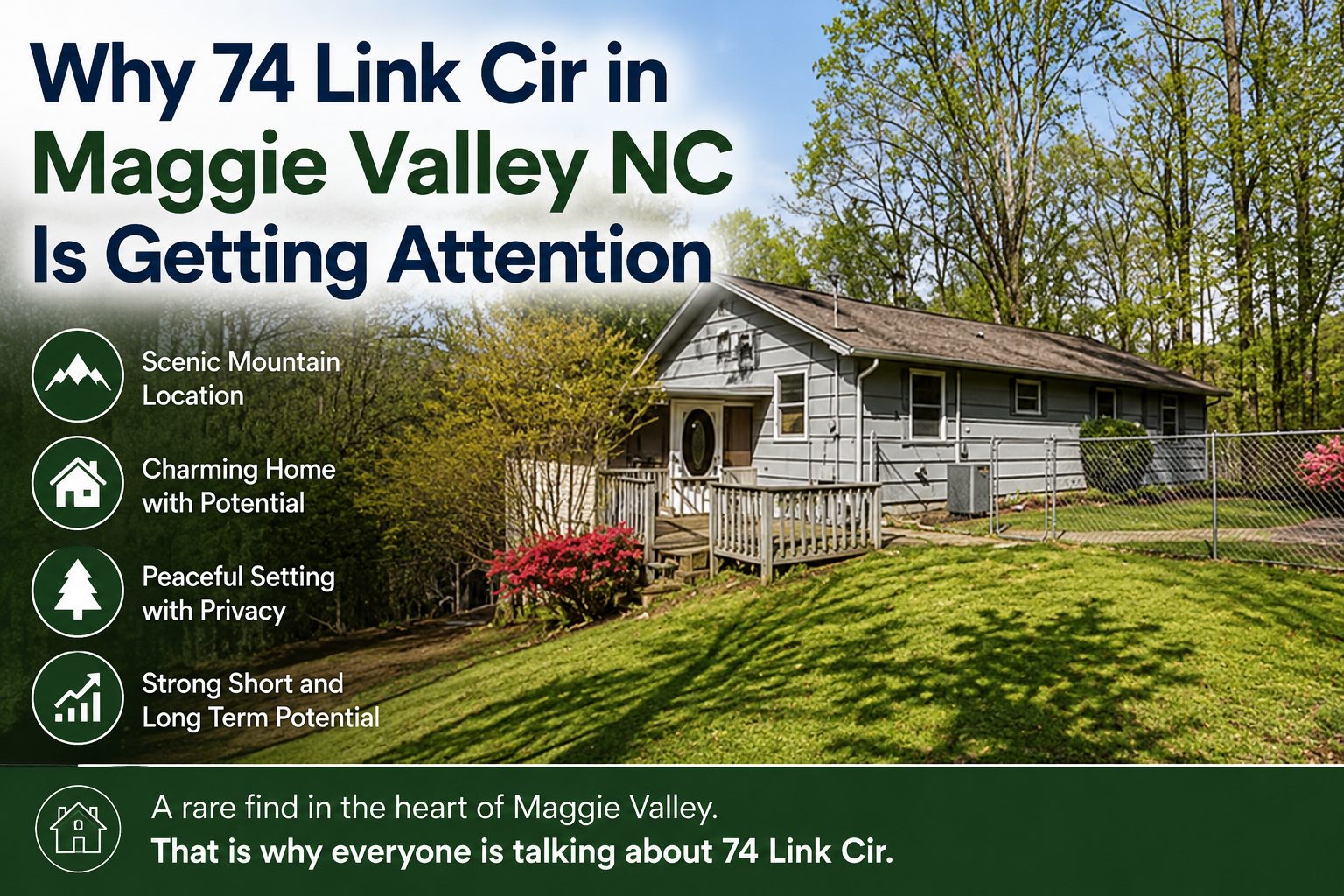
Real estate graphic for 74 Link Cir in Maggie Valley NC showing a small mountain home surrounded by green lawn and trees, with text highlighting its scenic location, charm, privacy, and short term or long term potential.

7 Reasons This Mountain Cabin Deserves a Serious Look

1
Location and Elevation

2,500 Feet Elevation in One of WNC's Most Scenic Communities

Maggie Valley sits in the heart of Western North Carolina at genuine mountain elevation, and 74 Link Cir at 2,500 feet offers the kind of cool summers, crisp falls, and snow dusted winters that buyers from Florida and Texas dream about when they are searching for mountain homes for sale in Western North Carolina.

The community is minutes from the Blue Ridge Parkway, the Cataloochee Valley where elk roam freely, Maggie Valley's main street of live music and local dining, and one of the most beloved ski resorts in the Southeast. This is not a generic mountain address. It is one of the most genuinely beautiful and lifestyle rich communities in the entire region.

2
Flexible Space

The Lower Level Is the Hidden Gem Nobody Is Talking About

The official square footage of 1,090 square feet does not tell the full story of this property. The lower level adds an expansive flex space, a second full bath, and a dedicated mini split climate control system. While it is not counted in the official square footage due to ceiling height, it is fully functional, fully climate controlled, and completely usable as a guest suite, home office, hobby room, or additional living area.

For buyers who are relocating to Western North Carolina and need flexible work from home space, or for second home buyers who want a private guest area separate from the main living floor, this lower level is exactly the kind of bonus that makes a small footprint property live much larger than its square footage suggests.

3
Short Term Rental Potential

A Legitimate STR Opportunity Under $340K in a High Demand WNC Destination

Maggie Valley is one of the most consistently popular vacation destinations in Western North Carolina. Proximity to Great Smoky Mountains National Park, Cataloochee elk viewing, Maggie Valley ski resort, and the Blue Ridge Parkway drives year round visitor traffic that supports a strong short term rental market.

A 3 bedroom mountain cabin with flex space, a wood burning fireplace, fire pit, private wooded setting, and a paved driveway at 2,500 feet elevation is exactly the type of property that performs well on Airbnb and VRBO in this market. According to AirDNA market research, the Maggie Valley area commands strong occupancy rates during peak seasons. For buyers evaluating this as a WNC vacation home under $350K with income potential, this property deserves serious financial modeling. Use the free financial calculators on my website to run your numbers.

4
Cozy Mountain Character

A Wood Burning Fireplace and Fire Pit in a Wooded Private Setting

The living room is centered on a wood burning fireplace, which in the WNC mountain market is not just a design feature. It is a lifestyle statement. There is a reason buyers from warmer climates specifically search for mountain cabins with real fireplaces. It is the defining experience of mountain living in the cooler months, and this home delivers it authentically.

Outside, the fire pit, the fenced yard area, the enclosed porch, and the wooded privacy of the 0.54 acre corner lot create an outdoor living experience that feels genuinely secluded despite being minutes from Maggie Valley amenities. This is the balance that buyers searching for WNC mountain homes with views and privacy are specifically looking for.

5
School Quality

Jonathan Valley Elementary Rated 9 Out of 10 by GreatSchools

For families considering this as a primary residence, the school ratings in this district are genuinely strong. Jonathan Valley Elementary, the assigned elementary school, holds a 9 out of 10 rating on GreatSchools, which places it among the top performing elementary schools in Haywood County. Tuscola High School, the assigned high school, holds a 7 out of 10 rating.

In a market where families are weighing relocation options across multiple WNC counties, school quality is a significant factor in neighborhood selection. This property's school assignment is a meaningful advantage for family buyers evaluating Haywood County NC real estate.

6
Financing Flexibility

Eligible for USDA, VA, and Conventional Financing

This property is listed as eligible for Cash, Conventional, USDA Loan, and VA Loan financing. The USDA eligibility is particularly significant for buyers who qualify, as it opens the door to zero down payment financing on an already reduced purchase price. For military veterans and service members, VA loan eligibility offers similarly powerful financing advantages.

At $335,000 with public water, the monthly payment on a conventional 30 year loan with 20 percent down is approximately $1,547 in principal and interest based on current rate estimates. Use the free financial calculators on my website to model your specific scenario based on your down payment and current rate.

7
Entry Point and Equity Upside

An Affordable Entry Into the WNC Mountain Market With Real Upside Potential

This home was sold in 2015 for $114,000. It is now listed at $335,000 after $52,000 in price reductions from a starting point of $387,000. The listing description itself notes that cosmetic updates offer genuine equity building potential, meaning the current price reflects both the current condition and the opportunity to add value through targeted improvements.

For buyers who want to enter the affordable mountain home Western North Carolina market at a point that still leaves room for appreciation and improvement, this property represents one of the most accessible entry points currently available in the Maggie Valley area. Explore all currently available mountain homes for sale in Western North Carolina to understand how this one compares to everything currently active in this price range.

Who Is This Home For?

✈️

The Out of State
Buyer

Looking for an affordable WNC mountain retreat under $350K with room to personalize and strong rental income potential when not in use.

🏡

The Primary Home
Buyer

Relocating to Western NC and wanting a private wooded setting near top rated schools, mountain trails, and Maggie Valley community life.

💼

The Remote Worker

Needing a dedicated flex space for a home office, wired internet connectivity, and the kind of natural surroundings that make remote work genuinely joyful.

Frequently Asked Questions

01

Is 74 Link Cir in Maggie Valley NC eligible for short term rental?

The property is located in the Wild Acres subdivision with a very low HOA of $28 annually. Buyers interested in using this property as a short term rental should verify current Haywood County short term rental regulations and any HOA restrictions before purchase. I can help you navigate that due diligence process as part of a purchase transaction. The property's location, elevation, wooded setting, fireplace, fire pit, and flex space make it a strong candidate for the Maggie Valley vacation rental market, and I am happy to walk through that opportunity in detail. Contact me directly to discuss.

02

What is the lower level of this home actually like and can I use it as a bedroom?

The lower level includes an expansive flex space, a second full bath, and a dedicated mini split climate control system. It is fully functional and comfortable. The reason it is not counted in the official square footage is due to ceiling height, which is a standard disclosure requirement in NC real estate. Whether it qualifies as a legal bedroom for financing purposes depends on your lender's requirements, which vary. I recommend confirming this with your lender before making an offer if the lower level bedrooms are important to your specific use case. The space is genuinely useful and comfortable regardless of how it is classified. Use the financial calculators on my website to model your payment scenarios.

03

How far is 74 Link Cir from Asheville and Waynesville?

Maggie Valley is approximately 35 to 40 minutes from downtown Asheville under normal driving conditions and approximately 15 to 20 minutes from Waynesville. This location gives buyers access to Asheville's world class dining, medical facilities, and regional airport while living in a smaller, quieter, and significantly more affordable mountain community. For buyers relocating to Western North Carolina who want mountain lifestyle without Asheville's price premium, Maggie Valley consistently delivers strong value.

04

Why has this home had so many price reductions?

The property was originally listed in March 2025 at $387,000, which was at the higher end of what the Maggie Valley market was supporting for a home of this size and vintage. The successive reductions reflect the seller's willingness to meet the market where it is rather than where they hoped it would be. At $335,000, the property is now priced competitively against comparable active listings in the area. For a buyer, this price history represents genuine negotiating context and a seller who is motivated to close. Read through the buying tips on my website for guidance on how to evaluate reduced price listings effectively.

05

What financing options are available for this property?

This property is listed as eligible for Cash, Conventional, USDA Loan, and VA Loan financing. USDA eligibility is particularly valuable for qualified buyers as it allows for zero down payment financing. VA loan eligibility provides similar advantages for veterans and active duty military. Conventional financing with 20 percent down at $335,000 produces an estimated monthly payment of approximately $1,547 in principal and interest at current rates. Use the free financial calculators on my website to model your specific scenario, and reach out to me to connect with trusted local lenders in the Haywood County market.

06

What are the best things about living in Maggie Valley NC?

Maggie Valley is one of the most genuinely beloved small communities in Western North Carolina. At 2,500 feet elevation with a mild four season climate, it offers cool summers, spectacular fall foliage, access to Cataloochee for elk viewing and skiing, the Blue Ridge Parkway within minutes, and a small town main street with live music venues, local dining, and a genuine sense of community. Haywood County NC real estate in Maggie Valley consistently attracts buyers who want the mountain lifestyle without the premium pricing of Asheville. Browse all available homes in the Maggie Valley area to see the full range of what is currently on the market.

07

How do I schedule a showing for 74 Link Cir in Maggie Valley NC?

The property is vacant and move in ready, which means showings can be arranged quickly and without coordination delays with an occupant. Contact me directly at (828) 400-9162 or at ginny@ginnyrealestate.com and I will arrange a showing at your earliest convenience. If you are visiting from out of state, I can also arrange a video walkthrough so you can experience the property before booking a trip. Nobody knows this market better, and I am here to make sure you have everything you need to make a confident and informed decision.

Ready to Talk Real Estate?

Have questions about 74 Link Cir in Maggie Valley or whether this price reduced mountain cabin could fit your goals? Reach out anytime. I would be happy to help you review the property, understand the financing options, check short term rental considerations, and compare it against other Maggie Valley and Haywood County homes in this price range. From USDA, VA, and conventional financing to payment estimates, local market value, showing availability, and what the lower level may mean for your needs, I can help you move forward with a clearer plan and more confidence.

Scenic Western NC mountain home with a text overlay reading “USDA Loans in Western NC,” highlighting 0 percent down home buying as a smart option for eligible buyers.

You don't need 20% down, or even 3%. In much of Western North Carolina, a USDA loan lets you buy a home with zero down payment. Here's everything you need to know.

Most buyers in Western NC have never heard of the USDA Guaranteed Loan, and that's a problem. It's one of the most powerful mortgage programs available, offering 100% financing (zero down payment), competitive fixed interest rates, and lower mortgage insurance costs than FHA loans. And in areas like Clyde, Canton, Maggie Valley, and parts of Waynesville, many properties qualify. This is the guide I wish every buyer in Haywood County had before they started shopping.
0%
Down Payment
Required
1%
Upfront
Guarantee Fee
0.35%
Annual Fee vs
0.85% FHA
640
Typical Min.
Credit Score

What Is a USDA Loan and Why Does It Exist?

The USDA Rural Development Guaranteed Housing Loan Program, commonly called a USDA loan or Rural Development loan, is a federally backed mortgage program administered by the U.S. Department of Agriculture. It was created with one goal: to help low-to-moderate income buyers purchase homes in eligible rural and suburban areas.

The word "rural" scares some buyers off. They assume USDA means farmland or remote country roads. In reality, the USDA's definition of rural is much broader than most people expect, and that's exactly why it matters so much in Western NC.

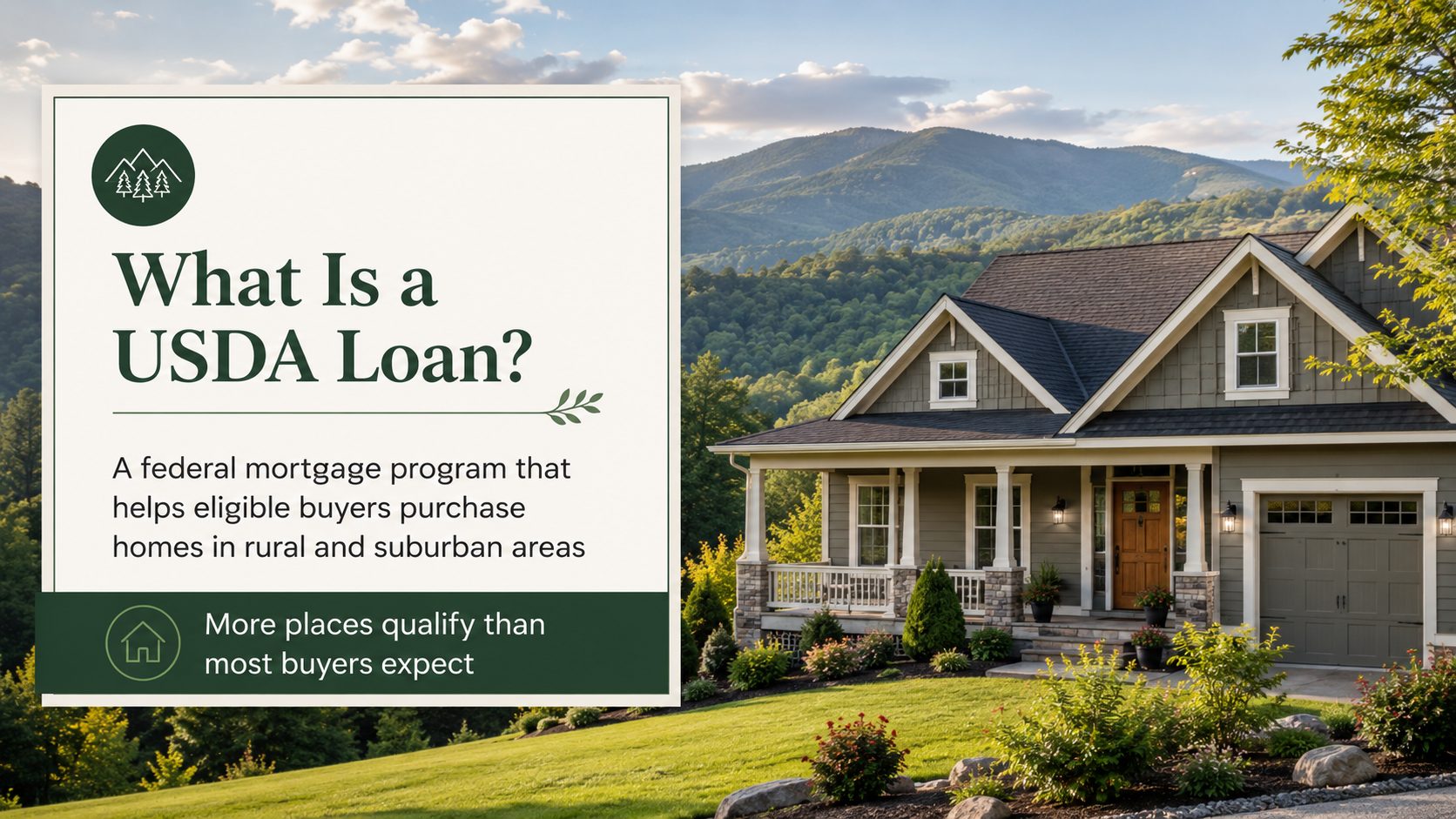
Western NC mountain home with an informational graphic explaining that USDA loans help eligible buyers purchase homes in rural and suburban areas, with more locations qualifying than many buyers expect.
★ Key Insight

The USDA Guaranteed Loan is NOT just for farmers. It is a standard 30 year fixed rate mortgage for anyone who meets income, credit, and property location requirements. No livestock required.

Is Western NC Eligible for USDA Loans?

Yes, and this is where it gets exciting for buyers in Haywood County. Large portions of Western NC, including communities in and around Clyde, Canton, Maggie Valley, Waynesville, and surrounding unincorporated areas, fall within USDA-designated rural eligible zones.

Eligibility is determined property by property using the USDA's official address lookup tool. Two homes on the same road can have different eligibility status depending on their exact location relative to the zone boundary. This is why checking a specific address before you fall in love with it is so important.

  • Clyde, NC, large portions are USDA eligible
  • Canton, NC, many areas qualify, check by address
  • Maggie Valley, NC, most of the community falls within eligible zones
  • Waynesville, NC, some areas qualify, check by address
  • Unincorporated Haywood County, broadly eligible in rural sections
  • Surrounding mountain communities, Balsam, Lake Junaluska area, Fines Creek, and more
Pro Tip

Check any specific address instantly at the official USDA eligibility tool: eligibility.sc.egov.usda.gov Enter the property address and it will tell you immediately whether it's in an eligible zone. I do this check for every buyer I work with before we even tour a home.

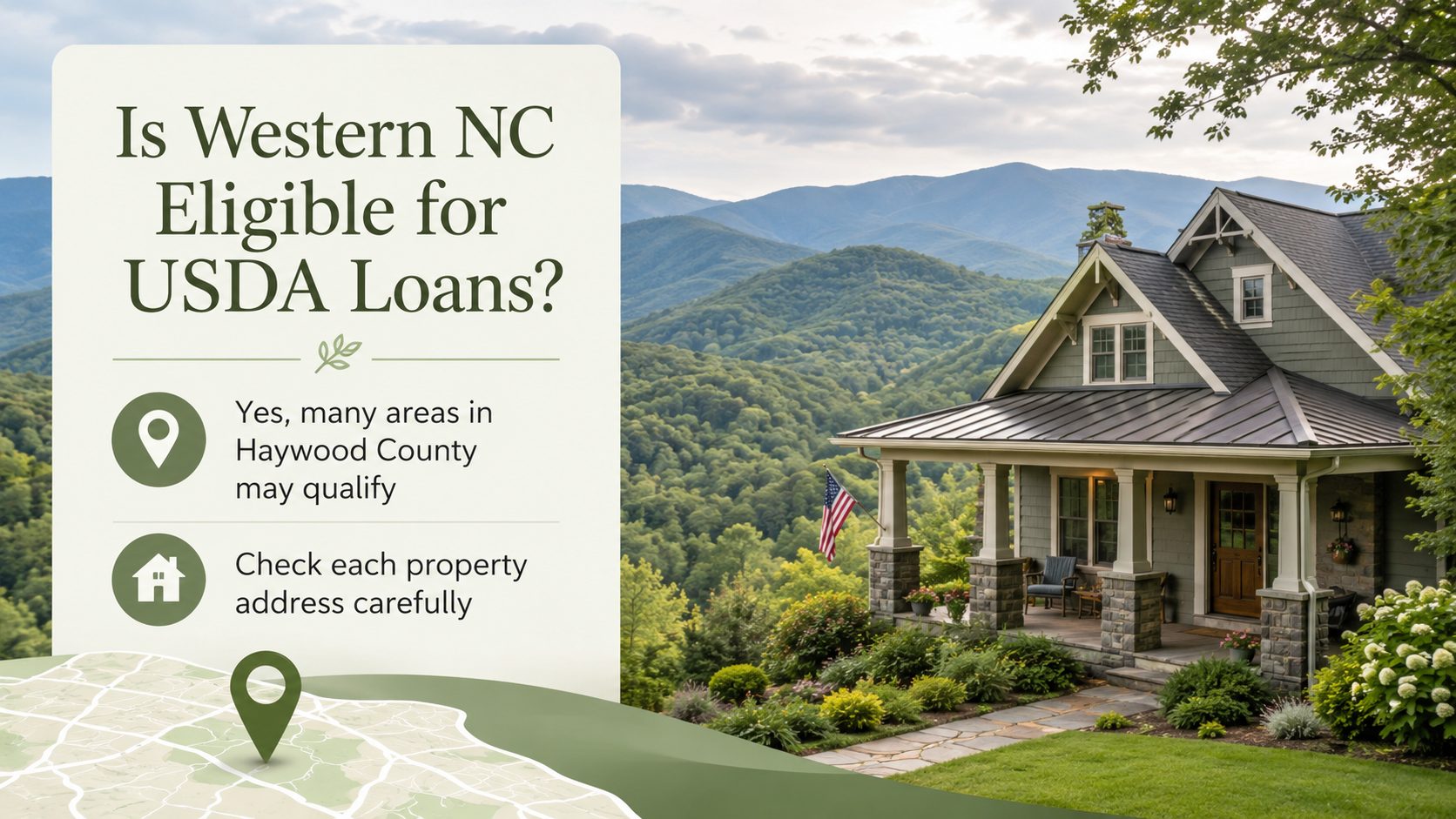
Western NC mountain home with a USDA loan eligibility graphic explaining that many areas in Haywood County may qualify and that buyers should check each property address carefully.

The Two Types of USDA Loans: Which One Is Right for You?

There are actually two distinct USDA mortgage programs, and they work very differently. Understanding which one applies to you is the first step.

Feature USDA Guaranteed Loan USDA Direct Loan
Who administers it Private lenders, banks, mortgage companies USDA directly
Income limit Up to approximately 115% of area median income Low to very low income only, about 50 to 80% AMI
Down payment 0% 0%
Interest rate Market rate, competitive and fixed Subsidized, can be as low as 1%
Processing time Standard mortgage timeline, 30 to 60 days Longer, often 60 to 90 plus days
Most common for buyers Most buyers use this Very low income buyers only

The USDA Guaranteed Loan is what most first-time buyers in Western NC will use. You apply through a USDA-approved private lender, just like a conventional or FHA loan, and the USDA guarantees a portion of the loan, reducing the lender's risk and allowing for zero down payment financing.

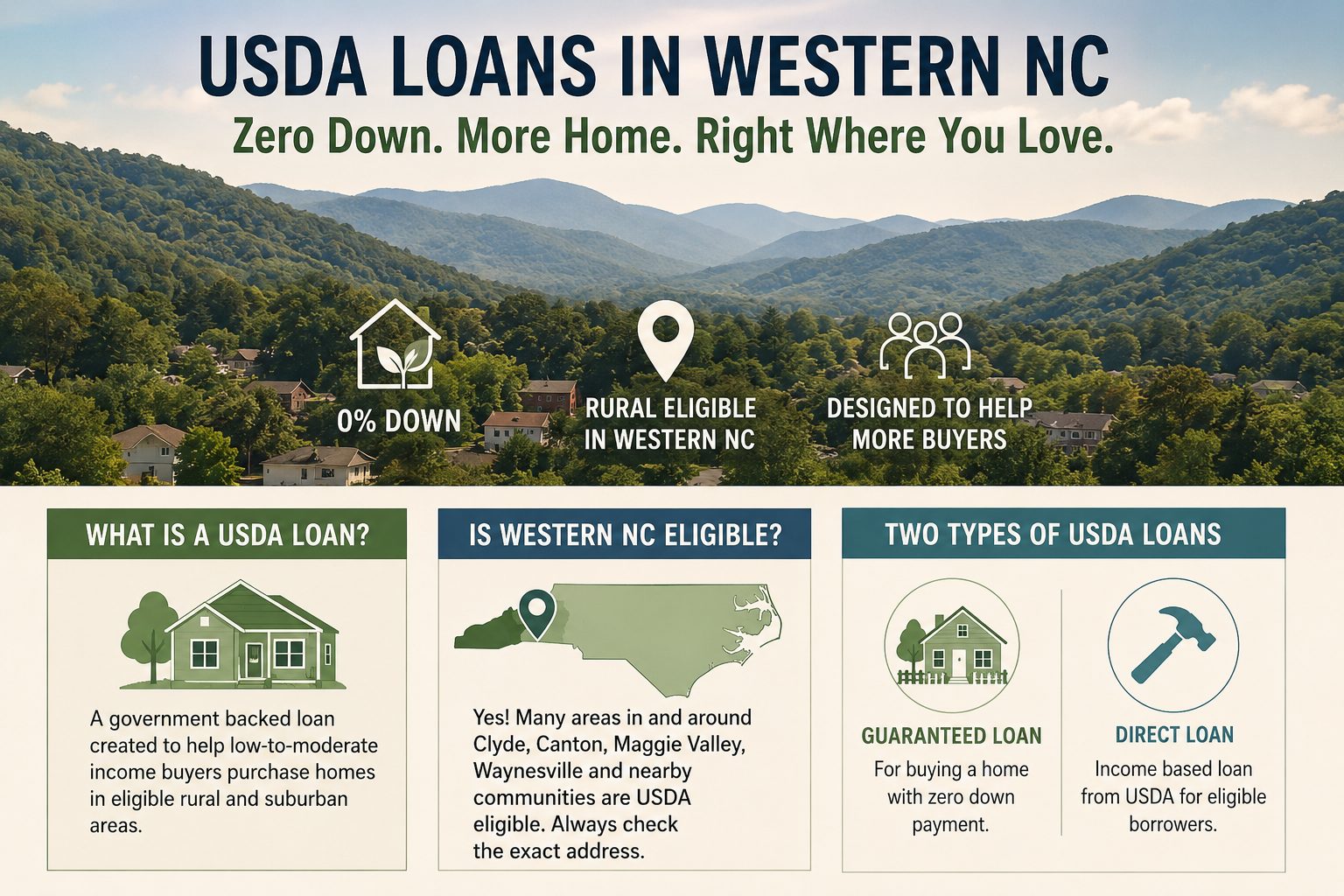
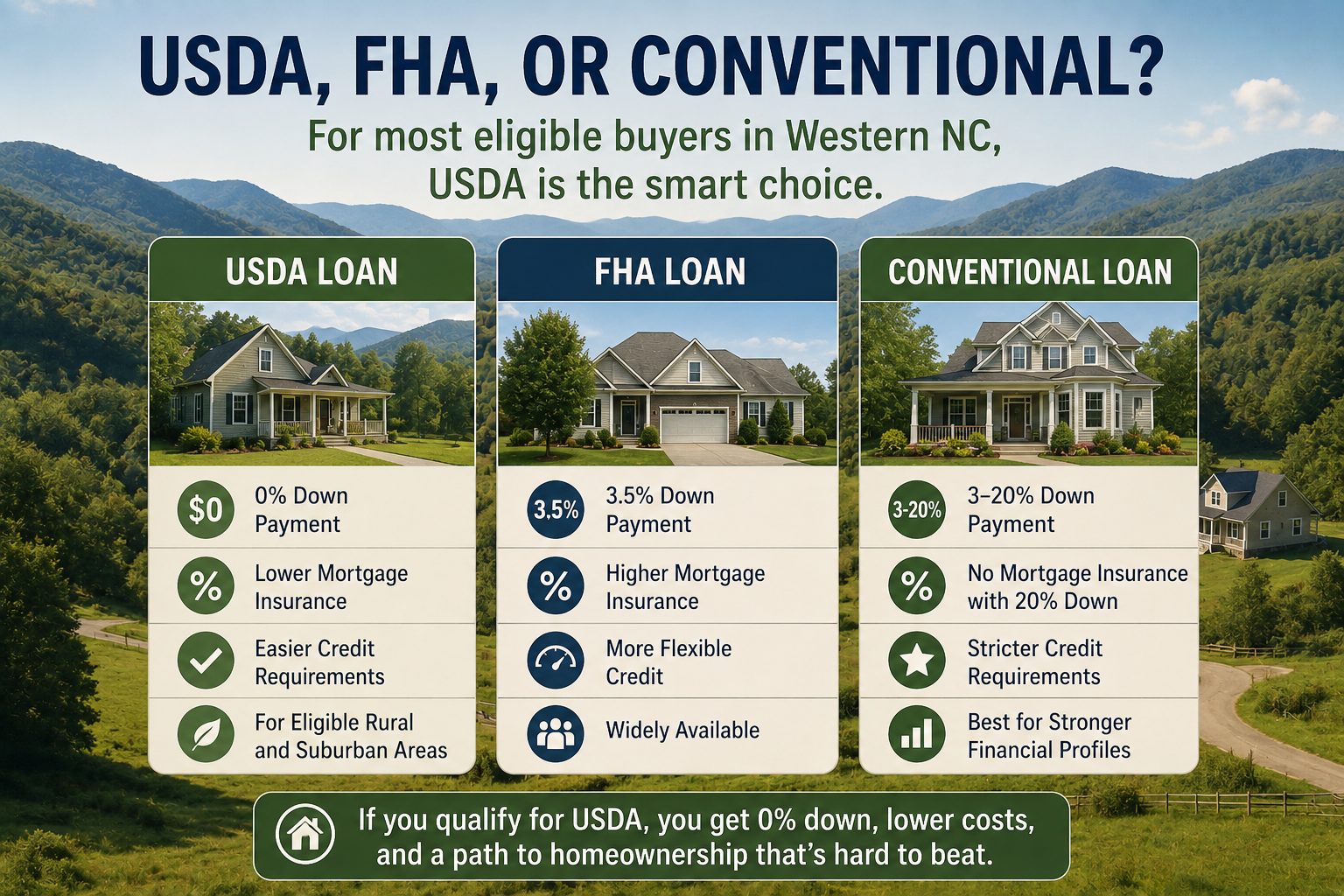
USDA loans in Western NC infographic with a mountain landscape background, highlighting 0 percent down, rural eligibility, buyer assistance, and the two main USDA loan types for eligible homebuyers.

USDA vs. FHA vs. Conventional: How Do They Compare?

One of the most common questions I get is: "Should I use a USDA loan or an FHA loan?" For buyers in USDA-eligible areas of Western NC, the answer is almost always USDA. Here's why:

Feature USDA Guaranteed FHA Loan Conventional 3%
Down payment 0% 3.5% 3%
Upfront mortgage insurance 1% financed into loan 1.75% financed None
Annual mortgage insurance 0.35% of loan/yr 0.85% of loan/yr Varies, can cancel
Min. credit score typical 640 580 with 3.5% down 620 to 640
Income limits Yes, about 115% AMI No No, some products
Property location requirement USDA eligible area only None None
Best for Rural or suburban eligible areas, moderate income Lower credit, non rural Higher credit, urban or suburban
★ Key Insight

On a $350,000 home, USDA's annual fee costs roughly $1,225/year ($102/month). FHA's costs roughly $2,975/year ($248/month). That's a $146/month difference, over $26,000 in savings over the life of a 15 year term. For a first time buyer in Western NC, that's significant.

USDA loans in Western NC infographic with a Blue Ridge mountain background, highlighting zero down payment, rural eligibility, buyer support, and the two USDA loan options for eligible homebuyers.

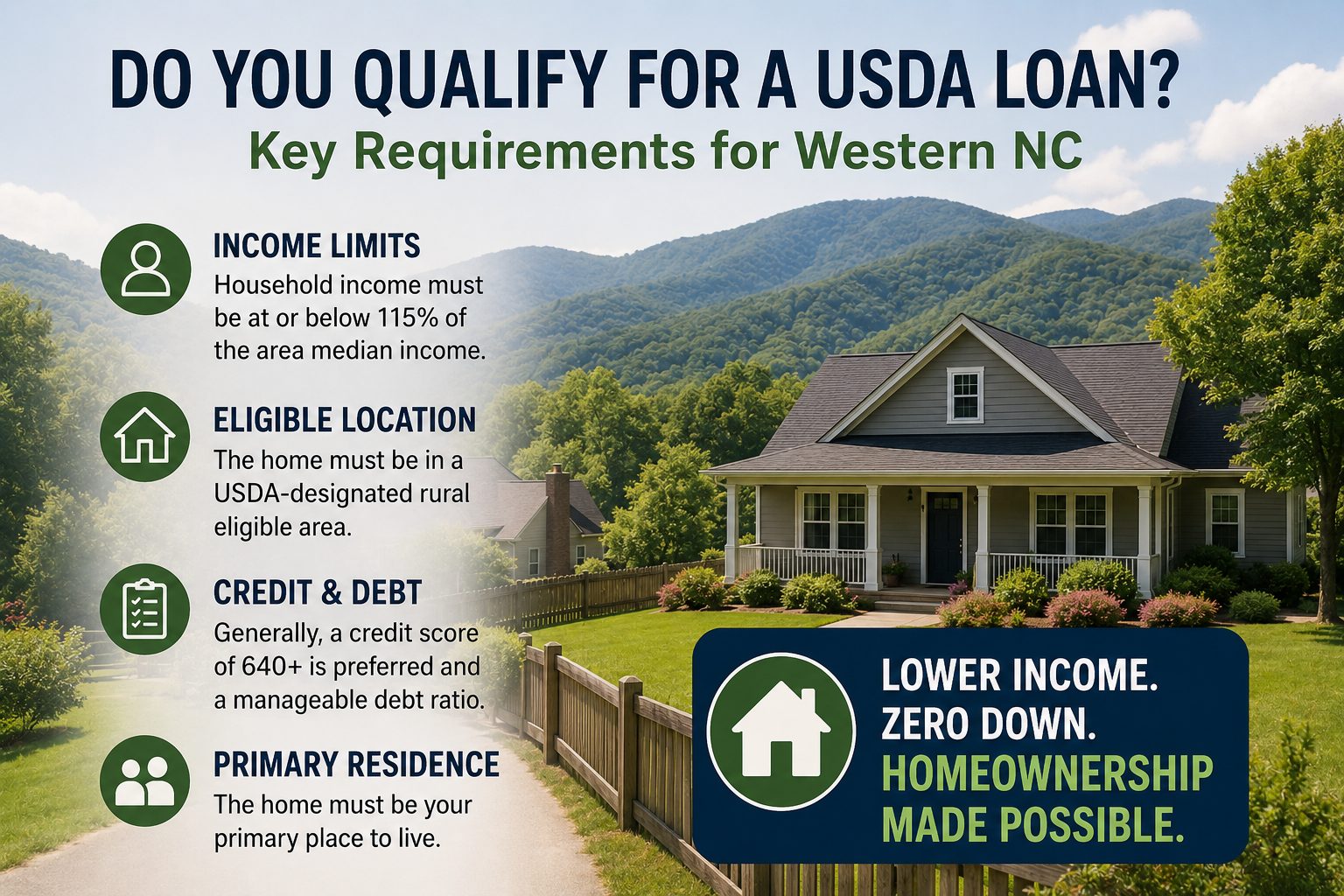
Do You Qualify? USDA Loan Requirements for Western NC

Income Limits

USDA Guaranteed Loans are available to households earning up to approximately 115% of the area median income (AMI). For Haywood County in 2025:

  • 1 to 4 person household: Income limit approximately $112,450
  • 5 to 8 person household: Income limit approximately $148,450
  • Limits are updated annually, always verify with your lender or at rd.usda.gov
  • All household income counts, including non borrowing adults living in the home

Credit Requirements

  • Most lenders require a minimum score of 640 for streamlined approval
  • Scores below 640 may still qualify through manual underwriting, but require a stronger full application
  • No official USDA minimum score, it's set by the individual lender

Other Eligibility Requirements

  • Must be a U.S. citizen or eligible non citizen
  • Must occupy the home as your primary residence, no investment properties or vacation homes
  • Must have dependable income, typically 2 years of employment history
  • Debt to income ratio generally should not exceed 41%, some flexibility with strong applications
  • No recent foreclosures within 3 years or bankruptcies within 1 to 3 years, varies by type
  • Property must be in a USDA eligible area and meet USDA property condition standards
USDA loan qualification infographic for Western NC showing income limits, eligible location, credit and debt guidelines, and primary residence requirements beside a mountain home backdrop.
Watch Out

All household income is counted toward USDA income limits, not just the borrower's. If a parent, adult child, or anyone else lives in the home, their income may count even if they're not on the loan. This surprises many buyers. Confirm your full household income with your lender before assuming you're over the limit.

The USDA + NC Down Payment Assistance Combination

Here is the strategy I consider one of the most powerful and most underused options available to first-time buyers in Western NC:

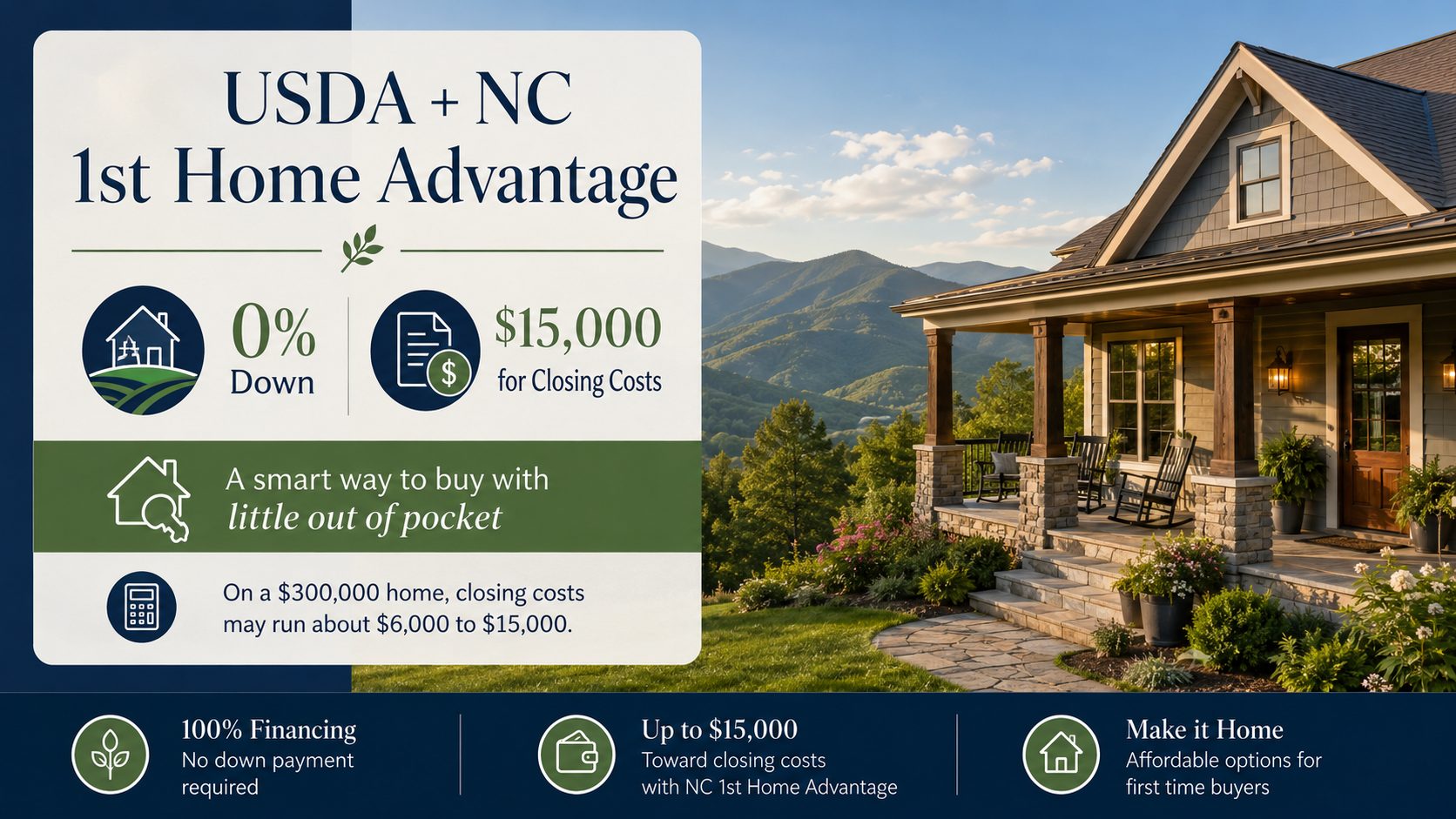
Combine a USDA loan, 0% down, with NC 1st Home Advantage Down Payment assistance, $15,000, to cover your closing costs.

Since USDA already covers your down payment, the $15,000 DPA from NCHFA doesn't need to go toward the purchase price at all. Instead, it can be applied directly to closing costs, which in NC typically run 2 to 5% of the loan amount. On a $300,000 home, that's $6,000 to $15,000 in closing costs. The combination can get you into a home with little to nothing out of pocket.

  • USDA Guaranteed Loan covers 100% of the purchase price
  • NC 1st Home Advantage DPA $15,000 covers closing costs
  • Result, potentially zero cash needed at closing beyond reserves
  • Both programs can be used together through an NCHFA approved lender
  • Income and eligibility requirements for both programs must be met
USDA and NC 1st Home Advantage graphic showing 0 percent down financing and up to $15,000 toward closing costs beside a Western NC mountain home.
Pro Tip

Read the full breakdown of NC down payment assistance programs, including income limits, eligibility, and how forgiveness works, in our companion post: How to Use NC Down Payment Assistance to Buy Your First Home .

"The USDA + NC DPA combination is the most powerful zero out of pocket strategy available to buyers in this area. I've walked buyers through it who thought homeownership was years away, and they closed within 90 days." — Ginny Mosteller

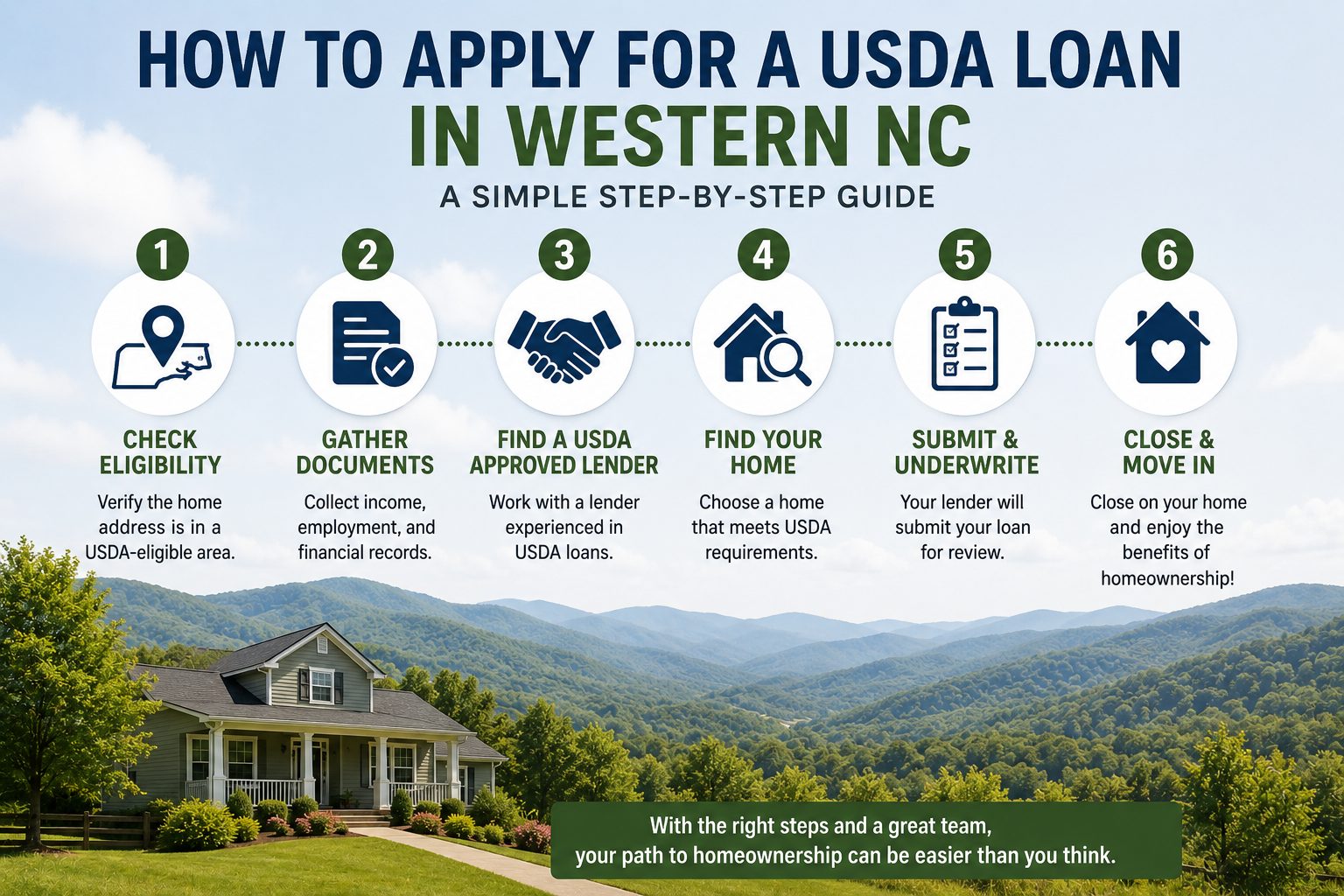
How to Apply for a USDA Loan in Western NC: Step by Step

  1. Check the Property Address for USDA Eligibility Use the official USDA eligibility map at eligibility.sc.egov.usda.gov. Do this before you get attached to any specific home. It takes 30 seconds and saves a lot of disappointment.
  2. Check Your Credit Score and Income Most lenders want to see 640 plus. Pull your free report at AnnualCreditReport.com and address any errors 3 to 6 months before you plan to buy. Also estimate your total household income, including all adults in the home, and compare it to Haywood County USDA limits.
  3. Run Your Numbers with a Mortgage Calculator Use the free mortgage calculators at Ginny Real Estate to estimate your monthly payment, understand what price range is realistic, and model different scenarios including USDA fees vs. FHA fees.
  4. Find a USDA Approved Lender Not all lenders offer USDA loans. Look for an approved lender at rd.usda.gov. If you also want NC DPA, make sure your lender is both USDA approved and NCHFA participating lender, some are both.
  5. Get Pre Approved Submit your financial documents, 2 years of tax returns and W 2s, recent pay stubs, bank statements, and photo ID. Your lender will confirm USDA eligibility, income limits, and issue a pre approval letter. This is your green light to make offers.
  6. Search for USDA Eligible Homes in Western NC Use the Ginny Real Estate live property search to browse current listings in Haywood County and surrounding areas. I'll help you cross reference each property against USDA eligibility as we go.
  7. Make an Offer and Complete USDA Processing Once under contract, your lender submits the USDA loan reservation. Standard processing runs 30 to 60 days, same as most mortgages. Budget extra time, 60 to 90 days, if combining with CPLP assistance.
  8. Close on Your Home At closing, USDA's 1% guarantee fee is typically financed into your loan, no cash needed for it. Your closing costs covered by DPA if used are disbursed, you sign, and you get your keys.
Step by step USDA loan application infographic for Western NC showing eligibility check, document gathering, lender selection, home search, underwriting, and closing over a Blue Ridge mountain background.

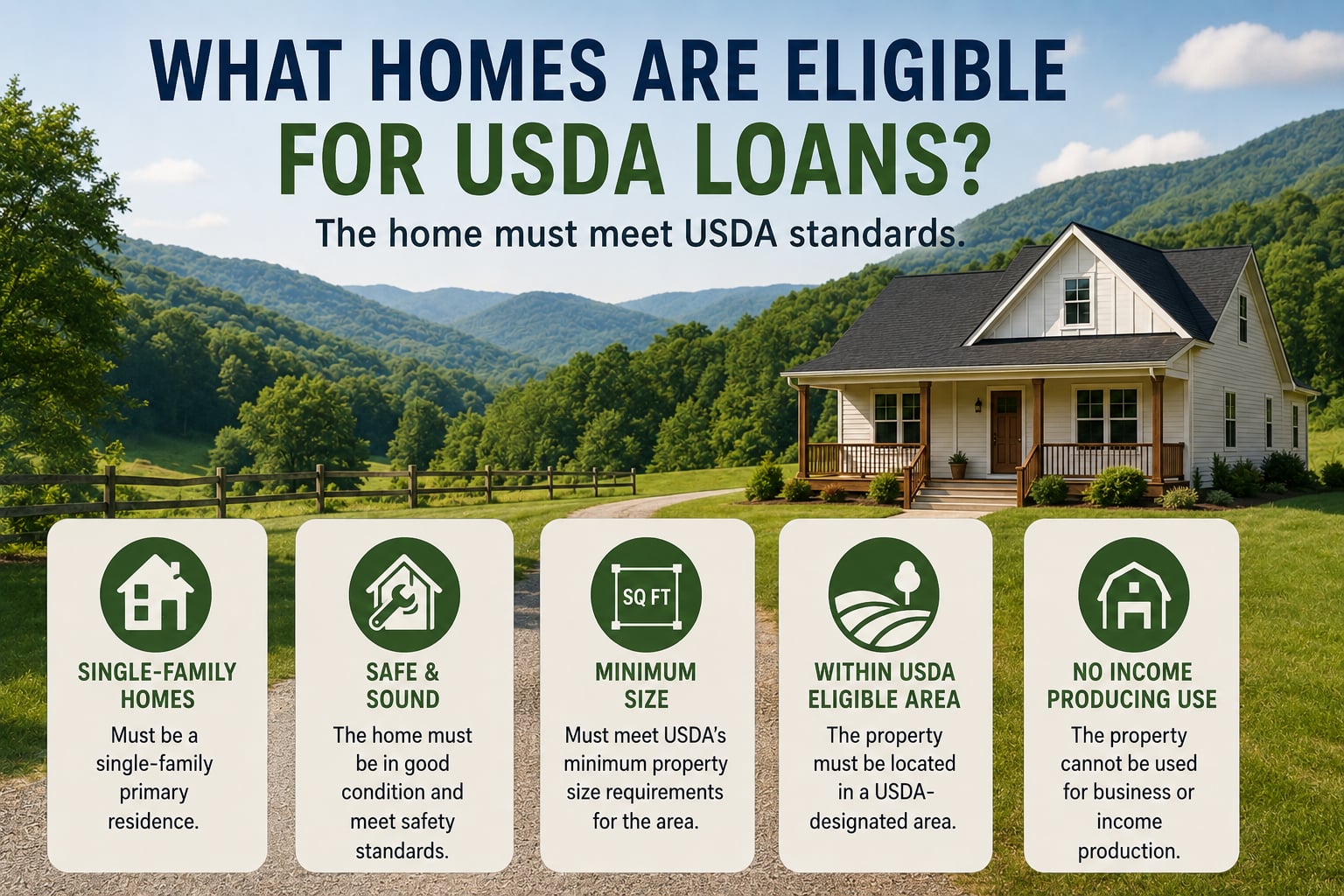
What Homes Are Eligible for USDA Loans?

The property itself must meet USDA standards, not just the location. Here's what qualifies:

  • Single family detached homes, the most common
  • Condominiums and townhomes, if USDA approved project
  • New construction, with USDA approved builder
  • Manufactured homes on permanent foundations, with restrictions
  • Must be used as your primary residence only
  • Must be modest in size and design, no luxury or income producing properties
  • Must be in good structural condition and meet USDA property standards
  • In ground pools, outbuildings used for income, and some large acreage parcels may disqualify a property
USDA home eligibility infographic showing a Western NC rural property and key requirements, including single family use, safe condition, minimum size, eligible location, and no income producing use.
Watch Out

Properties with in ground pools, outbuildings with commercial use potential, or large acreage used for farming or income may be flagged during USDA appraisal. In Western NC's mountain market, where many properties have barns, sheds, or substantial land, it's worth asking your agent about potential USDA property eligibility before making an offer.

Pro Tip

For more guidance specific to buying in Haywood County, including flood zone awareness, neighborhoods, and what to expect from the Western NC market, read: First Time Homebuyer Tips in Clyde, NC .

Common Mistakes Buyers Make with USDA Loans

  • Not checking eligibility early enough, falling in love with a home in an ineligible zone is heartbreaking and avoidable. Check every address before you tour.
  • Forgetting to count all household income, if anyone in the home earns income, it likely counts toward the limit, even if they're not on the loan.
  • Using a lender who doesn't offer USDA loans, many lenders don't. Always confirm USDA program availability before committing to a lender.
  • Assuming rural means far from everything, many USDA eligible homes in Haywood County are minutes from Waynesville, Asheville, and all the amenities of Western NC.
  • Not combining with NC DPA when eligible, USDA and NC 1st Home Advantage together can get you into a home with near zero cash at closing. Always ask about stacking.
  • Skipping the USDA appraisal prep, USDA appraisals evaluate both value and condition. Properties with deferred maintenance, safety issues, or ineligible features can delay or derail closing. Inspect before you offer.

Frequently Asked Questions

Can I use a USDA loan to buy a home in Western NC?

Yes. Large portions of Haywood County and surrounding Western NC, including areas near Clyde, Canton, Maggie Valley, and rural Waynesville, fall within USDA eligible rural zones. Check any specific address at eligibility.sc.egov.usda.gov .

What is the income limit for a USDA loan in Haywood County NC?

For 2025, the USDA Guaranteed Loan income limit for most 1 to 4 person households in Haywood County is approximately $112,450. For 5 to 8 person households, it is approximately $148,450. All household income counts, not just the borrower's. Verify current limits with an approved lender or at rd.usda.gov .

Do USDA loans require a down payment?

No. USDA Guaranteed Loans require zero down payment. You finance 100% of the purchase price. There is an upfront guarantee fee of 1%, typically financed into the loan, and an annual fee of 0.35%, both significantly lower than FHA mortgage insurance.

Can I combine a USDA loan with NC down payment assistance?

Yes. USDA loans are compatible with NC Home Advantage Mortgage and NC 1st Home Advantage Down Payment programs. Since USDA covers the down payment, DPA funds can be applied to closing costs, potentially resulting in near zero out of pocket costs at closing.

What credit score do I need for a USDA loan in NC?

Most USDA approved lenders require a minimum score of 640 for streamlined processing. Scores below 640 may qualify through manual underwriting but require a stronger overall application. There is no official USDA mandated minimum. It is lender specific.

How long does the USDA loan process take?

The USDA Guaranteed Loan process typically takes 30 to 60 days, similar to a standard mortgage. If combining with NCHFA CPLP down payment assistance, allow 60 to 90 plus days. Standard NC Home Advantage DPA runs on a normal mortgage timeline.

Is a USDA loan better than an FHA loan for buying in Western NC?

For buyers purchasing in USDA eligible areas with moderate income, USDA almost always wins: 0% down vs. 3.5%, lower annual mortgage insurance, 0.35% vs. 0.85%, and no down payment requirement. The main advantage of FHA is that it has no geographic restriction and allows lower credit scores with a smaller down payment.

Ready to Talk Real Estate?

Have questions about using a USDA loan to buy a home in Western NC? Reach out anytime. I would be happy to help you understand whether USDA financing fits your situation, check property eligibility, connect you with a USDA approved lender, and walk through the steps before you start house hunting. From credit score requirements and income limits to zero down payment options, NC down payment assistance, and USDA eligible homes in Clyde, Waynesville, Canton, Maggie Valley, and Haywood County, I can help you move forward with a clearer plan and more confidence.

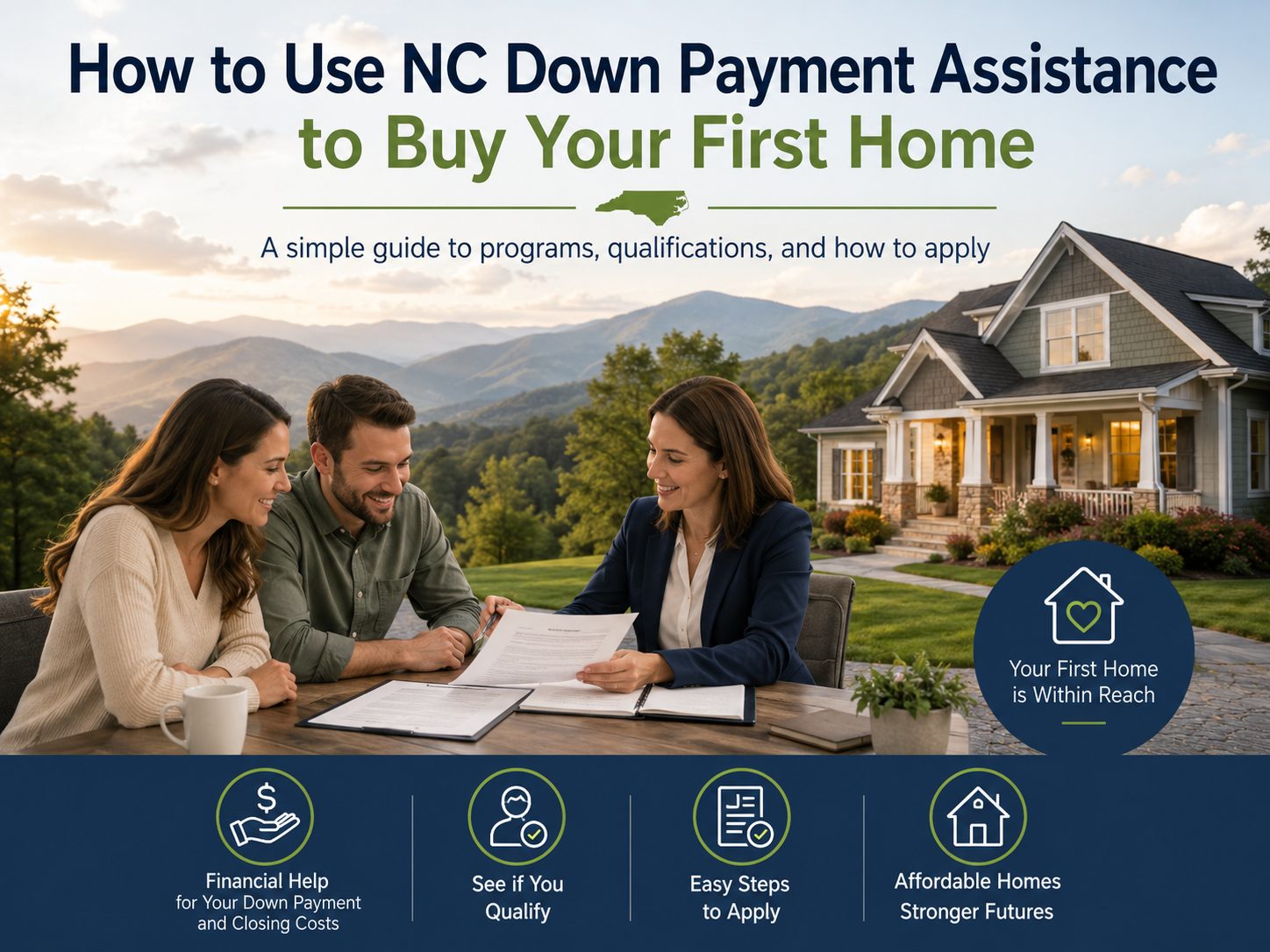
NC down payment assistance guide for first time homebuyers, showing a buyer consultation outside a mountain home with icons for financial help, eligibility, application steps, and affordable homeownership.

One of the biggest myths in real estate is that you need 20% down to buy a home. In North Carolina, that couldn't be further from the truth. The state's Housing Finance Agency (NCHFA) administers some of the most generous first-time homebuyer programs in the country, including up to $15,000 in forgivable down payment assistance and up to $50,000 for qualifying low-income buyers. Most people have never heard of these programs. This guide changes that.

$15K
NC 1st Home
Advantage DPA
$50K
Max CPLP
Assistance
$152K
2025 Income Limit
NC Home Advantage
5,880
NC Buyers Helped
in 2024
What Is NC Down Payment Assistance and Who Offers It?

Down payment assistance, DPA, refers to grants, forgivable loans, or deferred-payment second mortgages that help homebuyers cover the upfront costs of purchasing a home, primarily the down payment and closing costs. In North Carolina, most DPA programs are administered through the North Carolina Housing Finance Agency, NCHFA, a self-supporting state public agency created specifically to expand access to affordable homeownership.

The NCHFA doesn't lend directly to buyers. Instead, it works through a statewide network of approved participating lenders, mortgage companies and banks trained to offer these special programs. Your REALTOR® can help you connect with the right lender for your situation.

Key Insight

In 2024 alone, the NCHFA helped 5,880 North Carolinians purchase affordable homes and generated $22.3 million in state and local tax revenue from investments in newly constructed affordable housing. These are not obscure programs, they are actively funded and widely available.

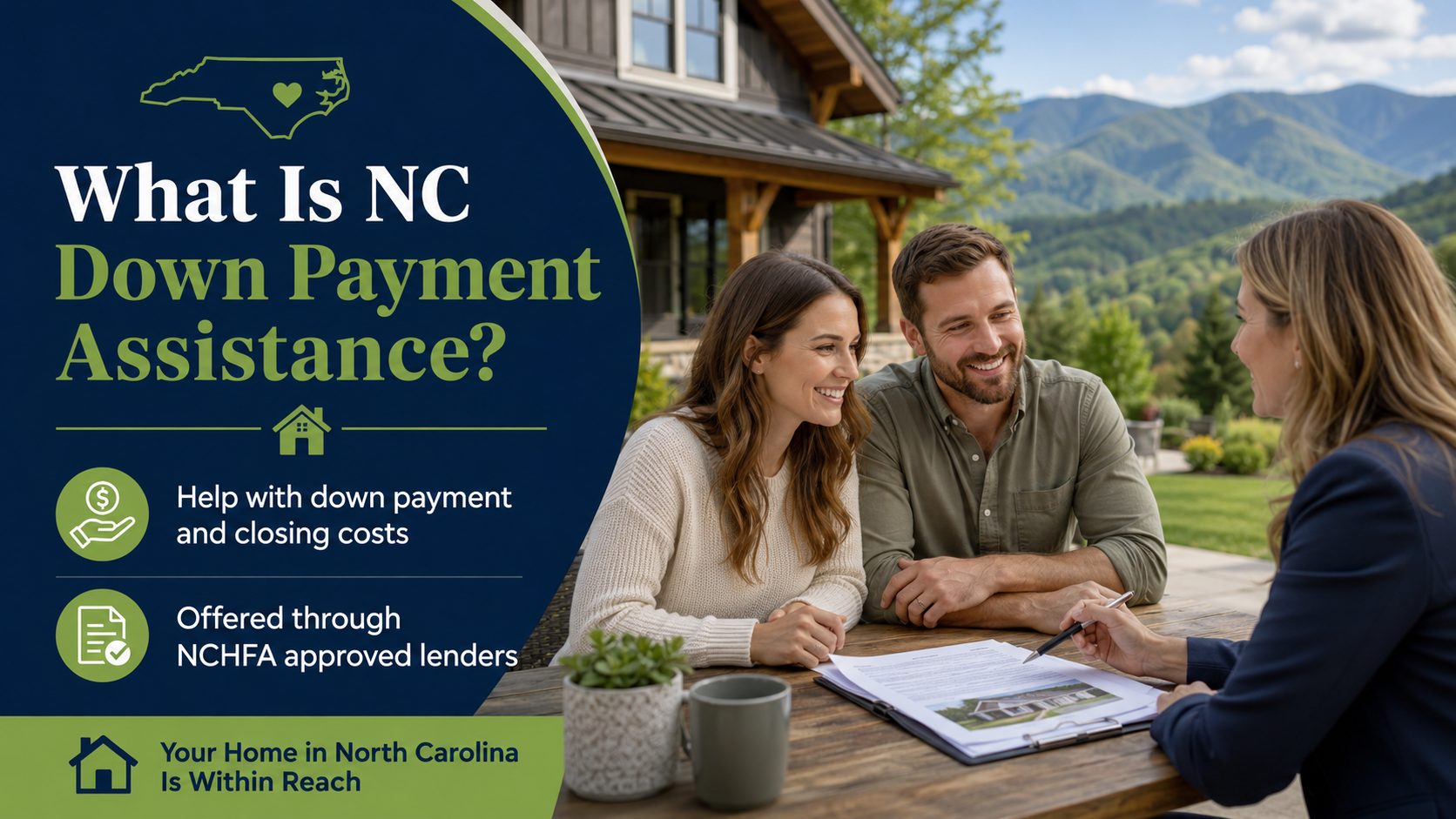
NC down payment assistance overview showing a first time buyer consultation at a mountain home, with key points about help for down payment and closing costs through NCHFA approved lenders.

The 4 Main NC Down Payment Assistance Programs in 2025

Here is a clear breakdown of the primary programs available to first-time buyers in North Carolina right now. Each serves a slightly different buyer profile, understanding which fits you is the key first step.

Up to 3% of loan

NC Home Advantage Mortgage™

A fixed rate mortgage for FHA, VA, USDA, or conventional buyers with down payment assistance of up to 3% of the loan amount built right in. Available to first time and move up buyers. Income limit is $152,000. Sales price limit is $495,000. Credit score is 640 or higher.

$15,000

NC 1st Home Advantage Down Payment

A $15,000 zero interest, deferred second mortgage for first time buyers and military veterans. Forgiven at 20% per year from years 11 to 15. Must be used with the NC Home Advantage Mortgage™. Credit score is 640 or higher. Income limits vary by county and household size.

Up to $50,000

Community Partners Loan Pool (CPLP)

The most generous program, up to 25% of the sales price or $50,000 for buyers earning below 80% of the area median income. Zero interest deferred loan with no monthly payments. Must work through a CPLP nonprofit member. Requires homebuyer education and in person counseling.

Up to $2,000/yr tax credit

NC Home Advantage Tax Credit (MCC)

A Mortgage Credit Certificate that lets first time buyers and veterans claim 30 to 50% of annual mortgage interest as a federal tax credit, up to $2,000 per year for the life of the loan. This program officially ended in June 2025, so confirm current availability with your lender.

💡 Pro Tip

Programs can be combined strategically. For example, pairing the NC 1st Home Advantage Down Payment ($15,000) with the NC Home Advantage Mortgage (3% DPA) gives you both a significant upfront cash boost and a competitive interest rate, all through a single participating lender.

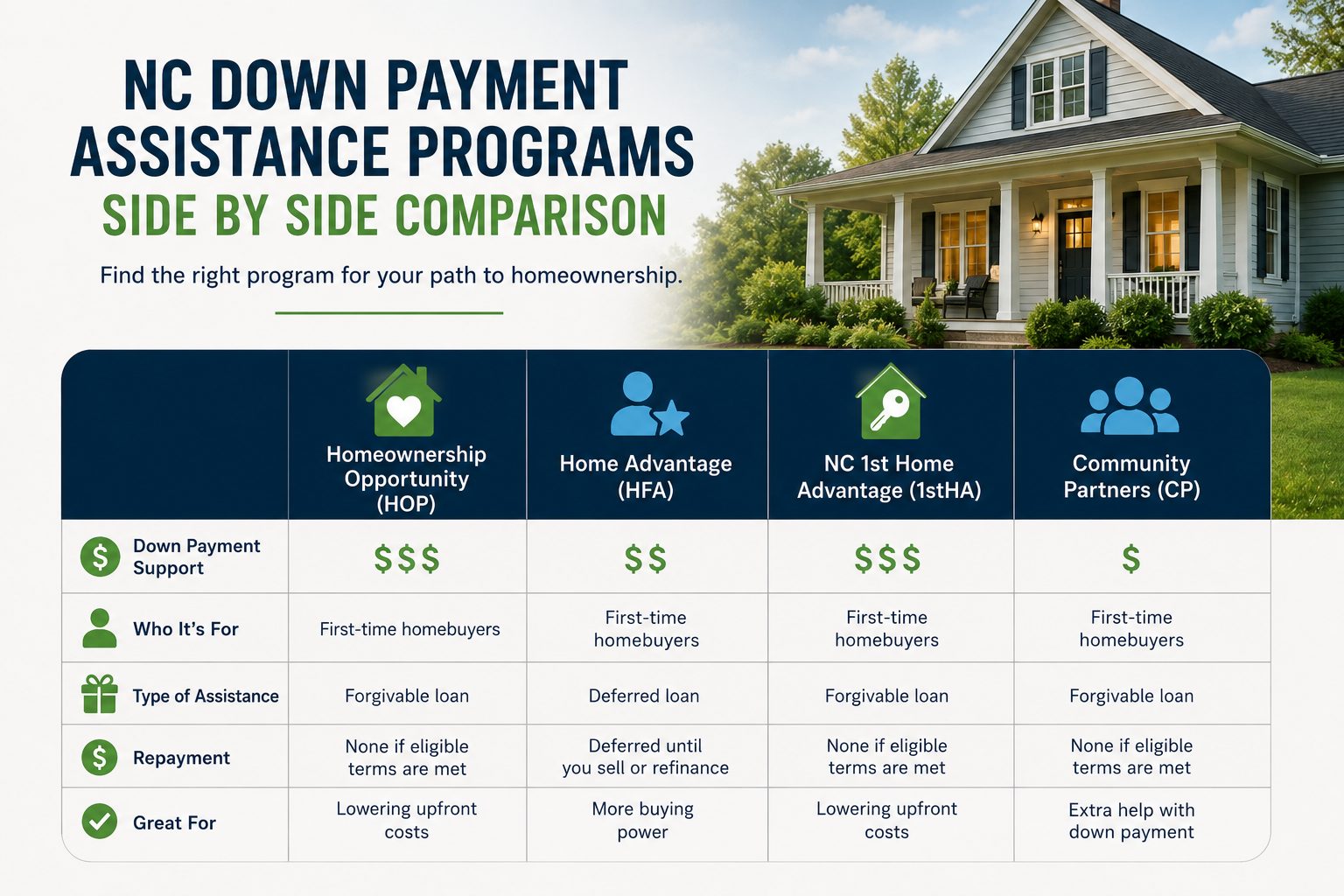
Side-by-Side Program Comparison

Use this table to quickly see which program or combination makes the most sense for your situation:

Program Max
Assistance
Who Qualifies Income Limit Repayment
NC Home
Advantage
Mortgage™
3% of loan First time and
move up
buyers
$152,000 Forgiven after 15 yrs if
you stay
NC 1st Home
Advantage DPA
$15,000 First time
buyers and
veterans
Varies by
county
Forgiven at 20%/yr, yrs
11 to 15
CPLP $50,000, 25%
of price
Buyers below
80% AMI
Below 80% area
median income
Deferred, due at sale or
end of term
NC Home
Advantage Tax
Credit
$2,000/yr tax
credit
First time
buyers and
veterans
Varies by
county
Ongoing annual tax
savings, ended June
2025, verify
Side by side comparison of NC down payment assistance programs, showing Homeownership Opportunity, Home Advantage, NC 1st Home Advantage, and Community Partners options with support levels, eligibility, assistance type, repayment, and best use.

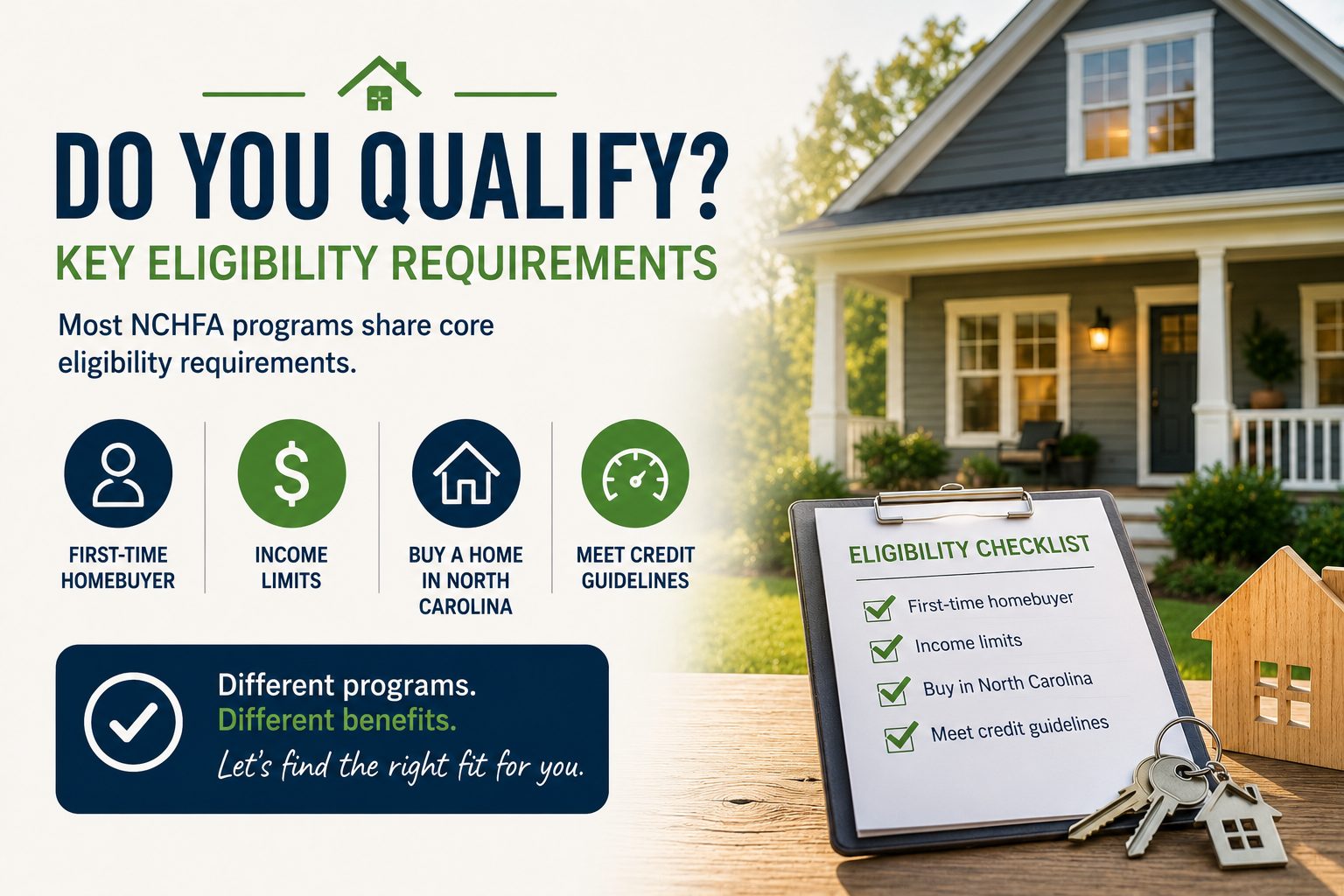
Do You Qualify? Key Eligibility Requirements

Most NCHFA programs share a core set of eligibility requirements with some variations by program. Here's what you'll need to qualify for the most popular options:

For the NC Home Advantage Mortgage™:

Purchase a primary residence in North Carolina
Annual income does not exceed $152,000, updated 2025
Credit score of 640 or higher
Apply through an NCHFA approved participating lender
Occupy the home as your principal residence within 60 days of closing
Be a legal U.S. resident
Home sales price must not exceed $495,000

Additional requirements for NC 1st Home Advantage Down Payment:

Must be a first time buyer, with no principal residence ownership in the past 3 years, or a military veteran
Income limits vary by county and household size, check NCHFA for your county's specific limit
Must be combined with the NC Home Advantage Mortgage™

Additional requirements for CPLP:

Household income must be below 80% of the area median income, AMI, for your county
Must complete a minimum of 6 hours of homebuyer education
Must complete at least 2 hours of one on one in person pre purchase counseling with a CPLP member
Must work through a CPLP nonprofit member organization, not a regular lender
Contact a CPLP member before signing any sales contract, this step cannot be skipped
NC down payment assistance eligibility graphic showing key requirements for first time homebuyers, including income limits, buying a home in North Carolina, meeting credit guidelines, and completing an eligibility checklist.

"The #1 mistake I see buyers make with NC assistance programs is finding out about them too late, after they are already under contract. These programs require preparation. Start the conversation before you start house hunting." — Ginny

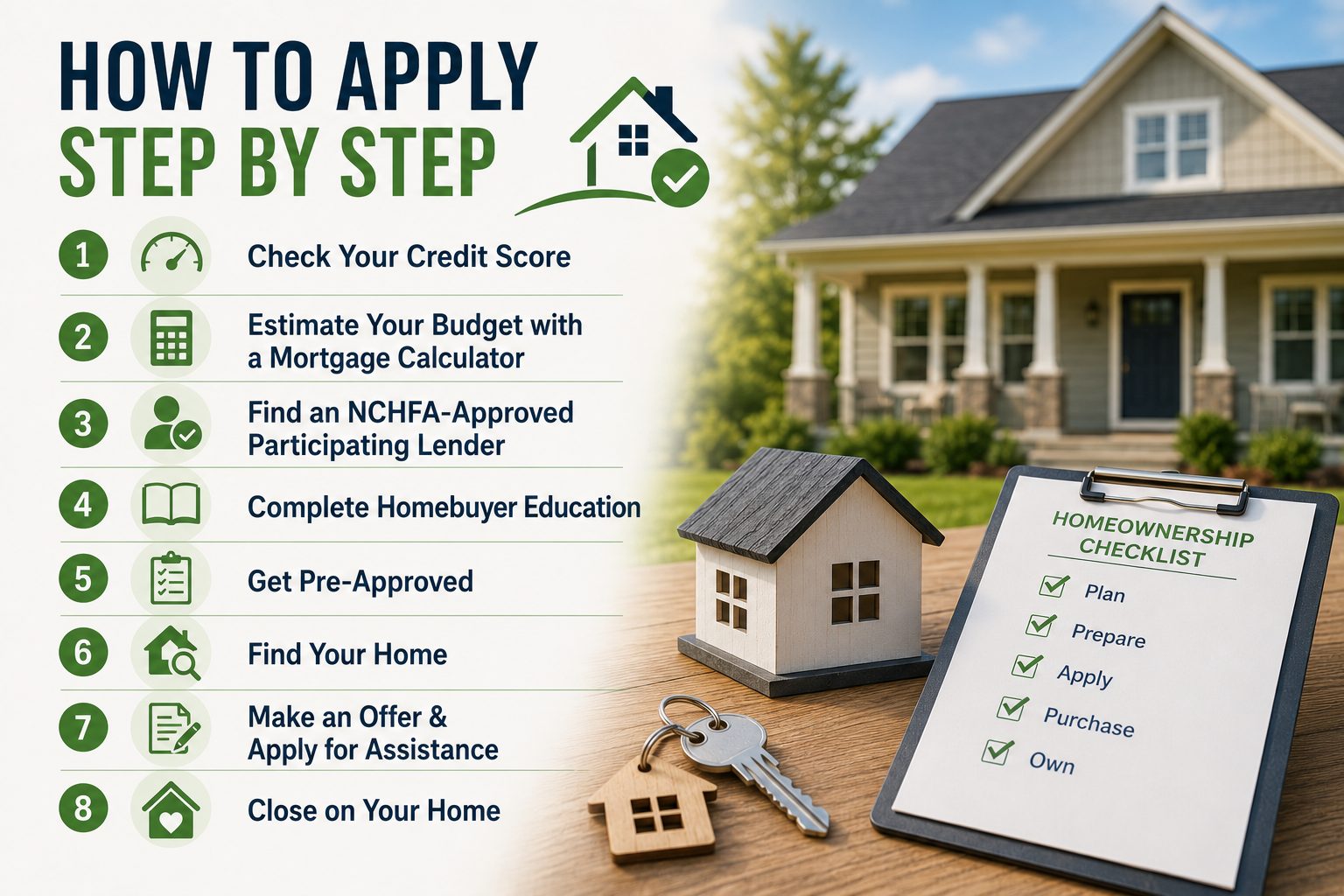
How to Apply: Step-by-Step

The application process for NC down payment assistance isn't complicated, but the order of steps matters. Here's exactly how to do it right:

1

Check Your Credit Score

Most NCHFA programs require a minimum score of 640, or 660 for manufactured homes. Pull your free credit report at AnnualCreditReport.com and address any errors or outstanding collections at least 3 to 6 months before you plan to buy.

2

Estimate Your Budget with a Mortgage Calculator

Before talking to a lender, use the free mortgage calculators at Ginny Real Estate to understand your realistic price range, estimated monthly payment, and what assistance programs could mean for your out of pocket costs.

3

Find an NCHFA Approved Participating Lender

Not every lender offers NCHFA programs. You must work with an approved participating lender to access NC Home Advantage Mortgage™ or NC 1st Home Advantage Down Payment funds. Find one at NCHomeAdvantage.com . If pursuing CPLP, you will need to contact a CPLP nonprofit member directly, since this is a separate network.

4

Complete Homebuyer Education

All NCHFA programs require a HUD approved homebuyer education course. The CPLP requires 6 hours of education plus 2 hours of in person counseling. Most courses are available online through programs like Fannie Mae's HomeView or CreditSmart Homebuyer U, and many buyers find them genuinely useful.

5

Get Pre Approved

Submit your financial documents to your lender, including 2 years of tax returns and W2s, recent pay stubs, bank statements, and photo ID. Your lender will verify your income, confirm program eligibility, and issue a pre approval letter, your green light to start making offers.

6

Find Your Home

Work with a local REALTOR® who understands NCHFA programs and can help you find homes that meet both your needs and the program's property eligibility requirements. Use the Ginny Real Estate live property search to browse current listings.

7

Make an Offer and Apply for Assistance

Once you are under contract, your lender will formally submit your NC Home Advantage Mortgage reservation through the NCHFA's Online Lender Services system. For CPLP, your CPLP member organization submits on your behalf, which is why you need to connect with them early. Allow 60 or more days for CPLP processing.

8

Close on Your Home

At closing, your DPA funds are applied directly, you do not receive a check. Your attorney or title company will coordinate the disbursement. Standard closing costs in NC typically run 2 to 5% of the loan amount on top of your down payment.

Step by step NC down payment assistance application guide showing a homeownership checklist, house keys, and the process from checking credit and estimating budget to finding an approved lender, getting pre approved, applying for assistance, and closing on a home.
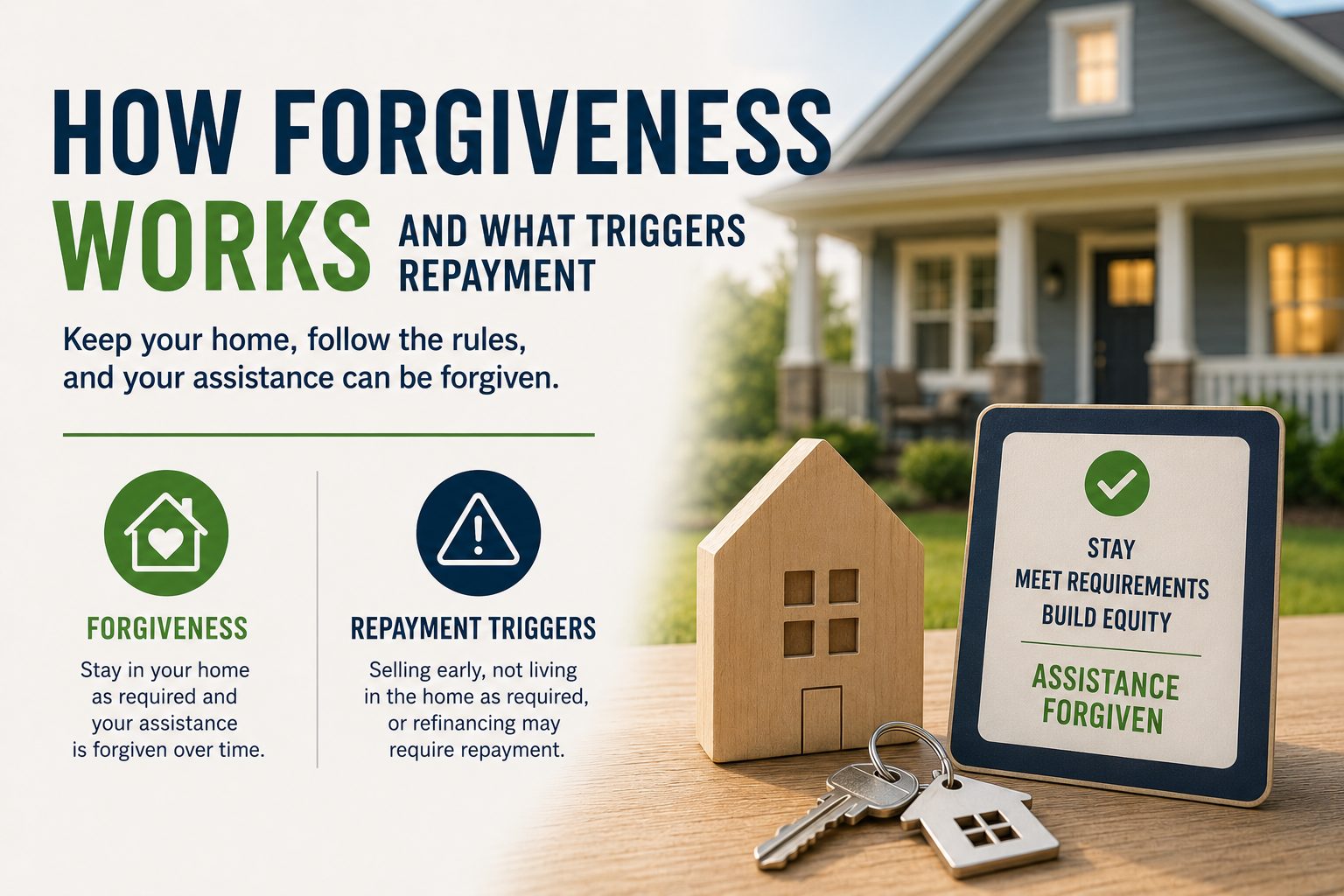
How Forgiveness Works and What Triggers Repayment

Understanding how NC down payment assistance is forgiven and what could require you to pay it back is critical before you commit to a program.

NC Home Advantage Mortgage™ / NC 1st Home Advantage Down Payment:

DPA is forgiven at 20% per year from years 11 through 15
After year 15, the assistance is completely forgiven, you owe nothing
If you sell, refinance for cash, or move out before year 15, the remaining unforgiven balance must be repaid
A standard refinance to get a lower rate may trigger repayment, discuss with your lender before refinancing

CPLP (Community Partners Loan Pool):

Zero interest, deferred loan, no monthly payments while you live in the home
Typically repaid when the home is sold or at the end of the loan term, matches your first mortgage term
Repayment also triggered if you refinance for cash out, move out, or no longer use the home as your primary residence
NC down payment assistance forgiveness graphic explaining how assistance can be forgiven over time and what may trigger repayment, including selling early, not living in the home, or refinancing.
💡 Pro Tip

If you plan to stay in your home long term, the NC 1st Home Advantage Down Payment is essentially a gift after 15 years. For buyers with a 5 to 10 year horizon, the CPLP's deferred structure with no monthly payments may be more favorable. Talk to your lender about which structure fits your plans.

What Homes Are Eligible for These Programs?

Not every property type qualifies. Here's what NCHFA programs generally accept:

Single family detached homes
Townhomes and condominiums, subject to lender guidelines
Duplexes, buyer must occupy one unit as primary residence
New manufactured homes, credit score minimum 660
Home must be used as your primary residence, no investment properties or vacation homes
For CPLP, all existing homes must pass a licensed home inspection and a local housing code inspection before assistance is approved
Sales price must not exceed program limits, $495,000 for NC Home Advantage Mortgage™ and varies by county for CPLP
Key Insight

For CPLP assistance on an existing home, both a licensed NC home inspector's report and a local housing code inspection are required, and any major deficiencies must be repaired before the assistance can be approved. Plan for this timeline when making your offer.

NC Down Payment Assistance + Western NC & Haywood County

If you're buying in Western North Carolina, including Clyde, Waynesville, Canton, Maggie Valley, or surrounding Haywood County communities, all NCHFA state programs apply. In addition, rural properties in parts of Western NC may also qualify for USDA Rural Development loans, which offer 0% down payment financing for eligible properties and buyers.

The combination of USDA 0% down and NC 1st Home Advantage Down Payment assistance for closing costs can make buying a home in rural Western NC remarkably affordable, even in today's market. This is one of the most underutilized strategies I walk buyers through in this region.

NC down payment assistance in Western NC and Haywood County, showing a first time buyer consultation at a mountain home with local guidance for affordable homeownership.
💡 Pro Tip

Read our in depth guide to First Time Homebuyer Tips in Clyde, NC for a deeper look at the local market, flood zone considerations, and what to expect buying in Haywood County specifically. More buying tips and local insights are also available on the Ginny Real Estate Buying and Selling Tips page .

Common Mistakes First-Time Buyers Make With DPA Programs

I've guided many buyers through these programs, and I've seen the same avoidable mistakes come up time and again:

Starting too late: CPLP especially requires early contact with a member organization before you sign a contract. Do not wait until you are under contract to explore it.
Working with a non participating lender: If your lender is not NCHFA approved, you cannot access these programs. Always confirm your lender's approval status first.
Skipping homebuyer education: It is required for all programs, and buyers who complete it consistently make better, more confident decisions. Do not treat it as a box to check.
Refinancing without checking DPA terms: Some refinances can trigger repayment of your assistance. Always ask before you refinance during the first 15 years.
Assuming you do not qualify: The 2025 income limit increase to $152,000 means many moderate income buyers in NC are now eligible. Run the numbers before assuming you are out.
Not stacking programs: Multiple programs can often be combined. A lender familiar with NCHFA products will maximize what is available to you.
Common mistakes first time buyers make with NC down payment assistance programs, showing a buyer consultation and key reminders to check eligibility, compare programs, complete education steps, and understand repayment rules.

"The buyers I've seen get the most out of NC's DPA programs are the ones who came in prepared, credit checked, budget understood, lender selected, and education completed before they fell in love with a house." — Ginny

Frequently Asked Questions

How much down payment assistance is available in North Carolina?

Depending on the program and your income, NC first-time buyers can receive up to $15,000 through the NC 1st Home Advantage Down Payment, up to 3% of the loan through the NC Home Advantage Mortgage, or up to $50,000 (25% of the sales price) through the Community Partners Loan Pool for low-income buyers.

Who qualifies for NC down payment assistance in 2025?

Most NCHFA programs require you to be a first-time buyer (no home ownership in the past 3 years) or a military veteran, have a credit score of 640 or higher, earn no more than $152,000 annually (for NC Home Advantage Mortgage), purchase a primary residence in North Carolina, and work with an NCHFA-approved participating lender.

Do I have to pay back NC down payment assistance?

The NC 1st Home Advantage Down Payment ($15,000) is forgiven at 20% per year from years 11–15, completely forgiven if you stay 15 years. Repayment is only required if you sell, refinance for cash, or move before year 15. The CPLP is deferred with no monthly payments and is typically repaid when you sell or at the end of the loan term.

Can I combine multiple NC down payment assistance programs?

Yes, many NCHFA programs can be stacked. For example, you can combine the NC 1st Home Advantage Down Payment ($15,000) with the NC Home Advantage Mortgage (3% DPA). The CPLP can also be combined with the NC 1st Home Advantage Down Payment and other assistance where eligible.

What is the income limit for NC down payment assistance in 2025?

The NC Home Advantage Mortgage income limit was raised to $152,000 in June 2025. The NC 1st Home Advantage Down Payment and CPLP income limits vary by county and household size. Check with an NCHFA-approved lender or visit NCHomeAdvantage.com for your county's specific limits.

How long does it take to get NC down payment assistance?

The NC Home Advantage Mortgage process runs on the same timeline as a standard mortgage. For CPLP assistance, allow at least 60+ days. You must contact a CPLP member before signing a sales contract, complete education and counseling, and allow time for inspections and application processing.

Ready to Talk Real Estate?

Have questions about using NC down payment assistance to buy your first home? Reach out anytime. I would be happy to help you understand which programs may fit your situation, connect you with the right participating lender, and walk through the steps before you start house hunting. From credit score requirements and income limits to homebuyer education, property eligibility, and local options in Clyde, Waynesville, and Haywood County, I can help you move forward with a clearer plan and more confidence.

First time homebuyer tips in Clyde NC with a local real estate expert guiding a couple outside a mountain home, highlighting Clyde as a charming and affordable Western North Carolina community.

Your local expert guide to buying a home in one of Western North Carolina's most charming and affordable mountain communities.

Clyde, NC is one of Western North Carolina's best kept secrets and for first time buyers, it might just be the opportunity you've been waiting for. Nestled in Haywood County just 23 miles west of Asheville, Clyde offers mountain charm, a genuine sense of community, and a price point that's still within reach. But like any real estate market, there are things you need to know before you make your move. I've helped buyers navigate this area firsthand, this guide is everything I share with them.

~$400K
Median Home Price Clyde NC
128%
Home Appreciation Last 10 Years
$15K
NC 1st Home Advantage DPA
23 mi
From Downtown Asheville

1. Why Clyde, NC Is Worth Considering

When most people think of Western NC real estate, Asheville comes to mind first. But Clyde, a small mountain town on the banks of the Pigeon River in Haywood County, offers something Asheville increasingly cannot: affordability, space, and a true small-town feel, without sacrificing access to everything the region has to offer.

Clyde is home to Haywood Regional Medical Center and sits adjacent to Haywood Community College. It's positioned perfectly near I-40 and US-23, giving residents easy access to Waynesville, Canton, Maggie Valley, Lake Junaluska, and the world-famous Blue Ridge Parkway. Around 1,368 people call Clyde home, and that intimacy is one of its greatest strengths.

"Clyde offers residents a suburban rural mix feel where most people own their homes. It's the kind of place where neighbors actually know each other, and that matters more than people realize when you're buying your first home."

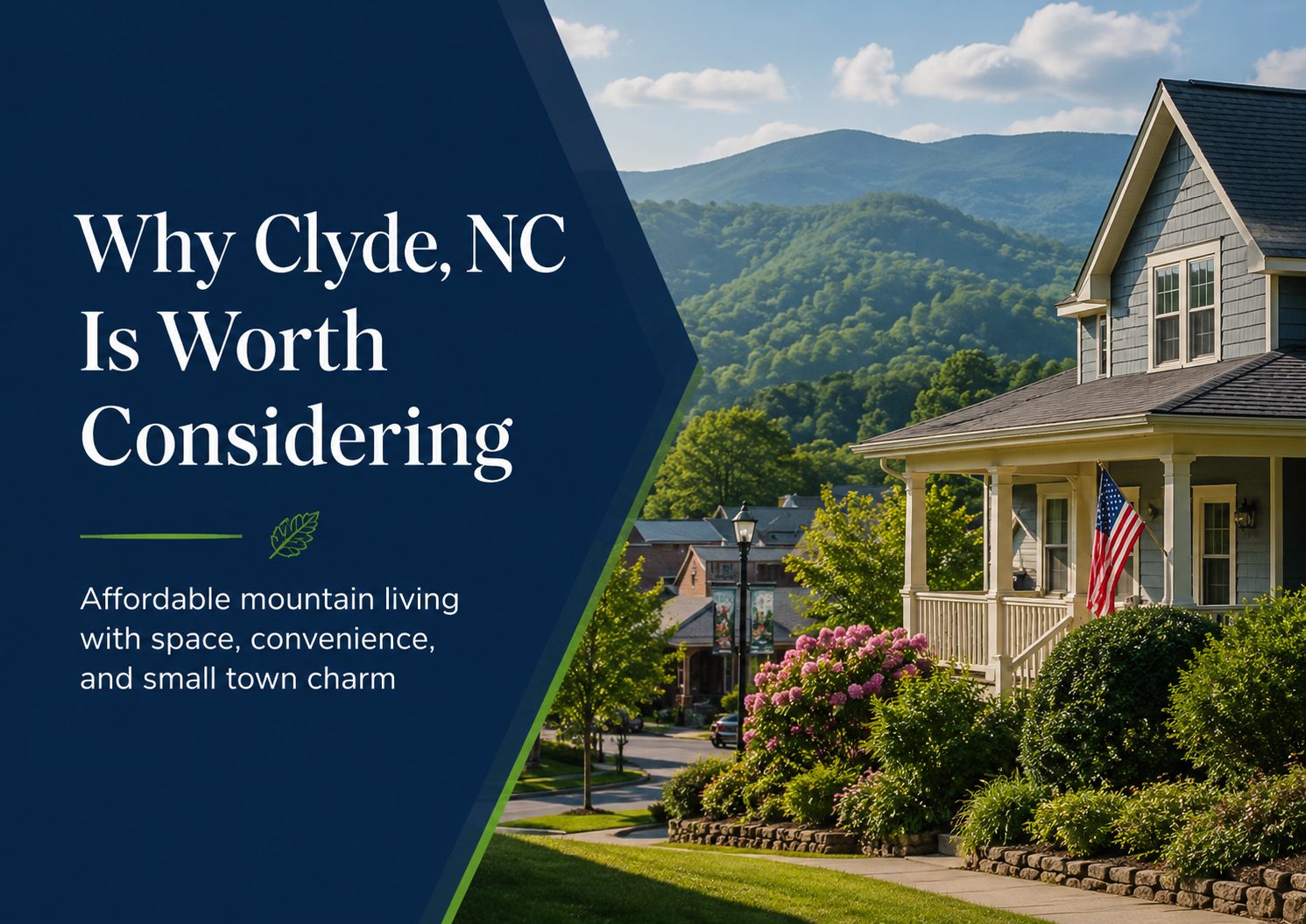
Clyde NC mountain neighborhood with a charming home and scenic Blue Ridge views, highlighting affordable mountain living, space, convenience, and small town charm.

What makes Clyde attractive for first time buyers:

Lower price point compared to Asheville, more home for your budget
Above average public schools including Pisgah High School and Clyde Elementary
Strong long term appreciation, homes in Clyde have gained 128% in value over the past decade
Close knit community with deep Appalachian roots and a welcoming culture
Convenient access to major employers, healthcare, and outdoor recreation
Cost of living index of 89.6, below the national average of 100
💡Pro Tip

Browse current homes for sale in Clyde and nearby Haywood County communities using the Ginny Real Estate live property search tool updated in real time.

2. Understand the Clyde NC Real Estate Market

The Clyde market has changed significantly over the past few years. While it remains more affordable than Asheville, prices have risen steadily. As of 2024 to 2025, the median home value sits around $395,000 to $402,000, though entry-level single-family homes and properties with some updating needed can still be found below that range.

About 67% of Clyde's housing stock is single-family detached homes, ideal for first-time buyers looking for space and privacy. There is also a notable presence of mobile homes, around 17%, and smaller multi-unit properties, which can offer affordable entry points for buyers open to different housing types.

Inventory remains limited. With only around 47 to 178 active listings in the broader zip code at any given time, homes that are priced right and in good condition can move quickly. Getting pre-approved and being ready to act decisively is more important here than in a slower market.

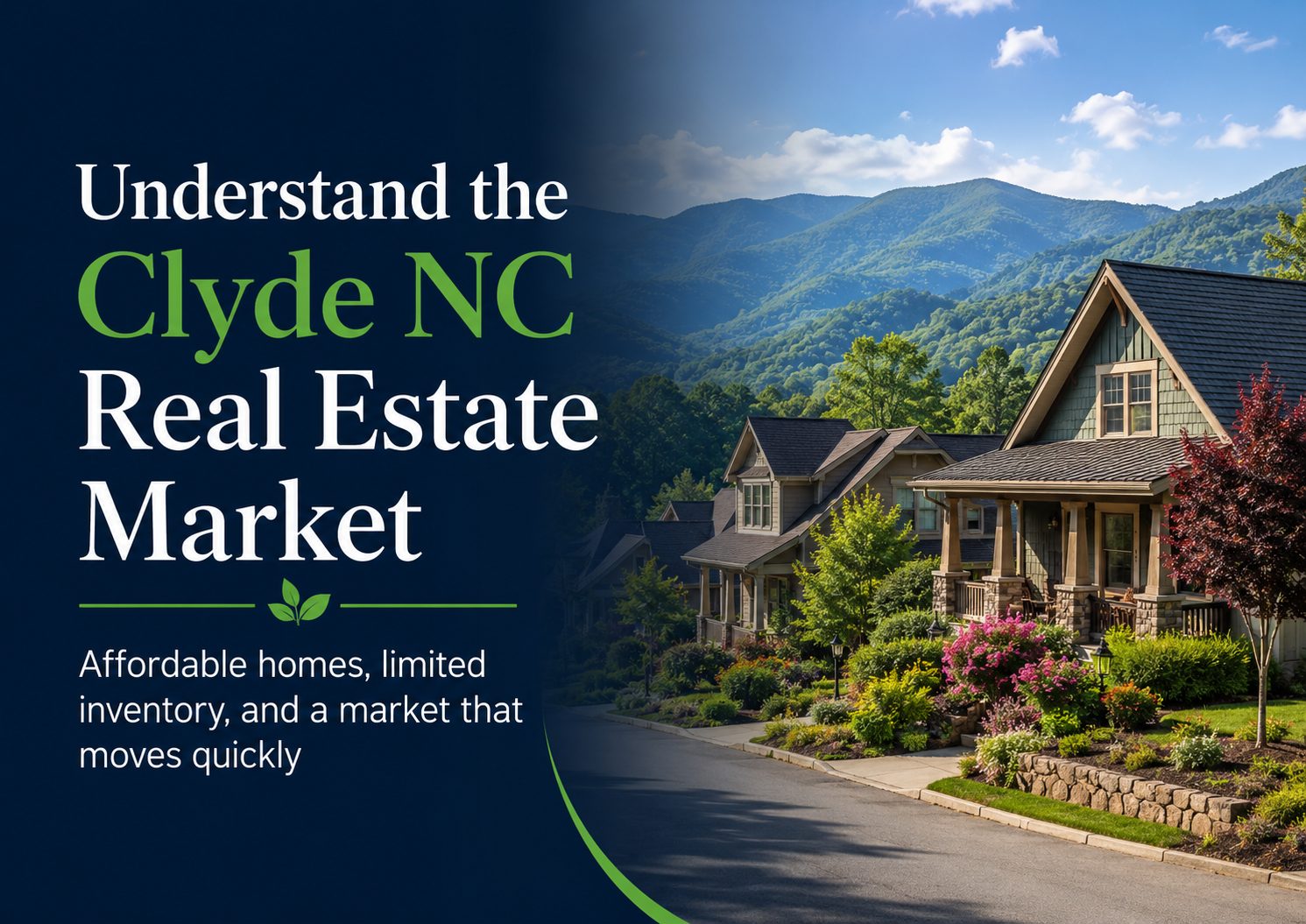
Clyde NC real estate market graphic showing a mountain neighborhood with homes and Blue Ridge views, emphasizing affordable homes, limited inventory, and a fast moving local market.
💡Pro Tip

Use the free financial calculators at Ginny Real Estate to estimate your buying power, monthly payments, and closing cost scenarios before you start touring homes.

3. The One Thing Most Buyers Don't Ask About: Flood Zones

This is the section I always make sure my buyers read carefully. Clyde sits along the Pigeon River, and flooding is a real and documented risk in this area. The town was significantly impacted by Hurricane Ivan in 2004, Tropical Storm Fred in 2021, and most devastatingly by Hurricane Helene in 2024. These were not minor events. They caused widespread damage to homes, infrastructure, and the fabric of the community.
⚠️Important: Flood Awareness

Before making any offer on a home in Clyde, always check the property's FEMA flood zone designation. Flood insurance can add hundreds of dollars per month to your housing costs and in some flood zones, it is required by your lender. I personally walk every buyer I work with through a flood history check on any property we consider.

What to verify before you buy in Clyde:

FEMA flood zone designation for the specific property, Zone AE means high risk
Whether flood insurance is required by your lender and estimated annual cost
History of prior flood damage or insurance claims on the property
Elevation certificate, which may reduce your flood insurance premium significantly
Proximity to the Pigeon River and any tributaries
Local drainage infrastructure and any improvements made post Helene
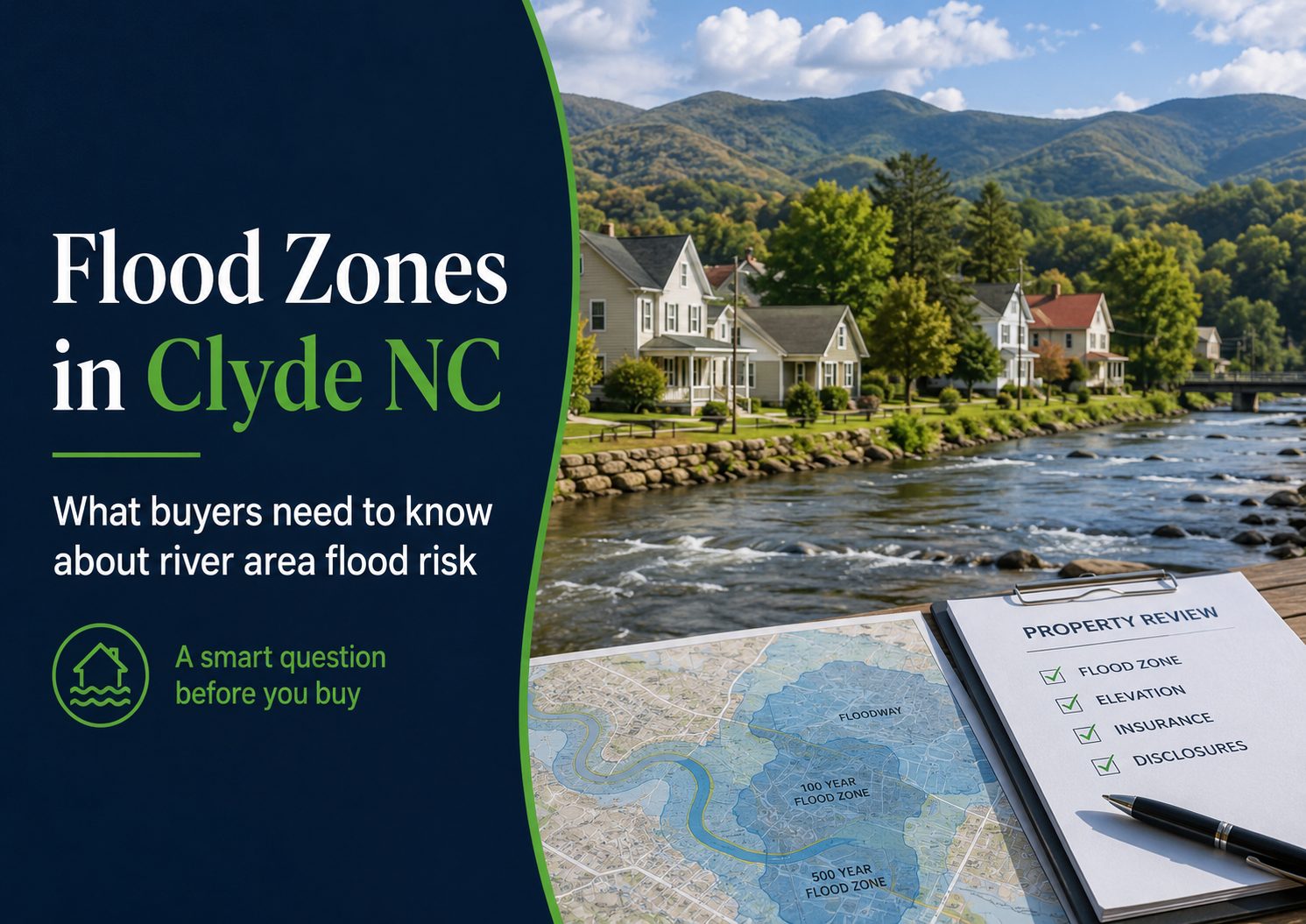
Flood zones in Clyde NC graphic showing homes along a river with mountains, a flood zone map, and a property review checklist for flood zone, elevation, insurance, and disclosures.

The good news: the community of Clyde has repeatedly shown incredible resilience. Neighbors stepped up for each other after every storm. But as a buyer, your due diligence here is non-negotiable, and a good local REALTOR® will know exactly which areas have the most exposure.

4. NC State Down Payment Assistance Programs

One of the most powerful tools available to first-time buyers in North Carolina, including those buying in Clyde, is the suite of programs offered by the North Carolina Housing Finance Agency (NCHFA). These programs are specifically designed to reduce the upfront cost of buying a home, and many buyers in Haywood County qualify.
Up to $15,000

NC 1st Home Advantage Down Payment

A 0% interest, deferred second mortgage for first time buyers and military veterans. Forgiven after 15 years if you remain in the home. Requires a credit score of 640+.

Up to 3% of loan

NC Home Advantage Mortgage™

A fixed rate mortgage, conventional, FHA, VA, or USDA, with built in down payment assistance up to 3% of the loan amount. Income limit is $152,000 as of 2025. Sales price limit is $495,000.

Up to $2,000/year

NC Home Advantage Tax Credit (MCC)

A Mortgage Credit Certificate that lets first time buyers claim up to 30 to 50% of mortgage interest as a federal tax credit, up to $2,000 annually for the life of the loan.

Up to $50,000

Community Partners Loan Pool (CPLP)

For buyers earning below 80% of the area median income. Provides up to 25% of the purchase price as a zero interest deferred loan through NCHFA nonprofit partners.

Key eligibility requirements, most NCHFA programs:

Must be a first time buyer, no home ownership in the past 3 years, or a military veteran
Minimum credit score of 640, 660 for manufactured homes
Household income at or below $152,000, as of 2025 update
Home must be primary residence, purchased in North Carolina
Must work with an NCHFA approved participating lender
Completion of a HUD approved homebuyer education course required
💡Pro Tip

Programs can often be combined, for example, pairing the NC 1st Home Advantage Down Payment with the NC Home Advantage Tax Credit (MCC) gives you both upfront cash assistance and ongoing annual tax savings. Ask your lender about stacking eligible programs.

5. Getting Pre-Approved: Your First Real Step

In a small market like Clyde, being pre-approved is not optional, it's essential. Sellers in tight inventory markets take pre-approved buyers far more seriously than those who are just "exploring." Pre-approval also gives you a clear, realistic budget so you don't fall in love with a home outside your range.

Documents you'll need for pre approval:

Last 2 years of federal tax returns and W 2s
Most recent 30 days of pay stubs
Bank statements for the last 2 to 3 months
Photo ID and Social Security number
Employment history for the past 2 years
Credit score, aim for 640 plus for most NCHFA programs
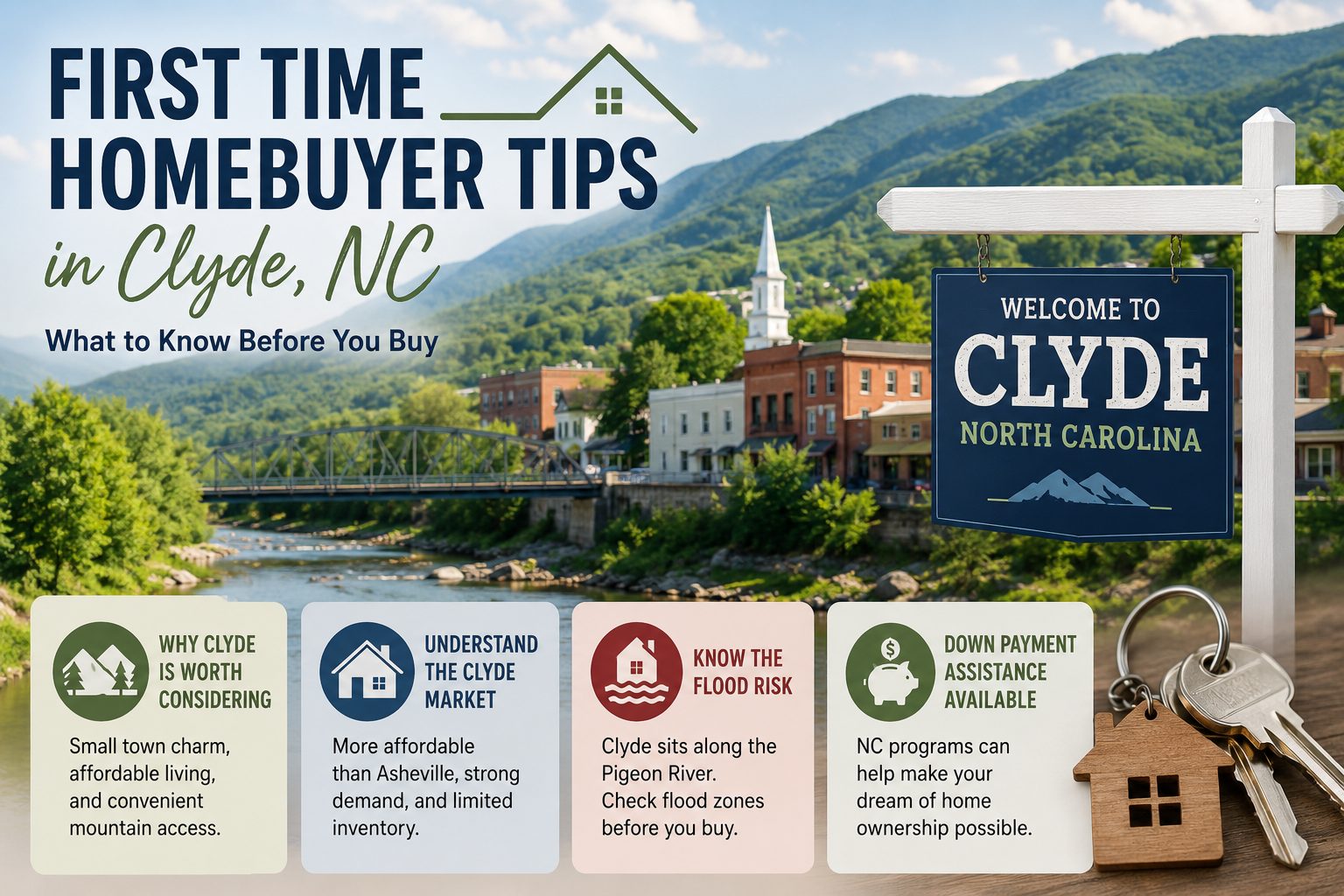
First time homebuyer tips in Clyde NC graphic with mountain town scenery, a welcome to Clyde sign, home keys, and key buyer topics including affordability, market conditions, flood risk, and down payment assistance.
💡Pro Tip

Run your numbers first. The mortgage and affordability calculators on Ginny Real Estate help you understand your realistic price range, estimated monthly payments, and closing costs before you ever sit down with a lender.

6. Know Your Loan Options in Western NC

Different loan types suit different buyers. In Clyde and surrounding Haywood County, several loan programs are particularly relevant to first-time buyers:

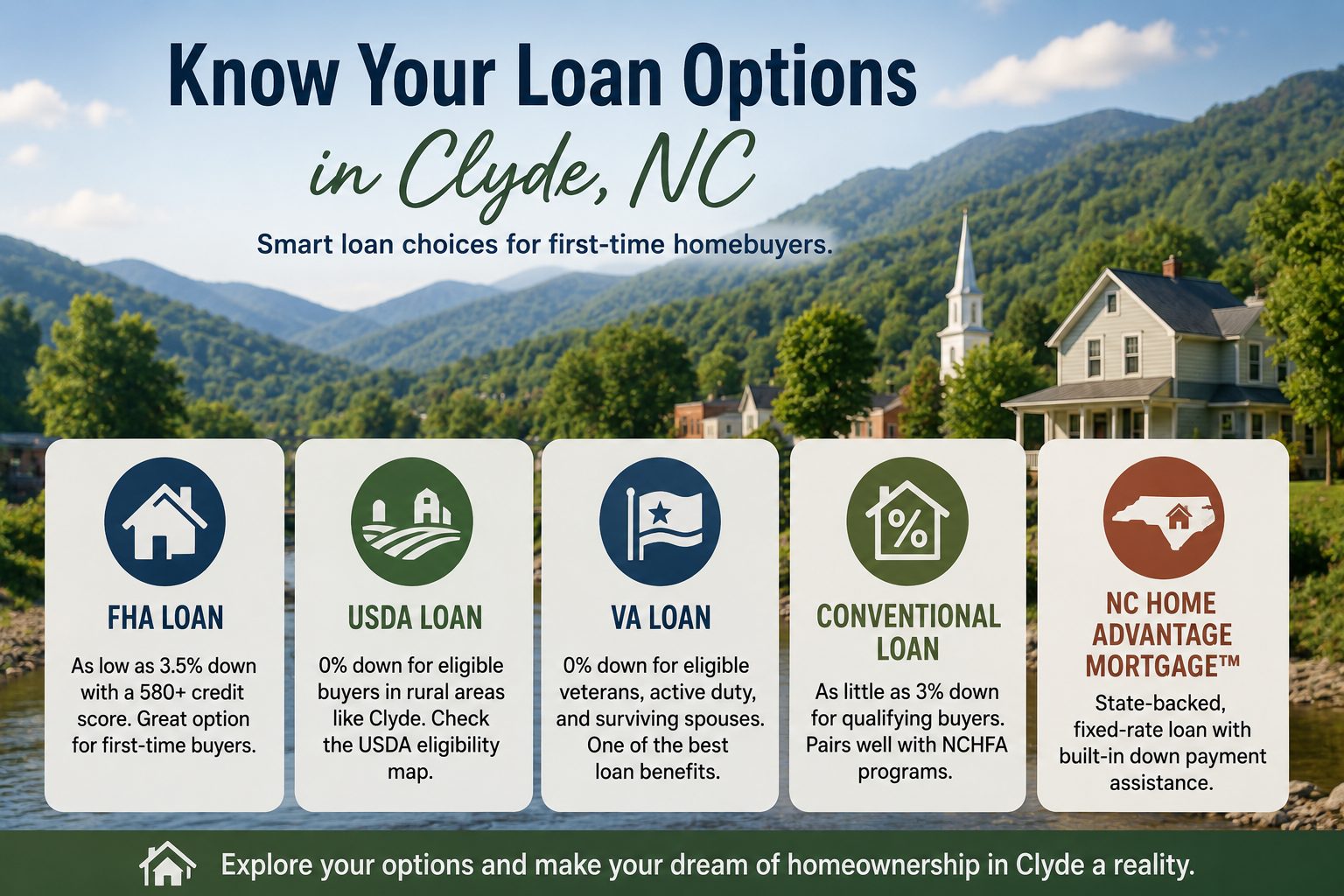
FHA Loan, as low as 3.5% down with a 580 plus credit score. Popular with first time buyers with lower savings or moderate credit.
USDA Rural Development Loan, Clyde and parts of Haywood County may qualify as rural areas. USDA loans offer 0% down for eligible buyers and properties. Check the USDA eligibility map.
VA Loan, 0% down for eligible veterans, active duty, and surviving spouses. One of the best loan products available if you qualify.
Conventional Loan, as little as 3% down for qualifying buyers. Works well when paired with NCHFA mortgage programs.
NC Home Advantage Mortgage™, state backed fixed rate option with built in DPA. Available through NCHFA approved lenders statewide.
Clyde NC loan options graphic for first time homebuyers showing FHA, USDA, VA, Conventional, and NC Home Advantage Mortgage choices against a scenic Western North Carolina mountain backdrop.
💡Pro Tip

For more buying and selling guidance specific to Western NC, visit the Ginny Real Estate Buying & Selling Tips page regularly updated with local market insights.

7. Exploring Clyde and the Surrounding Area

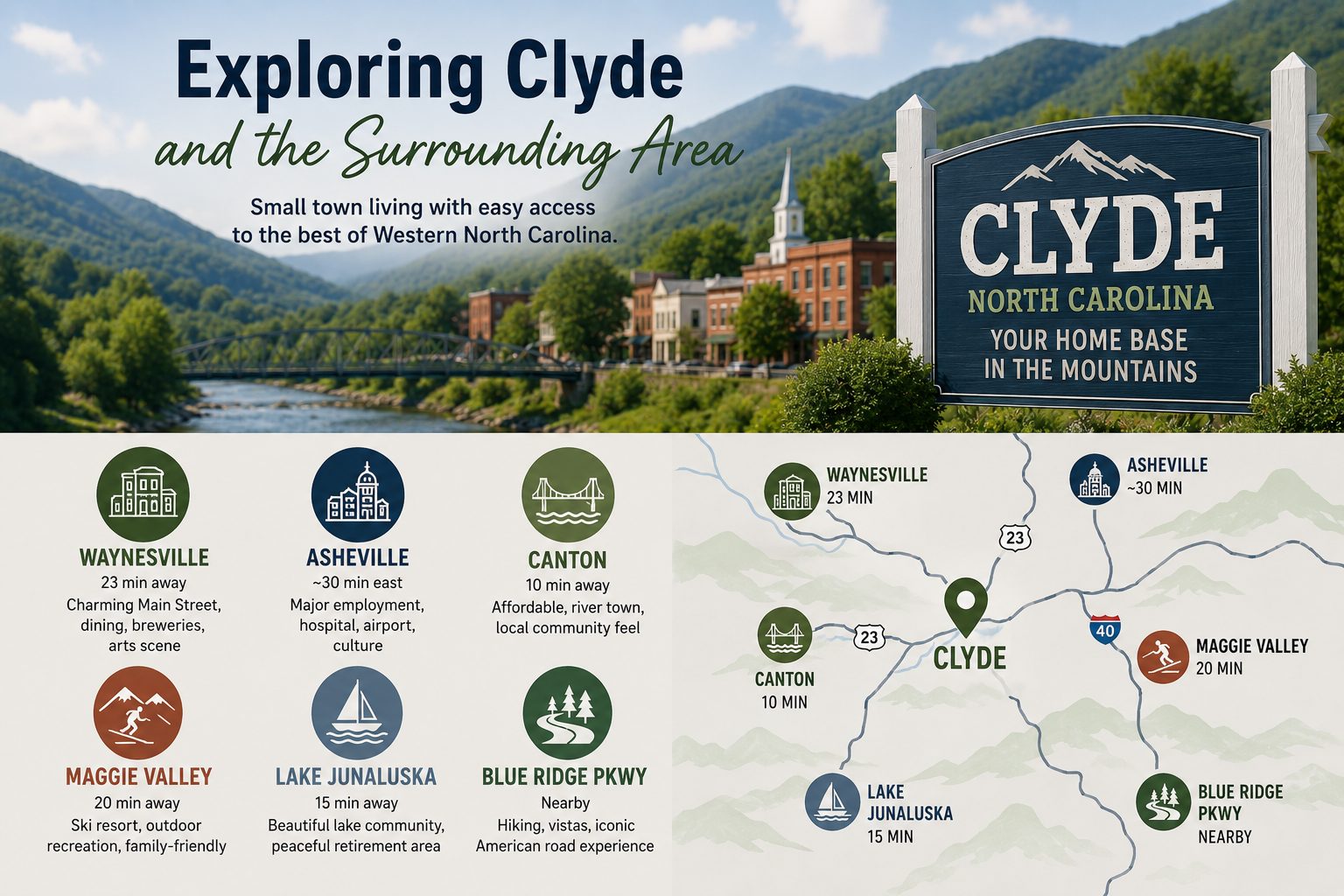
One of the advantages of buying in Clyde is its incredible location. You're not just buying a home. You're buying into a region with extraordinary quality of life. Here's how Clyde connects to the broader Haywood County area:

Waynesville

23 min away, charming Main Street, dining, breweries, arts scene

Asheville

30 min east, major employment, hospital, airport, culture

Canton

10 min away, affordable, river town, local community feel

Lake Junaluska

15 min, beautiful lake community, peaceful retirement area

Blue Ridge Pkwy

Nearby, hiking, vistas, iconic American road experience

Maggie Valley

20 min, ski resort, outdoor recreation, family friendly

Within Clyde itself, highlights include the Shook-Smathers House, listed on the National Register of Historic Places and thought to be the oldest standing frame-built house in Western NC, as well as the Haywood County Quilt Trails, a beloved community art project connecting neighborhoods through painted quilt patterns on barns and buildings.

Exploring Clyde NC and the surrounding area with a scenic mountain town background, Clyde welcome sign, and map showing easy access to Waynesville, Asheville, Canton, Maggie Valley, Lake Junaluska, and the Blue Ridge Parkway.

8. The True Cost of Owning a Home in Clyde, NC

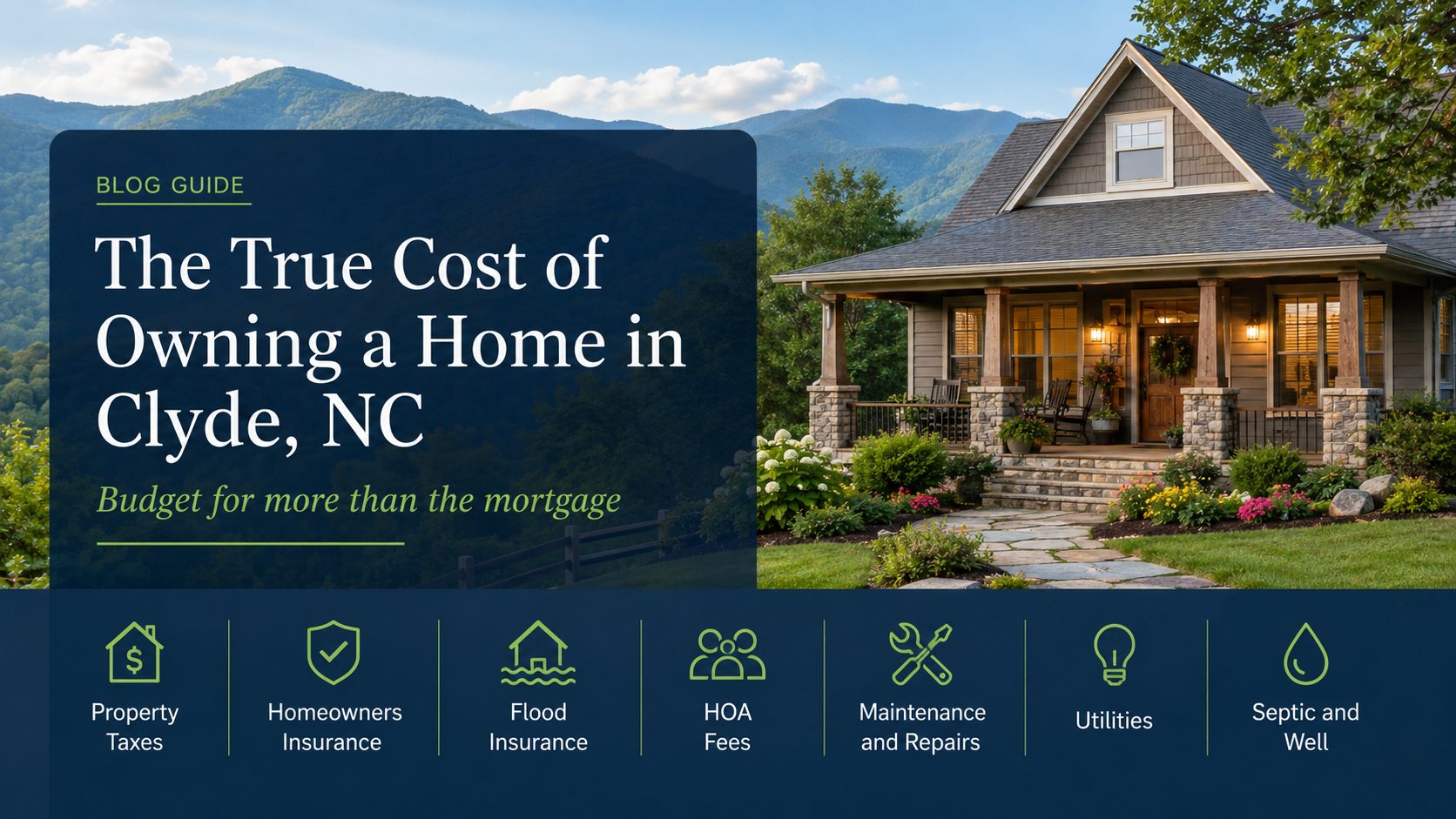
Your mortgage payment is just the beginning. As a first-time buyer in Clyde, budget for these additional ongoing co

Property taxes, Haywood County property taxes apply, verify the current rate with the county assessor
Homeowner's insurance, required by all mortgage lenders, get quotes early
Flood insurance, may be required depending on flood zone designation, can vary significantly by property
HOA fees, not universal in Clyde, but some communities or developments may have them
Maintenance & repairs, budget 1 to 2% of home value per year, older mountain homes may need more
Utilities, heating costs can rise in mountain winters, ask the seller for prior utility bills
Septic & well, many rural Haywood County properties use private well water and septic systems, get both inspected
⚠️Important: Flood Awareness

Properties outside town limits in Haywood County may use private wells and septic systems rather than municipal water and sewer. Always have both independently inspected before closing. Septic replacement costs can run $8,000 to $25,000 plus.

True cost of owning a home in Clyde NC graphic showing a mountain home with Blue Ridge views and buyer expenses including property taxes, homeowners insurance, flood insurance, HOA fees, maintenance, utilities, septic, and well costs.

9. What to Expect from Offer to Closing in NC

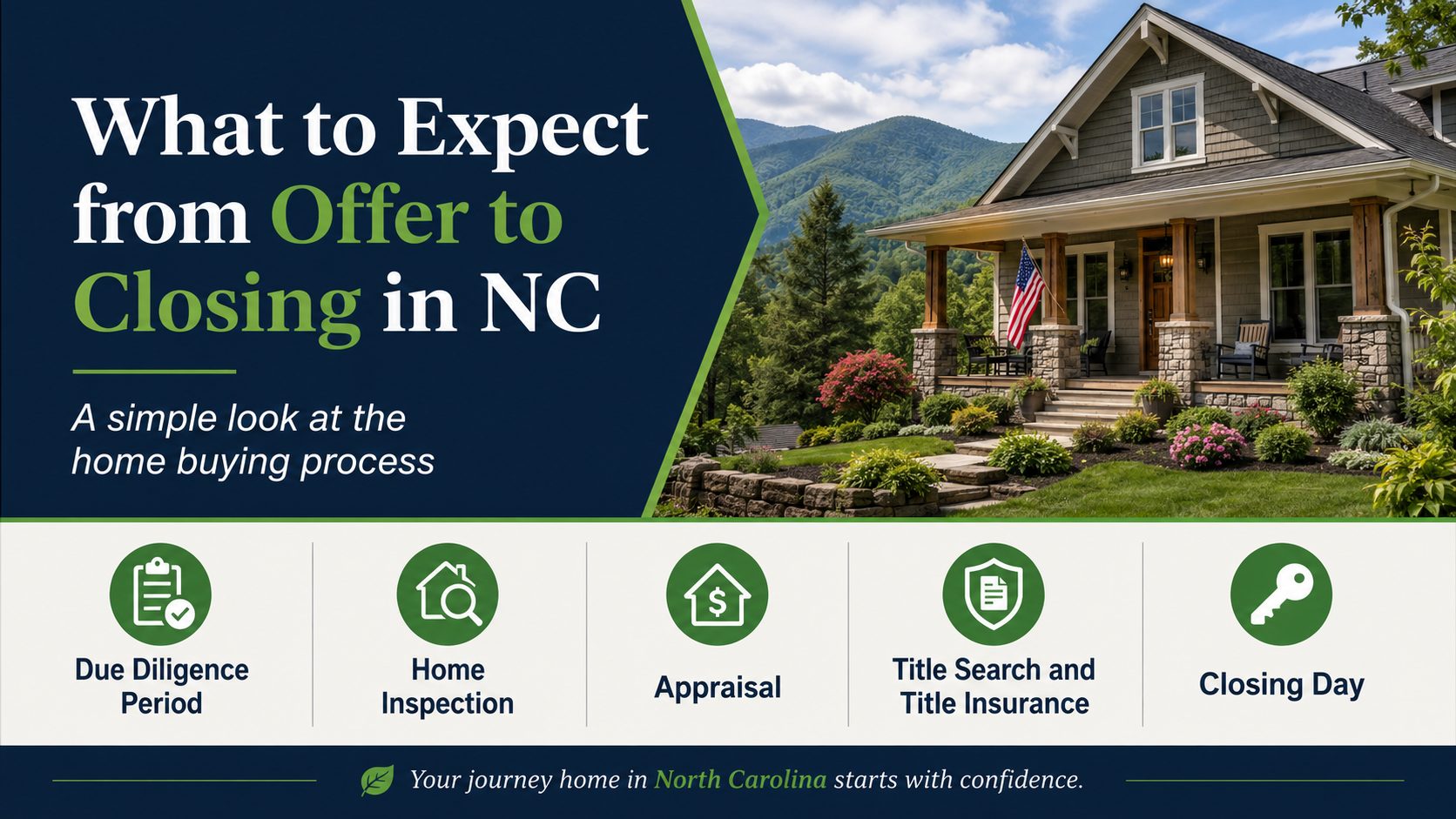
North Carolina has some unique features in its real estate purchase process that every first-time buyer should understand:

Due Diligence Period, North Carolina uses a due diligence contract structure. You pay a due diligence fee, negotiated and non refundable, and an earnest money deposit. During due diligence, you can back out for any reason and only lose the DD fee.
Home Inspection, always get one. In older mountain homes, budget $400 to $650. Look for inspectors who understand mountain construction, crawl spaces, and well and septic systems.
Appraisal, your lender will order an appraisal to confirm the home's market value.
Title Search & Title Insurance, standard in NC, protects you from ownership disputes or liens.
Clear to Close, lender gives final approval after all conditions are met.
Closing Day, sign documents, pay closing costs, typically 2 to 5% of loan amount, receive your keys.
North Carolina home buying process graphic showing a mountain home and the main steps from offer to closing, including due diligence, home inspection, appraisal, title search, title insurance, and closing day.
💡Pro Tip

The due diligence structure in NC is different from many other states. Understanding how to use that period wisely for inspections, lender conditions, and any negotiation is something I walk every buyer through before we submit an offer. It is one of the most important parts of protecting yourself as a buyer.

10. Work with a Local Expert Who Knows Haywood County

The difference between a smooth first-time homebuying experience and a stressful one almost always comes down to who's in your corner. In a small, tight-knit market like Clyde, local knowledge is everything. Flood zones, well and septic nuances, the right inspectors, which neighborhoods are recovering well post-Helene — these aren't things you find on Zillow.

Knows which Clyde neighborhoods have flood history and which do not
Has relationships with NCHFA approved lenders familiar with rural NC programs
Understands well, septic, and mountain construction considerations
Guides you through NC's due diligence process without surprises
Communicates clearly and promptly, never leaves you wondering what is next

"Buying your first home in Clyde, NC is an investment in a community, a lifestyle, and a future, not just four walls. My job is to make sure you find the right home, at the right price, with your eyes wide open." Ginny

Local Haywood County real estate expert guiding first time buyers outside a Clyde NC mountain home, with key local insights on flood zones, well and septic systems, trusted inspectors, and neighborhood knowledge.

Frequently Asked Questions

Is Clyde, NC a good place to buy a home for the first time?

Yes, Clyde offers a lower cost of living than nearby Asheville, a tight knit community feel, local town services, and access to the broader Haywood County lifestyle. It is an excellent entry point into the Western NC market for first time buyers who want mountain living without Asheville's price tag. Learn more about the town directly from the Town of Clyde.

What is the median home price in Clyde, NC?

Clyde home prices can vary by location, condition, acreage, flood zone, and mountain views. For the most accurate current pricing, buyers should compare recent sales and active listings in the local market. You can review local housing trends through Realtor.com Clyde NC market data or check broader property value trends through Zillow Clyde NC home values

Are there down payment assistance programs for buying a home in Clyde, NC?

Yes. The NC Housing Finance Agency offers programs that may help eligible first time buyers and veterans, including the NC 1st Home Advantage Down Payment and NC Home Advantage Mortgage. USDA financing may also be worth exploring for eligible rural properties. You can review program details through NCHFA Home Buyer Programs, the NC 1st Home Advantage Down Payment program and the USDA property eligibility tool.

Does Clyde, NC have flooding issues I should know about?

Yes, this is critical. Clyde sits along the Pigeon River and has experienced significant flooding from Hurricane Ivan in 2004, Tropical Storm Fred in 2021, and Hurricane Helene in 2024. Always check the FEMA flood zone designation and flood insurance requirements for any property you consider. A knowledgeable local agent will walk you through this before any offer is made.

What is Clyde, NC close to?

Clyde is located 23 miles west of Asheville and is close to Waynesville, Canton, Maggie Valley, Lake Junaluska, Haywood Regional Medical Center, Haywood Community College, and the Blue Ridge Parkway. It's conveniently located near I-40 and US-23 for easy commuting throughout the region.

Do many homes in Clyde have wells and septic systems?

Properties within the Clyde town limits typically have access to municipal water and sewer. However, properties in the broader Haywood County area, especially rural or mountain properties, may use private wells and septic systems. Always have both inspected independently before closing.

Ready to Talk Real Estate?

Have questions about buying your first home in Clyde, NC? Reach out anytime. I would be happy to help you understand the local market, compare neighborhoods, review buyer programs, and feel confident before you make a move. From flood zones, wells, septic systems, road access, and commute times to mountain lifestyle fit and long term value, I can help you look beyond the listing photos and make a smart, informed decision in Clyde and throughout Haywood County.

Couple exploring downtown Clyde NC with mountain views, small town charm, and text overlay about things to do before buying a home.

The smartest home purchase starts long before the paperwork. Here's how truly fall in love with Clyde, or make sure it's not the right fit before you sign anything

"Before you fall in love with a floor plan, fall in love with the town. In my years helping buyers find homes in Western North Carolina, the ones who explored Clyde first never had second thoughts."

Ginny, Clyde NC Real Estate Expert

IN THIS GUIDE

1.Why Clyde, NC is Turning Heads

2.Explore the Great Outdoors

3.Discover Clyde's Rich History & Culture

4.Eat, Drink & Meet Your Neighbors

5.Get a Feel for the Community

6.Real Estate Tips Before You Buy

7.Your Pre-Purchase Clyde Checklist

8.Frequently Ask Questions

-  THE COMMUNITY

Why Clyde, NC is Turning Heads Among Homebuyers

Tucked just 23 miles west of Asheville in the heart of Haywood County, Clyde, NC is one of Western North Carolina's best-kept secrets, and it isn't staying secret for long. As Asheville's real estate market has heated up, buyers have been looking westward and discovering that Clyde offers something rare: authentic small-town mountain living without the tourist-town price tag.

What makes Clyde different? It's not a resort town. It's a real community with families, longtime residents, local businesses, and deep Appalachian roots that stretch back to 1795. When I bring buyers to Clyde for the first time, I always tell them the same thing: don't just look at listings. Live here for a day first.

This guide covers exactly that, the experiences, activities, and observations that will help you decide whether Clyde is truly where you want to plant roots. Think of it as your personal pre-purchase tour.

Couple exploring downtown Clyde NC with mountain views, small town storefronts, and text highlighting Clyde as a small town mountain community for homebuyers.

- Nature & Recreation

Explore the Great Outdoors, Your Future Backyard

One of the most compelling reasons people choose to buy a home in Clyde, NC is the extraordinary access to nature. You're not just near the mountains. You're surrounded by them. The Great Smoky Mountains and Pisgah National Forest are practically in your backyard, offering year-round recreation that genuinely shapes how residents live and unwind.

Before you buy, spend a morning or two on these trails. Notice how close you feel to the land. Imagine doing this every weekend. That feeling, or its absence, will tell you a lot about whether Clyde is your kind of place.

Hike the Smoky Mountain Trails

Trails near Clyde range from easy riverside walks to challenging ridge climbs with stunning panoramic views of Haywood County. The Cataloochee Valley, a quiet corner of Great Smoky Mountains National Park, rewards those who make the trip with solitude, wildlife, and breathtaking history.

Outdoor · All Seasons

Camp at Mt. Pisgah

The Mt. Pisgah campground along the Blue Ridge Parkway sits at nearly 5,000 feet elevation, a perfect escape from summer heat and a remarkable test of how much you love waking up in the mountains. If this is your version of a perfect weekend, Clyde might be your forever home.

Camping · Summer Favorite

Test Your Patience at the Trout Pond

Fishing is a lifestyle in Haywood County, not just a hobby. Local trout ponds and mountain streams offer some of the best freshwater angling in the Southeast. Spending an afternoon here gives you an honest feel for the slow, intentional pace of life that defines Clyde and whether it suits you.

Fishing · Family Friendly

Horseback Riding & Scenic Drives

From horseback riding tours through the foothills to motorcycle routes weaving through mountain passes, Clyde rewards those who love to explore by land. The Blue Ridge Parkway overlooks, especially Mills River Valley Overlook at 4,085 feet, offer views that no photo can fully capture.

Adventure · Scenic

Expert Tip From Ginny

When you visit, drive the roads around the neighborhoods you're considering, not just the main highway. Notice travel times to the trailheads, the nearest grocery store, and the school zones. That daily reality matters as much as the weekend adventure. Ready to browse homes near these natural gems? Search available listings in Clyde, NC

- History & Culture

Discover Clyde's Rich History & Appalachian Soul

Clyde is the kind of town that takes its history seriously, and that tells you everything about the kind of community you'd be joining. When residents care about where they came from, they tend to care deeply about where they're going. That community pride is woven into the fabric of daily life here in ways that matter enormously to homeowners.

The Shook-Smathers House, built in 1795, is recognized as the oldest frame house west of the Blue Ridge, and it still stands in Clyde today. The town's seal features a World War I anti-aircraft gun honoring veterans, and a 9/11 memorial made from actual World Trade Center steel beams stands in front of the local fire department. This is not a town that forgets.

Spend an afternoon at the Shook-Smathers Museum. Walk the town square. Read the plaques. Ask a local about the town's history, they'll happily tell you. That conversation alone will give you a powerful sense of whether this is the community you want to belong to.

Historic Clyde NC home, veterans memorial, and downtown street with mountain views highlighting Appalachian heritage and community pride.

- Food & Local Life

Eat, Drink, and Meet Your Future Neighbors

There's an old real estate saying I've come to believe wholeheartedly: you can change a house, but you can't change a neighborhood. And nothing reveals a neighborhood's character faster than its restaurants and gathering spots. In Clyde, the dining scene is unpretentious, warm, and deeply local, exactly like the town itself.

Pull up a stool at a local diner and order the biscuits. Chat with the person next to you. Linger over coffee. The conversations you have and the welcome you feel, or don't, are more valuable data points than any neighborhood statistics report.

Haywood Smokehouse

A local institution. The brisket and ribs draw people from across the county, but what keeps them coming back is the atmosphere, friendly, unpretentious, and genuinely reflective of mountain culture. This is the kind of spot where you'll meet your potential neighbors over a plate of pulled pork.

BBQ · Local Favorite

Local Cafes & Cozy Diners

Clyde's small town cafes offer something chain restaurants simply can't replicate, a window into daily community life. Come on a weekday morning. Watch who comes in, how the staff knows their names, and how neighbors catch up over coffee. That's the rhythm of life you'd be buying into.

Cafes · Community Vibe

Visit the Specialty Market

Clyde's local specialty markets carry regional products, homegrown produce, and artisan goods that reflect the area's deep agricultural heritage. Shopping here is both practical research, how far is it from the neighborhoods you're considering, and a genuine pleasure.

Local Market · Everyday Living

Evening Wine & Socializing

The broader Haywood County area has a growing wine and cocktail scene. A Thursday or Friday evening out introduces you to a different side of the community, the one you'll be socializing with at neighborhood events, school fundraisers, and holiday gatherings for years to come.

Nightlife · Community
People sharing coffee and local food at a cozy Clyde NC cafe with mountain views, small town dining, and community connection.

- Community Life

Get a Real Feel for the Community Before You Commit

Beyond the trails and restaurants, the most important thing you can do before buying a home in Clyde is simply spend time here on ordinary days. Not a festival weekend. Not a real estate tour. A Tuesday afternoon. A Sunday morning. Walk downtown, stop at the fire department, visit the library. Introduce yourself as someone thinking about moving to the area.

Clyde has a particularly strong sense of community identity rooted in its Appalachian heritage, its veterans' history, and its small-town pride. The 9/11 Memorial, the town seal, and the preserved historic buildings aren't just tourist attractions. They're daily reminders of what this community values.

Pay attention to community events through local channels and the Haywood County area calendar. Naturalist walks, educational programs at the Great Smokies, and local gatherings happen regularly and give you a real picture of how engaged and active the community actually is.

Also worth noting: Clyde's proximity to Asheville, just 23 miles east, gives residents access to a major city's amenities, including hospitals, airports, universities, and arts, while living in genuine small-town peace. That balance is genuinely rare and deeply valuable for homeowners in the long run.

Couple talking with a local resident in downtown Clyde NC near the library, fire department, and veterans memorial with mountain views.

My Honest Take

In my experience, buyers who visit Clyde with open eyes and an open afternoon almost always feel something here that they don't feel in more developed or touristy areas. It's quieter. It's more authentic. And for the right buyer, someone who values community, nature, and a genuine mountain lifestyle, it becomes obvious very quickly. Explore our buying tips resource to understand what to look for during your visits.

- Smart Buying Advice

Real Estate Tips for Buying a Home in Clyde, NC

Once you've spent time in Clyde and you're ready to take the buying process seriously, here are the most important practical steps I always walk my buyers through.

Understand the Clyde Real Estate Market

Clyde's market has been evolving steadily. As Asheville prices have risen, more buyers have discovered the value in Haywood County, which means inventory in Clyde moves faster than it used to. Homes with mountain views, privacy, and acreage are especially competitive. Working with a local agent who knows this specific market, not just "Western NC" in general, gives you a real edge.

Factor in the Commute & Proximity to Asheville

If you work in or regularly visit Asheville, run the commute during actual rush hours, not on a Sunday afternoon. I-40 through the Pigeon River Gorge is scenic but can slow down. Knowing your real commute experience versus the Google Maps estimate matters enormously for day-to-day quality of life.

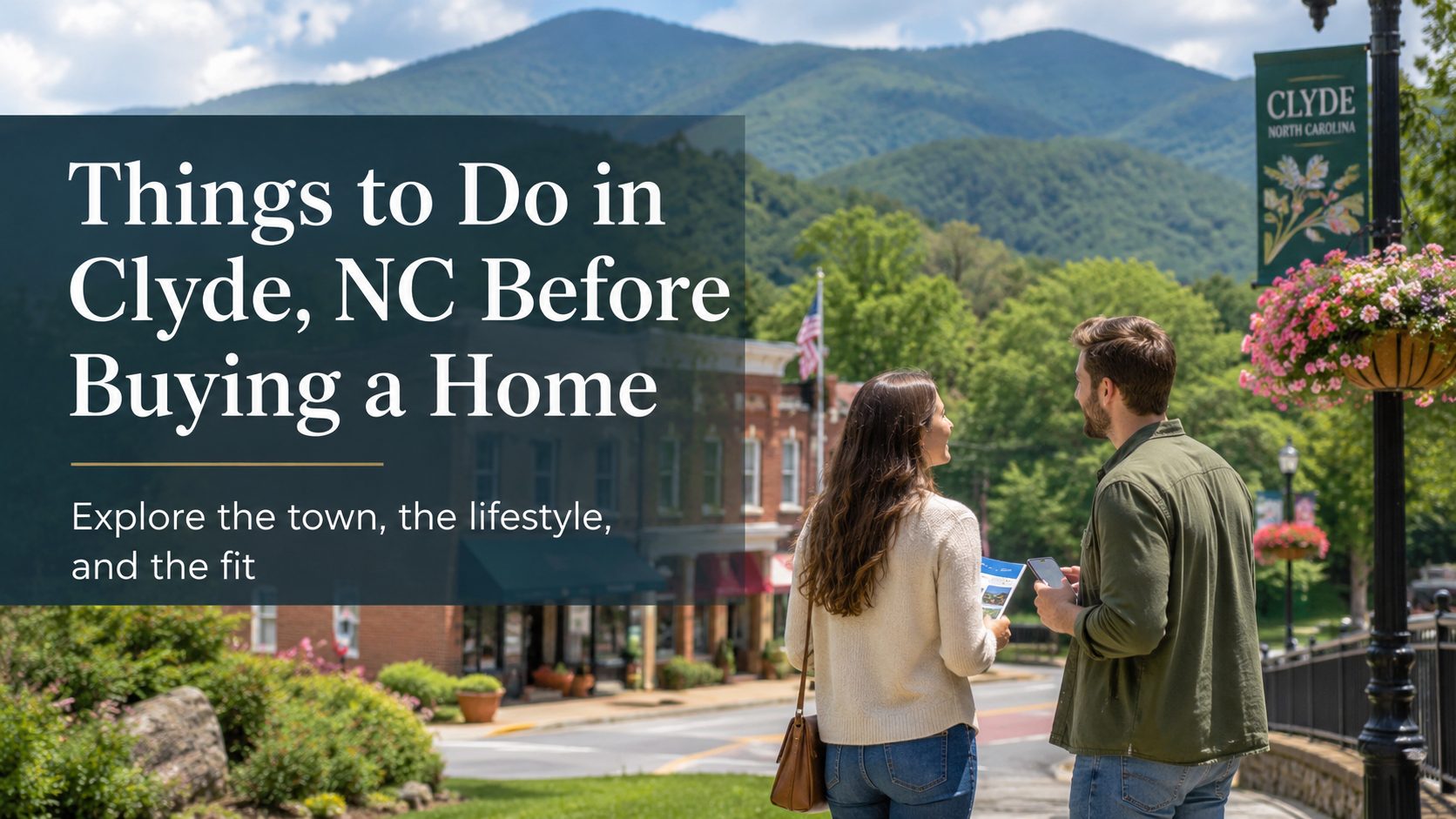
Know What You're Buying: Land, Elevation & Weather

Mountain properties come with unique considerations: elevation, sun exposure, access roads, well and septic systems, and seasonal weather patterns. Some roads that look fine in summer become challenging in winter. I always recommend visiting the property you're considering in multiple seasons if possible, or at minimum asking pointed questions about winter access and maintenance.

Use the Right Financial Tools Before You Offer

Before you fall in love with a listing, know your real numbers. Use our mortgage and financial calculators to get clear on your budget, monthly payments, and what different down payment scenarios actually mean for your long-term finances. Clarity upfront prevents heartbreak later.

Clyde NC mountain community collage showing downtown, local food, hiking trails, memorial landmarks, scenic homes, and mountain views for homebuyers.

- Smart Buying Advice

Your Pre-Purchase Clyde Checklist

Use this as your guide before making any offer on a home in Clyde, NC:

🗺️ Community & Lifestyle Exploration

  • Spend at least one weekday and one weekend day in Clyde, not just during a real estate tour
  • Hike at least one nearby trail to experience your potential outdoor lifestyle firsthand
  • Have a meal at a local restaurant and engage with the community naturally
  • Visit the Shook Smathers Museum and walk the historic downtown area
  • Drive from your target neighborhoods to Asheville during morning commute hours
  • Check local event calendars and attend at least one community gathering

🏠 Real Estate Due Diligence

  • Get pre-approved with a lender before beginning serious property searches
  • Use the financial calculators to stress test different scenarios
  • Ask about well and septic status, road access, and mountain specific maintenance considerations
  • Research Haywood County school zones, services, and property tax rates
  • Visit any property you're seriously considering in at least two different weather conditions
  • Work with a local agent who specializes in this specific area, not just Western NC broadly
  • Review buying and selling tips to stay ahead of common pitfalls
  • Search current Clyde listings to understand pricing and inventory before your first showing

-  Final Thoughts

Clyde Isn't for Everyone, That's What Makes It Special

Not every buyer who visits Clyde decides to buy here. And honestly? That's the point of this process. The town's unhurried pace, its deep mountain roots, its distance from the bustle of city life. These are features to some buyers and dealbreakers to others. There's no wrong answer.

But the buyers who fall in love with Clyde do so completely. They're not buying a house. They're buying into a way of life. One with mountain air, genuine community, Appalachian history, and the kind of quiet that lets you actually hear yourself think. For the right person, there's nowhere else on earth quite like it.

If that sounds like you, I'd love to help you find your place here. Visit Ginny Real Estate to get started, or browse current listings in Clyde and Haywood County right now.

Couple overlooking downtown Clyde NC with mountain views, small town streets, and quiet mountain living for the right homebuyer.

Frequently Asked Questions

FAQs About Things To Do In Clyde NC Before Buying A Home

What should I do in Clyde NC before deciding to buy a home?

Spend time in Clyde like a local, not just like a buyer on a showing appointment. Drive the neighborhoods, visit local restaurants, walk through town, check daily commute times, and explore nearby outdoor areas. You can also review local town services and community information through the Town of Clyde official website before deciding if the lifestyle fits you.

Is Clyde NC a good place for buyers who love the outdoors?

Yes, Clyde can be a strong fit for buyers who want access to mountain scenery, hiking, fishing, scenic drives, and quiet outdoor living. The nearby Cataloochee area of Great Smoky Mountains National Park offers trails, mountain views, historic buildings, and wildlife viewing. You can learn more through the National Park Service Cataloochee guide.

How close is Clyde NC to mountain camping and scenic drives?

Clyde is close enough to enjoy classic Western North Carolina mountain recreation without living directly in a tourist heavy area. Buyers who enjoy camping, hiking, and Blue Ridge Parkway drives should explore places like Mount Pisgah before purchasing. You can review campground details through Recreation.gov Mount Pisgah Campground.

What should buyers research before making an offer on a Clyde NC home?

Buyers should look at road access, driveway grade, well and septic information, property boundaries, flood considerations, utility access, school zones, and tax details. For property research, the Haywood County Land Records and GIS department is a helpful place to start.

Where can I check Haywood County property tax information?

Before buying in Clyde, it is smart to understand the property tax picture along with your mortgage payment, insurance, utilities, and maintenance costs. Haywood County provides tax collection information through the Haywood County Tax Collections office.

Should I visit Clyde during the week or only on the weekend?

Visit both if you can. A weekend visit shows you the slower lifestyle and nearby recreation, while a weekday visit gives you a better feel for traffic, school routines, grocery runs, workday commute patterns, and daily services. That balance helps you decide if Clyde feels right beyond the excitement of looking at homes.

Why does local experience matter when buying a home in Clyde NC?

Clyde and the surrounding Haywood County market can vary street by street. Elevation, road condition, view quality, acreage, utility setup, internet access, and winter access can all affect value and daily life. A local real estate expert can help you compare homes with the right context, not just the listing photos.

Ready to Talk Real Estate?

Have questions about buying a home in Clyde, NC? Reach out anytime. I would be happy to help you explore the area, understand the local market, compare neighborhoods, and feel confident about whether Clyde is the right fit before you make a move. From mountain access and commute times to property details like road access, wells, septic systems, and long-term lifestyle fit, I can help you look beyond the listing photos and make a smart, informed decision.

Clyde NC mountain home with long range views and a fresh strategy real estate sign, promoting how expired listings can be repositioned and sold with better pricing, presentation, and marketing.

“Your home sat on the market. The listing expired. It feels discouraging — but it doesn't mean your home won't sell. It means something needs to change. Here's exactly how to find out what, and what to do about it.”

Ginny Mosteller, REALTOR® & Waynesville NC Broker

What Does It Mean When a Listing Expires in Clyde, NC?

In real estate, a listing "expires" when it reaches the end of its contract period without selling. In the Clyde, NC and greater Haywood County market, this typically happens after 30, 60, or 90 days on the market, depending on what was agreed upon with your agent.

An expired listing is not a rejection of you or your home. It is a market signal. Something, or a combination of things, did not align with what buyers in the area were looking for at that price point. The good news? Every one of those things can be identified and corrected before you re-list.

68%

of expired listings sell within 90 days of re-listing with a new strategy

3

average time to re-position and re-launch your listing properly

14 Days

faster average time to close when working with a broker who has existing contractor and lender relationships

Clyde NC home with mountain views and real estate statistics explaining what it means when a listing expires, including relisting strategy, pricing, presentation, and marketing improvements.

The 3 Real Reasons Your Clyde NC Home Didn't Sell

Before rushing back to the market, it is critical to diagnose what actually prevented a sale. In the Western NC market, most expired listings fall into one or more of these three categories:

1. The Price Was Above Market Value

Buyers in Clyde and Haywood County are informed. They are comparing your home to every other active and recently sold listing in the area. If your price was even 5 to 8% above what the data supports, you likely watched buyers walk past your home online without ever scheduling a showing. Use our financial calculators to get a clearer picture of realistic numbers before re-listing.

2.The Presentation Didn't Match The Price

Photography, staging, curb appeal, and the condition of the home all communicate value to buyers before they ever set foot inside. If your listing photos were dark, cluttered, or failed to capture what makes your home special in the Western NC landscape, buyers moved on. First impressions are made in under 10 seconds online.

3.The Marketing Didn't Reach The Right Buyers

Many sellers don't realize that listing a home on the MLS is just the starting point. In a market like Clyde, NC, where buyers may be relocating from Charlotte, Asheville, or out of state, your home needs targeted digital exposure. Check how homes are currently marketed in this market to see what a competitive listing looks like.

“Ginny's insight: In my experience working with sellers across Western NC, price is the most common culprit, but it is almost never the only issue. When a home expires, I do a full audit of all three factors before recommending any next steps.”

Clyde NC home selling infographic showing the three main reasons an expired listing did not sell, including pricing, presentation, and marketing reach, with a mountain home and sold sign in the background.

How To Reposition Your Home for a Successful Re-Listing

Repositioning is not just lowering your price and re-launching. It is a strategic reset. Here is the step-by-step process that consistently works for sellers in the Clyde, NC market:

1.Request An Honest Market Analysis

Get a fresh, data-driven CMA, comparative market analysis, based on the most recent Haywood County sales, not what your home was worth 90 days ago. Markets shift. Visit ginnyrealestate.com to connect with Ginny for a no-obligation analysis.

2.Do A Showing Walkthrough With A Critical Eye

Walk through your home the way a buyer would, starting from the curb. Note anything that signals deferred maintenance, clutter, or dated finishes. Small investments here, such as paint, fixtures, and staging, often return $3 to $5 for every $1 spent.

3.Invest In Professional Photography

If your listing photos were taken on a phone or poorly lit, this is non-negotiable. In the Western NC market, buyers are scrolling on Zillow and Realtor.com from hundreds of miles away. Your photos are your first showing.

4.Price Strategically, Not Emotionally

Work with your agent to set a price that positions you competitively in the Clyde, NC market. Use the seller financial calculators to model different price points against your net proceeds.

5.Expand Your Marketing Reach

Ensure your re-listing includes professional social media promotion, targeted digital ads to out-of-state buyers, email campaigns to active buyer pools, and strong MLS syndication across all major platforms.

6.Wait the Right Amount Of Time Before Re-Listing

In most MLS systems, waiting at least 30 days resets your "days on market" counter, which removes the stigma of a long-sitting listing. Time this strategically with your agent.

Clyde NC mountain home with a relisting strategy graphic showing six smart steps to reposition a home, including market analysis, buyer walkthrough, professional photography, pricing, marketing, and relaunch timing.
Clyde NC mountain home with a relisting checklist graphic showing key steps before putting an expired listing back on the market, including updated pricing, professional photos, home staging, repairs, marketing, and relaunch timing.

Expired Listing FAQ: Clyde, NC Sellers

Can I re-list my home immediately after it expires in NC?

Yes. In North Carolina, once your listing agreement has expired, you can usually relist your home right away with the same agent or a new agent. Before you do, review your listing agreement and make sure the prior contract has fully ended. The North Carolina Real Estate Commission explains that a seller’s agent must have a written listing agreement before marketing a property for sale.

What is the most common reason homes expire in the Clyde NC market?

Overpricing is one of the most common reasons homes sit without selling. Buyers compare your home against active listings, recent sales, condition, location, and value. The National Association of REALTORS® notes that pricing should reflect market conditions, comparable sales, and the seller’s timeline.

Do I have to use the same agent to re-list my home?

No. Once your listing agreement expires, you may choose to work with a new agent, depending on the terms of your prior agreement. Many Clyde sellers use this moment to get a fresh pricing review, updated photography, stronger marketing, and a new relaunch plan. The North Carolina Real Estate Commission’s seller agency guidance explains how listing representation works in North Carolina.

How long does it typically take to sell a home in Clyde, NC?

Market conditions change, but current Realtor.com data shows Clyde homes have been spending around 100 plus days on the market, depending on price, condition, location, and buyer demand. A well priced and well presented home can still move faster, while a mispriced or poorly marketed listing may sit much longer.

What should I do first if my listing just expired?

Do not rush back onto the market with the same plan. Start with a fresh market analysis, review recent Haywood County sales, audit your photos and showing feedback, check your pricing, and create a stronger marketing plan before relisting. Haywood County GIS and land records can also help sellers and agents review property details that may affect pricing and buyer expectations.

Ready to Talk Real Estate?

Have questions about relisting an expired home in Clyde, NC? Reach out anytime. I would be happy to help you review what held your listing back, create a clear repositioning checklist, and build a smarter relaunch strategy with stronger pricing, better presentation, and targeted marketing that helps your home attract the right buyers.

Blog Title

In a market as unique as Waynesville NC, local knowledge isn't just a nice-to-have. It's the difference between the right home at the right price and an expensive lesson learned the hard way.

IN THIS GUIDE

  1. Why Local Knowledge Is Non-Negotiable in Waynesville NC
  2. Advantage #1: Neighborhood-Level Market Intelligence
  3. Advantage #2: A Network That Opens Doors Before They're Listed
  4. Advantage #3: Relationships That Save Deals
  5. Advantage #4: Honest Pricing Rooted in Real Data
  6. Advantage #5: Community Knowledge No Algorithm Can Replicate
  7. What a Local Waynesville Broker Actually Knows That Others Don't
  8. Real Client Story: The Deal That Local Connections Saved
  9. Questions to Ask Any Broker Before You Hire Them
  10. Frequently Asked Questions

“There is no algorithm, no national database, and no out-of-area agent who can replicate what comes from years of living, working, and building relationships in this community. In Waynesville NC real estate, local knowledge doesn't just help, it changes outcomes.”

Ginny Mosteller, REALTOR® & Waynesville NC Broker

If you're buying or selling a home in Waynesville NC, you've probably encountered the temptation of large national platforms, out-of-area agents offering referral discounts, or tech-driven services promising streamlined transactions. Some of these have their place. But when it comes to navigating the specific dynamics of the Haywood County real estate market, where micro-location matters enormously, where off-market relationships carry serious weight, and where the right connection can mean the difference between closing and losing a home, nothing replaces a deeply rooted local broker.

This guide is for out-of-state buyers researching Waynesville from a distance, local sellers weighing their options, and first-time buyers who aren't sure how to choose the right representation. In every case, the same truth applies: the broker you choose shapes your entire experience and outcome.

Before we go further, browse our buyer and seller resource library. It's full of tools built specifically for Waynesville NC and Haywood County clients.

23%

higher sale prices on average when sellers work with a local market specialist vs. generalist

40%

of Waynesville area sales involve off market or pre market conversations a local broker facilitates

faster average time to close when working with a broker who has existing contractor and lender relationships

Neighborhood-Level Market Intelligence

National platforms show you average prices. A local Waynesville NC real estate broker shows you why two homes on the same street, same square footage, same year built, can sell for $40,000 different prices based on which side of the ridge they sit on, which school bus route serves them, and whether they face the morning sun or the afternoon shadow.

In Waynesville and Haywood County, micro-location matters in ways that don't show up in Zillow's estimates or in the CMAs of agents who drove in from Asheville for the listing appointment. The difference between a property with a protected ridgeline view and one whose view corridor will be obstructed by the next development phase, that's local knowledge. The seasonal road conditions that affect a mountain cabin's appeal to different buyer types, that's local knowledge. The upcoming infrastructure improvements that will affect value in a given neighborhood, that's local knowledge.

Local Waynesville Broker Knows
  • Which streets flood in heavy rain
  • Protected vs. buildable ridgeline views
  • Neighborhood trajectory and development plans
  • Seasonal access issues on mountain roads
  • Which HOAs have strong management vs. issues
Out Of Area Agent Relies On
  • MLS averages and Zillow estimates
  • Comparable sales without context
  • Google Maps for neighborhood assessment
  • Generic NC market data not specific to Haywood County
  • Information the seller provides, unverified
Ginny's take: I've lived and worked in this community long enough to know that two properties can look identical on paper and feel completely different in reality. That context, built from years of showing, selling, and simply being here, is what I bring to every client conversation. It can't be downloaded.
Neighborhood Level market Intelligence

A Network That Opens Doors Before They're Listed

One of the most valuable and least visible advantages of working with a deeply connected local Waynesville NC broker is access to properties that never formally hit the MLS. In a small market like Haywood County, a significant portion of the best transactions happen through relationships: a seller who mentions to their neighbor that they're thinking of selling, a builder with a finished spec home not yet listed, or an estate trustee looking for a quiet, professional transaction.

These opportunities are invisible to buyers working with out-of-area agents who have no existing relationships in the community. And they're equally invisible to sellers who list with agents who don't have active buyer networks in the market, because those buyers are searching elsewhere, with brokers who know where to find them.

What A Local Network Provides
  • Pre market and off market property access
  • Early awareness of coming soon listings
  • Buyer pipeline for seller clients
  • Trusted contractor, lender, and inspector referrals
  • Attorney relationships that smooth closings
Without A Local Network
  • Limited to publicly listed MLS inventory
  • No early access to desirable properties
  • Generic vendor referrals with no local track record
  • No buyer pipeline for off market sellers
  • Longer timelines due to relationship building from scratch
Ginny's take: Some of the best transactions I've been involved in started with a conversation, not a listing. A seller who trusted me enough to call before signing anything. A buyer I knew was looking for exactly what a homeowner was quietly considering selling. Those moments are the product of years in this community, and they benefit my clients directly.
A network that opens doors before they're listed

Relationships That Save Deals

Real estate transactions are rarely perfectly smooth. Inspections surface unexpected issues. Appraisals come in below contract price. Lenders hit underwriting snags. Sellers get cold feet. In every one of these scenarios, what determines whether the deal closes or falls apart is often the quality of the relationships on both sides of the table.

A Waynesville NC broker with years of local transactions has existing relationships with the appraisers who work in this market, the inspectors who know mountain homes specifically, the lenders who understand Haywood County property types, and the attorneys who close deals here week after week. When something goes sideways, and eventually, something always does, those relationships are what keep the transaction moving forward.

Local Broker Advantage When Problems Arise
  • Direct line to appraisers to provide comparable context
  • Trusted inspector relationships for reinspection coordination
  • Lender relationships to problem solve financing hiccups
  • Existing rapport with the other broker to negotiate repairs
  • Attorney relationships for fast turnaround on title issues
Out Of Area Agent Limitations
  • No existing relationships with local appraisers
  • Generic inspector referrals without local mountain experience
  • Unfamiliar with Haywood County title quirks and easements
  • No rapport with local listing agents to facilitate negotiation
  • Communication delays due to geography and time zone differences
Ginny's take: I've watched deals that should have fallen apart stay together because of a phone call to someone I've worked with for years, an appraiser willing to look at one more comp, an inspector who could squeeze in a reinspection on 24 hours' notice. Those aren't accidents. They're the result of showing up consistently and building trust over time in this community.
Relationships That Save Deals

Honest Pricing Rooted in Real Local Data

Pricing a home in Waynesville NC, or advising a buyer on what to offer, requires more than pulling MLS averages. It requires understanding the specific factors that drive value and discount value in this micro-market: elevation and view quality, road type and accessibility, well versus municipal water, proximity to downtown versus mountain seclusion, and the seasonal buyer pools that are attracted to different property types.

An out-of-area agent applying a broad Asheville or Western NC pricing model to a Waynesville home will almost always miss these nuances. The result is a listing price that's either too high, generating the stagnation and eventual price cuts that follow overpricing, or too low, leaving real money on the table that a well-informed local analysis would have captured.

Local Pricing Advantage
  • Adjustments for view quality and elevation, not just bedroom and bathroom counts
  • Awareness of seasonal buyer demand by property type
  • Knowledge of upcoming comparable listings about to hit the market
  • Understanding of well and septic vs. municipal utility value impact
  • Familiarity with which buyer pools pay premiums for specific features
Generic Pricing Misses
  • Over reliance on Zillow Zestimate or broad regional averages
  • No adjustment for mountain property specific value drivers
  • Stale comparable data not accounting for seasonal shifts
  • Missing nuances between Clyde, Waynesville, and Canton values
  • Pricing strategy that does not account for Haywood County buyer behavior
Ginny's take: Use our financial calculators to model what different price points mean for your net proceeds, but pair that with a local CMA conversation. The numbers matter, and so does the context behind them.
Honest pricing rooted in Real Local Data

Community Knowledge No Algorithm Can Replicate

Buyers relocating to Waynesville NC aren't just buying square footage. They're buying a lifestyle, a community, and a version of their future. They have questions that no Zillow listing page answers: Which neighborhoods have the strongest sense of community? Where do locals actually shop, eat, and gather? Which areas are up-and-coming and which have stalled? What's the vibe on Main Street on a Tuesday in January versus a Saturday in October?

A local broker doesn't just know the answers to these questions. They live them. And that lived knowledge translates directly into better guidance for buyers who are making one of the most significant decisions of their lives, often from hundreds of miles away.

What Local Community Knowledge Looks Like
  • Honest guidance on neighborhood character and trajectory
  • Real talk about seasonal town dynamics, not just the highlights
  • School district insights beyond what websites provide
  • Healthcare, services, and amenity proximity context
  • Candid advice on which areas match your lifestyle, not just your budget
What Out Of Area Agents Can't Offer
  • Lifestyle guidance based on secondhand or online research
  • No personal experience of seasonal community rhythms
  • Generic "great schools, great amenities" placeholder copy
  • No honest opinion on neighborhood trajectory or concerns
  • Limited ability to answer candid "what's it really like" questions
Ginny's take: Buyers moving here from Charlotte or Atlanta often tell me they feel like they're buying blind. My job isn't just to find them a home, it's to help them find the right community for the life they're trying to build. That requires being honest, even when the honest answer is "that neighborhood isn't the right fit for what you're describing."
Community Knowledge No Algorithm Can Replicate

What a Local Waynesville Broker Actually Knows That Others Don't

Here's a sample of the hyper-local intelligence a true Waynesville NC real estate broker brings to every transaction, the kind of knowledge that isn't in any database:

🏔️

View Corridor Protection

Which ridgelines have protected view corridors and which are at risk from future development, a $30K+ value difference.

🌧️

Flood & Drainage Patterns

Which roads and coves flood seasonally, critical for mountain properties not reflected in FEMA maps alone.

📶

Internet & Cell Coverage

Which areas have reliable high-speed internet, essential for remote workers and a dealbreaker in some coves.

🏫

School District Nuances

Real school quality and culture context, not just state ratings, for families with children making this move.

🛠️

Trusted Contractor Network

Who does quality work at fair prices locally, invaluable for buyers needing repairs or renovations post closing.

📅

Seasonal Market Rhythms

Exactly when buyer traffic peaks, when inventory thins, and how to time your transaction for maximum advantage.

🏘️

Neighborhood Trajectory

Which areas are gaining investment and momentum, and which have plateaued, for smarter long-term decisions.

⚖️

Local Easements & Title Issues

Common property access and easement patterns in Haywood County that out-of-area agents routinely overlook.

Want to see what's currently available in Waynesville and across Haywood County? Browse active listings here and reach out when you see something you'd like local context on

Real Client Story · The Deal That Local Connections Saved

How a Single Phone Call and Years of Local Relationships Kept a Transaction Together

David and Michelle had been searching for a home in Waynesville for several months, mostly online, with an agent they'd worked with in their home state of Tennessee who offered to help them remotely. They found a property they loved: a three-bedroom craftsman with a long-range mountain view, walking distance to downtown, priced just within their budget.

They went under contract. Then the inspection came back with a significant finding: a portion of the property's boundary overlapped with a recorded access easement that hadn't been clearly disclosed. Their out-of-state agent, unfamiliar with how these easements typically function in Haywood County, advised them to walk away entirely, characterizing it as a dealbreaker.

David called me before they canceled. I knew the area well enough to recognize that this type of shared access easement was common in older Waynesville plats and rarely affected day-to-day property use. I also knew the closing attorney who had handled the original title work on the property. One conversation, facilitated by an existing professional relationship, clarified the easement's scope and confirmed it posed no material issue for the buyers' intended use.

The deal closed. David and Michelle moved in on schedule. They've told me since that they came within one panicked phone call of walking away from a home they now love, over an issue that a local expert recognized as routine in under 20 minutes. That is what local knowledge and local relationships look like in practice.

Deal Saved by Local Easement Knowledge Closed On Schedule Existing Attorney Relationship = Fast Resolution Out-of-State Agent Would Have Walked Away
Names changed for privacy. Story shared with client permission.

Questions to Ask Any Broker Before You Hire Them

Whether you're buying or selling in Waynesville NC, these questions will quickly reveal how local and how experienced any broker really is:

  1. 1 How many transactions have you closed in Waynesville or Haywood County in the past 12 months, and can you share examples?
  2. 2 Can you describe how the Waynesville market behaves differently in spring vs. fall, from firsthand experience?
  3. 3 What are the most common title or easement issues that come up on Haywood County properties?
  4. 4 Who are your preferred local inspectors, lenders, and closing attorneys, and why?
  5. 5 Have you personally dealt with a mountain property with well and septic, and what should buyers know about those systems here?
  6. 6 How do you market to out-of-state buyers specifically looking at the Waynesville area?
  7. 7 What's your honest assessment of this neighborhood's trajectory over the next 3 to 5 years?

A broker who knows this market will answer these confidently and specifically. Vague or generic answers are a signal worth paying attention to.

Frequently Asked Questions: Working with a Waynesville NC Real Estate Broker

What's the difference between a real estate broker and a real estate agent in NC?

In North Carolina, all licensed real estate professionals are technically brokers. The state eliminated the salesperson license classification in 2006, meaning salesperson licenses were converted to broker licenses. However, a broker-in-charge has additional qualifications and is licensed to operate or supervise a real estate firm. You can learn more through the North Carolina Real Estate Commission License Law and Rules. When people refer to a real estate broker in Waynesville NC, they typically mean an experienced, licensed professional who can represent buyers and sellers in transactions. What matters most is not the title, it is the depth of local experience and professional track record.

Is it worth using a local Waynesville broker if I've already found the home I want online?

Absolutely. Finding a listing online is just the beginning. A local broker will help you evaluate the property accurately, negotiate effectively, navigate inspection findings with local context, and manage the transaction through closing with established local relationships. The North Carolina Real Estate Commission explains due diligence as the buyer’s opportunity to investigate the property and the transaction before closing, which is exactly where local guidance can make a major difference. Buyers who waive representation to save on commission often end up paying more through mispriced offers, inspection oversights, or failed negotiations. See our buyer resources here.

How does a local Waynesville NC broker help out-of-state buyers specifically?

Out-of-state buyers face a unique challenge: making major financial decisions about a community they may have visited only once or twice. A local broker bridges that gap by providing candid, firsthand guidance on neighborhoods, lifestyle fit, seasonal realities, and community character. For buyers evaluating property remotely, tools like Haywood County GIS and the FEMA Flood Map Service Center can be helpful, but they do not replace local interpretation. A Waynesville broker can also coordinate virtual showings, facilitate remote offer processes, and manage the transaction on the buyer's behalf without requiring them to be physically present for every step.

What should I look for in a Waynesville NC real estate broker?

Look for a verifiable track record of closed transactions in Waynesville and Haywood County specifically, not just Western NC broadly. You can verify license status through the North Carolina Real Estate Commission license lookup. Look for someone who can speak with specificity about different neighborhoods, property types, and market dynamics in this area. Look for established relationships with local inspectors, lenders, attorneys, and contractors. And look for honest communication, someone who will tell you what you need to hear, not just what you want to hear.

Does it cost more to work with a local Waynesville NC broker vs. a national platform?

Not necessarily, and in most cases, the value delivered by a local broker far exceeds any marginal difference in cost. National discount platforms often provide limited service and no local expertise, which can result in missed price opportunities, failed negotiations, and transactions that fall apart over issues a local expert would have caught early. For buyers and sellers comparing costs, the North Carolina Real Estate Commission’s Working With Real Estate Agents brochure is a helpful resource for understanding agency relationships and representation. Use our financial calculators to model the real numbers, because the difference between working with and without the right local representation can be significant.

What makes the Waynesville NC real estate market unique compared to other NC markets?

Several factors make Haywood County distinctly different from urban and suburban NC markets. Mountain property types, with elevation, views, well and septic systems, and seasonal road access, require specialized knowledge. Buyers and sellers can use public resources like Haywood County Land Records and GIS and the FEMA flood maps resource page for property research, but local interpretation still matters. The buyer pool is heavily influenced by out-of-state migration, second-home interest, and remote work relocations, which creates seasonal demand patterns unlike typical markets. And the community's small-town character means relationships and reputation matter more than they do in high-volume urban markets.

Ready to Talk Real Estate?

Have questions about choosing the right Waynesville NC real estate broker? Reach out anytime. I would be happy to help you understand the local market, compare your options, and make sure you have experienced guidance from someone who knows Haywood County neighborhoods, pricing, property details, and the local relationships that can make a real difference from search to closing.

Blog Title

If you are selling a home in Waynesville, NC, the biggest mistakes usually come down to pricing, presentation, preparation, and marketing. If your home is sitting on the market with little traction, something specific is holding it back. Here's the honest truth about what's happening and exactly how to fix it.

IN THIS GUIDE - Common Seller Mistakes

  1. Pricing Based on Hope Instead of Buyer Behavior
  2. Using Photos That Do Not Tell the Full Story
  3. Skipping Preparation Before Listing
  4. Not Staging for the Waynesville Lifestyle
  5. Writing a Listing Description That Sounds Like Every Other Home
  6. Relying Only on the MLS
  7. Ignoring Buyer Feedback
  8. Case-Study Style Example: Three Changes That Made the Difference
  9. Quick Seller Checklist Before You List in Waynesville, NC
  10. Frequently Asked Questions About Waynesville NC Home Selling Mistakes
Quick Diagnostic

Waynesville sellers are not just competing on square footage. They are competing on first impressions, online presentation, buyer confidence, and the way the home fits the Western North Carolina lifestyle.

In my experience as a lifelong Haywood County resident and local real estate professional, the homes that struggle are often not bad homes. They are homes that were launched with the wrong strategy.

Before you list, or if your home is already sitting without the right activity, here are the most common Waynesville NC home selling mistakes that can cost homeowners time and money.

For more local seller resources, visit the Buying and Selling Tips page, browse current market competition through Property Search, or use the Financial Calculators to review different pricing scenarios.

Pricing Based on Hope Instead of Buyer Behavior

The most costly mistake sellers make is pricing the home based on what they want to net instead of what the current market supports.

In Waynesville, a home that is even slightly above the right pricing range can lose early momentum. Buyers compare homes quickly. If your home appears overpriced next to similar properties in Haywood County, it may receive views online but fewer showing requests.

Pricing Based on Hope Instead of Buyer Behavior
Ginny's Take

The first two weeks matter. That is when your listing feels fresh to buyers and agents. A strong pricing strategy from day one often performs better than testing a high price and adjusting later.

Using Photos That Do Not Tell the Full Story

Buyers may decide whether to schedule a tour before they ever read the full description. If the photos are dark, limited, poorly angled, or missing key lifestyle features, the home may not get the attention it deserves.

This matters even more in Western North Carolina, where buyers often care about setting, natural light, outdoor space, privacy, mountain views, porches, decks, and how the home feels in its surroundings.

Using Photos That Do Not Tell the Full Story
Ginny's Take

Professional photography, strong natural light, thoughtful shot order, and clear visuals of the home’s setting can change how buyers respond. For mountain homes, the land and surroundings are part of the value.

Skipping Preparation Before Listing

Many sellers wait for buyer feedback before making improvements. That can be expensive.

Buyers notice signs of deferred maintenance quickly. Small issues can create larger doubts in a buyer’s mind, especially in mountain homes where moisture, crawlspaces, roofing, drainage, HVAC, and access can become points of concern.

NC State Extension recommends regular home inspection and maintenance, starting at the foundation and working upward and inward, which is especially helpful for homeowners preparing to sell. Read the NC State Extension home maintenance guide.

Skipping Preparation Before Listing
Ginny's Take

You do not always need major renovations. You do need to remove doubt. The goal is to help buyers feel confident about the home before they start negotiating.

Not Staging for the Waynesville Lifestyle

Staging is not about making a home feel generic. It is about helping buyers understand how the home lives.

In Waynesville, buyers are often drawn to mountain views, natural surroundings, comfortable gathering spaces, outdoor living, and a slower pace. Your home should make those benefits easy to see.

The National Association of REALTORS® reported that 83% of buyers’ agents said staging made it easier for buyers to visualize a property as a future home. View NAR home staging research.

Not Staging for the Waynesville Lifestyle
Ginny's Take

You do not always need major renovations. You do need to remove doubt. The goal is to help buyers feel confident about the home before they start negotiating.

Writing a Listing Description That Sounds Like Every Other Home

A listing description should do more than list facts.

Yes, buyers need bedrooms, bathrooms, square footage, acreage, and updates. But they also need to understand why this home is worth seeing.

A weak description may say: “3 bedroom, 2 bath home with mountain views and updated kitchen.”

A stronger description explains what that means: “Start the morning with soft mountain light through the main living area, then step onto the deck for quiet views of the surrounding hills. Inside, updated finishes and an easy-flowing layout create a comfortable setting for everyday living or time away in the mountains.”

Writing a Listing Description That Sounds Like Every Other Home
Ginny's Take

Words matter. The right copy helps buyers understand the value before they ever step inside.

Relying Only on the MLS

The MLS is important, but it should not be the entire marketing plan.

Today’s buyers may come from Waynesville, Asheville, Charlotte, Atlanta, Florida, or beyond. Many start their search online long before they schedule a showing. They may be looking for mountain homes, second homes, updated cabins, homes with views, or property with more breathing room.

Your marketing needs to reach buyers where they are searching.

Relying Only on the MLS
Ginny's Take

This is where Ginny Mosteller’s local insight and Better Homes and Gardens Real Estate Heritage marketing support can help a property stand out in a thoughtful, property-focused way.

Ignoring Buyer Feedback

Feedback is not always easy to hear, but it is useful.

If several buyers mention the same concern, pay attention. One comment may be opinion. Repeated comments are data.

Ignoring Buyer Feedback
Ginny's Take

TDo not wait too long to respond. Adjust the strategy based on what the market is telling you. That may mean new photos, staging changes, repairs, pricing adjustments, or clearer marketing.

Case-Study Style Example · Three Changes That Made the Difference

Three Changes That Made the Difference

A Waynesville homeowner had a home with good bones, a peaceful setting, and a usable deck, but buyer activity was low. The home had been priced slightly ahead of the market, the photos did not show the outdoor space well, and the description focused mostly on room count.

The strategy shift was simple:

  • Reposition the price based on recent comparable sales
  • Retake photos with better light and stronger outdoor images
  • Rewrite the listing description around setting, updates, and daily life in the home

The result was stronger online engagement, more qualified showing activity, and a clearer story for buyers.

The lesson: Sellers do not always need to change the home. Sometimes they need to change how the home is priced, prepared, and presented.

Price Repositioned New Photography Stronger Listing Story Better Buyer Engagement

Example based on common seller strategy patterns in the Waynesville and Haywood County market.

Seller Prep Guide · Waynesville NC Pre Listing Checklist

Quick Seller Checklist Before You List in Waynesville, NC

Before your home goes live, review this list:

  • Is the price supported by recent Waynesville and Haywood County sales?
  • Do the photos show the home, setting, light, and outdoor spaces clearly?
  • Are maintenance concerns addressed or documented?
  • Does the home feel clean, calm, and easy to tour?
  • Does the listing description explain the lifestyle and location?
  • Is the marketing plan designed to reach local and out of area buyers?
  • Are you ready to respond quickly to feedback?
  • Do you understand your likely net proceeds?

You can also review current listings at ginnyrealestate.com and compare your home’s presentation to active competition.

Pricing Check Photo Review Marketing Readiness Net Proceeds Plan

A simple pre listing review can help sellers strengthen presentation, pricing, and buyer response before going live.

Frequently Asked Questions About Waynesville NC Home Selling Mistakes

What is the biggest mistake Waynesville sellers make?

The biggest mistake is pricing too high without a clear market-based strategy. Overpricing can reduce showings, weaken early momentum, and make buyers question the home’s value.

Why is my Waynesville home getting views but no showings?

This often points to a pricing, photography, or presentation issue. Buyers may be interested enough to click, but not convinced enough to schedule a tour.

Should I renovate before selling my Waynesville home?

Not always. Many sellers benefit more from targeted repairs, deep cleaning, staging, fresh photos, and better pricing than from large renovations.

How important are mountain views when selling in Waynesville?

Views can be a meaningful selling point, but they need to be presented clearly. Photos, copy, and showing preparation should make the view easy to see and understand.

When should I adjust my price?

If your home has limited showings, repeated price feedback, or no meaningful offer activity after the first few weeks, it is time to reassess the strategy.

Ready to Talk Real Estate?

Have questions about common seller mistakes that may be costing your Waynesville home attention, showings, or strong offers? Reach out anytime. I would be happy to help you review your pricing, presentation, photos, listing strategy, and marketing plan so your home can attract the right buyers and move forward with fresh momentum.

Blog Title

If your home is sitting on the market with little traction, something specific is holding it back. Here's the honest truth about what's happening and exactly how to fix it.

IN THIS GUIDE - 7 FIXES

  1. The Number 1 Unexpected Reason Clyde NC Homes Sit Unsold
  2. Fix Number 1: Your Price Is Sending the Wrong Signal
  3. Fix Number 2: Your Photos Aren't Telling the Right Story
  4. Fix Number 3: Your Staging Isn't Speaking to the Clyde Buyer
  5. Fix Number 4: Your Marketing Isn't Reaching the Right Buyer Pool
  6. Fix Number 5: Your Listing Description Is Working Against You
  7. Fix Number 6: Deferred Maintenance Is Killing Buyer Confidence
  8. Fix Number 7: You May Have the Wrong Agent for This Market
  9. Real Client Story: 3 Fixes, 22 Days to Contract
  10. Frequently Asked Questions
⚠️ Quick Diagnostic, Does Any of This Sound Familiar?
  • Multiple showings, zero offers
  • Price already reduced once, still sitting
  • Listed for 45+ days with no contract
  • Buyers touring but not following up
  • Showing requests dropped off suddenly
  • Feedback from agents feels vague or repetitive
  • Previously expired and relisted, same results
  • Listing views online but no showing requests
🔑 The Unexpected Truth

The #1 Reason Clyde NC Homes Sit, and It's Almost Never What Sellers Expect

When I sit down with a seller whose Clyde NC home has been on the market without meaningful traction, the first thing they almost always say is: "Is it the market? Is Clyde just slow right now?"

And almost every time, the honest answer is: No. It's not the market. Haywood County continues to attract steady buyer interest in 2026, particularly from out-of-state relocators, remote workers, and buyers looking for an authentic mountain community at a more accessible price point than Asheville.

The real culprit, the one that surprises sellers most, is almost always a mismatch between how the home is being presented and what the 2026 Clyde buyer is actually looking for. It's not the home itself. It's the story being told about it. And that story is told through pricing, photography, staging, marketing, and listing copy, all of which can be changed.

In my years working in this market, I've seen homes that seemed impossible to sell close in under 30 days once the right combination of fixes was applied. The 7 issues below are the ones I see most consistently, and every single one is fixable.

87% of stalled listings have a pricing or presentation issue, not a location issue
more showing requests with professional photography vs. DIY photos
22 days, average time to contract after applying the right combination of fixes

Before we dive in, visit our seller resources page for tools that complement every fix below. And if you want to see what comparable homes in Clyde are currently doing, browse active listings here! Your competition tells you a lot.

Your Price Is Sending the Wrong Signal

I'll lead with this because it's the most common and most costly issue I see: overpricing. Not dramatically, that's easy to spot. I'm talking about being 4 to 8% above the market. In Clyde NC, that's often enough to take you from the list buyers are actively touring to the list they're watching and waiting on.

Here's what overpricing does in the Haywood County market that sellers often don't realize: it doesn't just slow your showing traffic. It creates a narrative. Buyers and their agents notice when a home has been active for 30, 45, or 60 days. They wonder what's wrong with it. They start assuming problems that may not exist. And when they finally do come to see it, they come in looking for reasons to lowball rather than reasons to offer.

HOW TO DIAGNOSE AND FIX IT:

Signs Your Price Is Off

  • Showings dropped after week 2 to 3
  • Comparable homes nearby went under contract
  • Consistent agent feedback mentioning price
  • Online views but no showing requests
  • Offers coming in 10%+ below asking

The Fix

  • Get a fresh CMA using last 90 days only
  • Price at or just below the market midpoint
  • Make one meaningful adjustment, not gradual cuts
  • Use our calculators to model your net at different price points
  • Relaunch on a Thursday after the price change
Ginny's take: A confident, meaningful price adjustment, done once, done decisively, almost always outperforms a series of small, reluctant reductions. Buyers respect sellers who know their market. Small cuts signal uncertainty, and uncertainty invites low offers.
Fix number 1

Your Photos Aren't Telling the Right Story

In 2026, your listing photos are your first showing. Buyers in Charlotte, Atlanta, Raleigh, and beyond are making shortlists and eliminating properties based entirely on photos before they ever contact an agent. If your photos don't immediately communicate the value and lifestyle of your home, buyers scroll past without a second thought.

For Clyde NC specifically, there's an additional dimension: buyers are purchasing the mountain experience as much as the house. If your photos don't capture the views, the natural light, the morning mist on the ridgeline, or the way the trees frame the property in fall, you're selling the walls without the soul of the home.

Common Photo Mistakes

  • Smartphone or low-light photography
  • No aerial or drone footage for mountain setting
  • Interior photos without wide-angle lens
  • Outdoor shots on overcast or foggy days
  • Missing the view, the #1 selling feature

The Fix

  • Hire a professional real estate photographer
  • Schedule for a clear morning, best light for mountain views
  • Add drone footage showing lot, setting, and surroundings
  • Consider twilight shots for emotional appeal
  • Add a 3D Matterport tour for out-of-state buyers
Ginny's take: I've seen the same home get dramatically different results before and after professional photography, with more showing requests in the first 48 hours of a relisting than in the previous 6 weeks combined. For mountain properties especially, this is not optional. It's the single highest-ROI investment a seller can make.
fix number 2

Your Staging Isn't Speaking to the Clyde Buyer

Generic staging advice like declutter, neutralize, and depersonalize is the floor, not the ceiling. In Clyde NC, you need to go one step further: you need to stage for the specific lifestyle buyer who is drawn to this community.

The buyer who is seriously considering a home in Clyde is picturing something specific. They're imagining a cozy fire on a cold mountain morning. Coffee on a wraparound porch with a view. A vegetable garden in the side yard. A quiet evening without traffic noise. If your home's presentation doesn't help them feel that life, even in small, atmospheric ways, you're leaving a powerful emotional trigger unused.

Staging Issues I Commonly See

  • Heavy window treatments blocking natural light
  • No "porch moment" created for outdoor spaces
  • Personal photos and clutter distracting buyers
  • Musty or stale odors from mountain humidity
  • No fireplace feature, left unstaged and cold

The Fix

  • Remove heavy curtains, maximize every window
  • Stage porch/deck: 2 chairs, small table, a plant
  • Use warm earth tones, natural wood, neutral textiles
  • Deep clean & deodorize, especially if vacant
  • Stage the fireplace as a focal point, not an afterthought
Ginny's take: Buyers buy emotionally and justify rationally. The staging details that seem small, a pair of rocking chairs on the porch and a throw blanket near the fireplace, are actually creating a feeling that buyers carry with them when they're comparing your home to the next one. That feeling is what prompts offers.
fix number 3

Your Marketing Isn't Reaching the Right Buyer Pool

In many markets, putting a home on the MLS is enough to generate interest. In Clyde NC, a small community that most out-of-state buyers won't find by searching "Clyde," it's just the starting point. If your marketing strategy begins and ends with the MLS listing, you're missing the buyers most likely to purchase your home.

The 2026 Clyde NC buyer is often coming from Charlotte, Raleigh, Atlanta, or Florida. They're searching for "mountain homes Western NC," "small town mountain living," and "Haywood County real estate," not "Clyde NC homes for sale." Your marketing needs to intercept them where they actually are in their search.

Signs of Insufficient Marketing

  • No social media presence for the listing
  • No targeted digital ads beyond MLS syndication
  • No outreach to out of state buyer networks
  • No video or virtual tour for remote buyers
  • Listing description doesn't mention Haywood County or WNC lifestyle

The Fix

  • Run geo targeted social ads to Charlotte, Raleigh, Atlanta, and FL markets
  • Create a lifestyle video tour, not just a photo slideshow
  • Feature Clyde's I-40 access prominently, it matters to commuter buyers
  • Market to relocation and remote work buyer databases
  • Email previous showings and interested parties directly with updates
Ginny's take: Clyde is an underrated gem, but "underrated" means you have to work harder to put it on buyers' radar. When I market a Clyde listing, I'm not just marketing the home. I'm marketing the lifestyle, the community, and the access, because that's what's drawing buyers to this part of Western NC.
fix number 4

Your Listing Description Is Working Against You

Most listing descriptions read like a spec sheet: "3BR/2BA, 1,450 sq ft, updated kitchen, hardwood floors, mountain views." That's not a description. That's a label. And in a market where buyers are searching for a feeling as much as a floor plan, generic copy is a missed opportunity.

A compelling listing description for a Clyde NC home does three things: it paints a picture of the lifestyle, it answers the buyer's unspoken question, "Why should I choose Clyde over Waynesville or Canton?" and it includes the specific language buyers are actually searching for online.

Description Red Flags

  • No mention of the outdoor lifestyle or mountain setting
  • Leads with specs instead of lifestyle and feeling
  • No mention of I-40 access or proximity to Waynesville or Asheville
  • Vague phrases like "cozy" without showing why
  • Under 150 words, leaving SEO value on the table

The Fix

  • Open with a vivid, sensory lifestyle sentence
  • Name the specific views, outdoor features, and community feel
  • Mention Clyde's location relative to Waynesville, Asheville, and I-40
  • Include keywords buyers actually search: "mountain retreat," "Blue Ridge," "Haywood County"
  • End with a clear, low pressure call to action
Ginny's take: I rewrite listing descriptions for nearly every relist I take on. Not because the previous copy was terrible, but because there's almost always an untapped opportunity to connect more emotionally with the buyer. Words matter. They set the frame for every showing that follows.
Fix number 5

Deferred Maintenance Is Killing Buyer Confidence

Mountain homes in Haywood County face specific maintenance challenges, including moisture, aging HVAC systems, wood rot, foundation settling on slopes, and well and septic systems requiring attention. When buyers walk through a home and see visible deferred maintenance, their imagination runs wild. They don't just see the issue in front of them. They start wondering what else is hidden.

You don't need to renovate. But addressing the high-visibility items that signal neglect to buyers can dramatically shift how they experience the property and what they're willing to offer.

High-Impact Maintenance Red Flags

  • Visible water stains on ceilings or walls
  • Peeling exterior paint or damaged siding
  • Overgrown landscaping blocking curb appeal
  • Outdated or visibly faulty electrical or HVAC
  • Musty smell from crawlspace moisture

The Fix

  • Get a pre-listing inspection, know what buyers will find first
  • Address all visible cosmetic and moisture issues
  • Power wash exterior, clean gutters, trim landscaping
  • Service HVAC and provide documentation to buyers
  • Disclose known issues transparently, it builds trust
Ginny's take: A pre-listing inspection is one of the best investments a seller can make, not to fix everything, but to know what you're dealing with and address it on your terms. When buyers discover issues in their own inspection, it becomes a negotiating weapon. When you've already addressed them proactively, you demonstrate integrity and remove uncertainty.
fix number 6

You May Have the Wrong Agent for This Market

This is the conversation nobody wants to have, but it's one of the most impactful. Not all real estate agents are equally equipped to sell a home in Clyde NC. Local market knowledge, a proven marketing system, strong negotiation skills, and the ability to reach the specific buyer pools attracted to Haywood County all vary significantly between agents.

Some agents are excellent at representing buyers but have limited experience with strategic listing campaigns. Some have high volume but low individual attention to each property. And some, this is the hardest truth, told a seller what they wanted to hear about price rather than what the market would actually support, and now both parties are stuck.

Signs You May Need a New Agent

  • Communication is infrequent or reactive
  • No concrete marketing plan was provided upfront
  • Agent agreed with your price without pushback
  • Showing feedback isn't being collected or shared
  • No strategy discussion after 3+ weeks with no offers

What to Look for in a New Agent

  • Verifiable Haywood County sales history
  • Proactive communication, not just responses
  • A written marketing plan before signing anything
  • Willingness to give honest pricing feedback
  • Experience with out of state and relocation buyers
Ginny's take: Asking these hard questions isn't disloyal, it's responsible. You're trusting someone with one of your most significant financial assets. If they can't answer directly and confidently, or if their plan for your relist is the same as their plan for your original listing, it may be time for a fresh perspective. See our full guide to choosing the right listing agent →
fix number 7
Real Client Story · 3 Fixes, 22 Days to Contract

From 67 Days of Silence to Multiple Offers in Under 3 Weeks

When Robert and Sandra called me in February, their Clyde home had been on the market for 67 days. They'd had six showings, feedback that ranged from vague to mildly encouraging, and one offer that came in so far below asking they didn't even counter. They were frustrated, second guessing themselves, and starting to wonder if they'd ever sell.

When I reviewed their listing, three issues stood out immediately. First, the price was 7% above what recent comparable sales in the area supported, not dramatically, but enough to put them in a different mental category for buyers comparing options. Second, the listing photos had been taken on an overcast December day. The home had a beautiful long range view from the back deck that you simply could not see in the photos. Third, the listing description was 87 words of spec data with no sense of the lifestyle the property offered.

We addressed all three before relisting. I brought in a professional photographer on a clear March morning, the view shots were stunning. We adjusted the price by 6.8% to a number that lined up precisely with the best comparable sale in the past 60 days. And I rewrote the listing description to lead with the deck, the view, the mountain morning experience that made this home special.

The listing went live on a Thursday. By Sunday there were four scheduled showings. By day 10, they had received two offers. They accepted one above the new list price and closed 22 days after the relist.

Three fixes. No renovations. No dramatic interventions. Just the right price, the right photography, and the right story, told to the right buyers at the right time.

67 Days Stalled → 22 Days to Closing Sold Above New Ask Price 6.8% Price Reset New Photography + New Description
Names changed for privacy. Story shared with seller permission.

Frequently Asked Questions: Why Clyde NC Homes Aren't Selling

Is the Clyde NC real estate market slow in 2026?

Not broadly, but it is more balanced than the ultra-competitive 2021 to 2022 market. Haywood County continues to attract consistent buyer interest, particularly from out-of-state relocators and remote workers seeking an affordable mountain lifestyle. The homes that are sitting are almost always facing a pricing, presentation, or marketing issue rather than a lack of buyer demand. Well-priced, well-presented Clyde homes continue to attract offers and close. Use our financial calculators to model your position at different price points.

You can also review local property and market context through the Haywood County Register of Deeds and Haywood County Land Records/GIS, which are helpful resources for understanding local property records and area data.

How long is too long for a home to sit on the market in Clyde NC?

In the current Haywood County market, if a home hasn't received meaningful offer activity within the first 21 to 30 days, it's time to reassess the strategy, not just wait longer. The first two weeks of a listing generate the highest buyer traffic. After that, interest drops significantly unless something changes. If you're past 45 days without a strong offer, at least one of the 7 issues in this guide is almost certainly at play.

For broader context on how pricing, presentation, and buyer perception affect home sales, the National Association of REALTORS® Profile of Home Staging offers helpful insight into how staging impacts buyer visualization and decision-making.

Should I reduce my price or make improvements first?

It depends on the root cause. If showing feedback consistently points to condition issues, visible deferred maintenance, staging problems, or odors, addressing those first before a price adjustment will likely yield better results. If feedback points to price, or if there's no feedback because showings aren't happening, price is your first lever. In many cases, the best approach is a combination: targeted improvements and a meaningful price adjustment, relaunched simultaneously with new photography.

If condition concerns are part of the feedback, NC State Extension’s Preventative Home Maintenance guide and Mold and Moisture Checklist are useful homeowner resources, especially for crawlspace moisture, leaks, and maintenance issues common in Western North Carolina homes.

What do buyers in Clyde NC actually want in 2026?

From my firsthand observations, the 2026 Clyde buyer is typically looking for: authentic mountain character, not cookie-cutter suburban, manageable acreage with privacy, reasonable access to town amenities, lower price points than neighboring Waynesville, and increasingly, strong internet infrastructure for remote work. Homes that communicate these qualities clearly in their marketing, photography, and listing copy tend to attract the most motivated, best-fit buyers in this market.

Because internet access is increasingly important for relocation and remote-work buyers, sellers may also want to review Haywood County Broadband updates and the N.C. Department of Information Technology broadband project information.

How do I know which of the 7 fixes applies to my home?

Start by systematically reviewing your showing feedback. Patterns in buyer and agent comments will usually point directly to the issue. If feedback is absent or vague, look at your online listing analytics. High views with low showing requests suggest a photography or description problem. Low views suggest a pricing or marketing reach problem. Consistent showings with no offers usually point to price, condition, or staging. A local agent who knows this market can also walk your property with fresh eyes and give you an honest, specific diagnosis. Reach out to Ginny for a no-pressure consultation.

For seller and buyer protection basics in North Carolina, the North Carolina Real Estate Commission is a helpful official resource for understanding real estate licensing, brokerage, and consumer guidance.

Can I sell my Clyde NC home in winter?

You can, but it's the slowest buyer traffic period in this market. If you have an urgent timeline, list when you're ready. If you have flexibility, using winter months to prepare, fix maintenance issues, arrange professional photography for spring light, adjust pricing strategy, and launching in late March or April will almost always produce better results. See our full guide: Seller Tips & Resources.

If you are preparing during the slower winter months, the NC State Extension Preventative Home Maintenance guide can help you prioritize seasonal maintenance before relaunching in spring.

Ready to Talk Real Estate?

Have questions about why your Clyde NC home is sitting on the market without strong offers? Reach out anytime. I would be happy to help you review what may be holding your listing back, identify the right pricing, presentation, and marketing fixes, and create a smart strategy to help your home regain buyer interest with fresh momentum.