

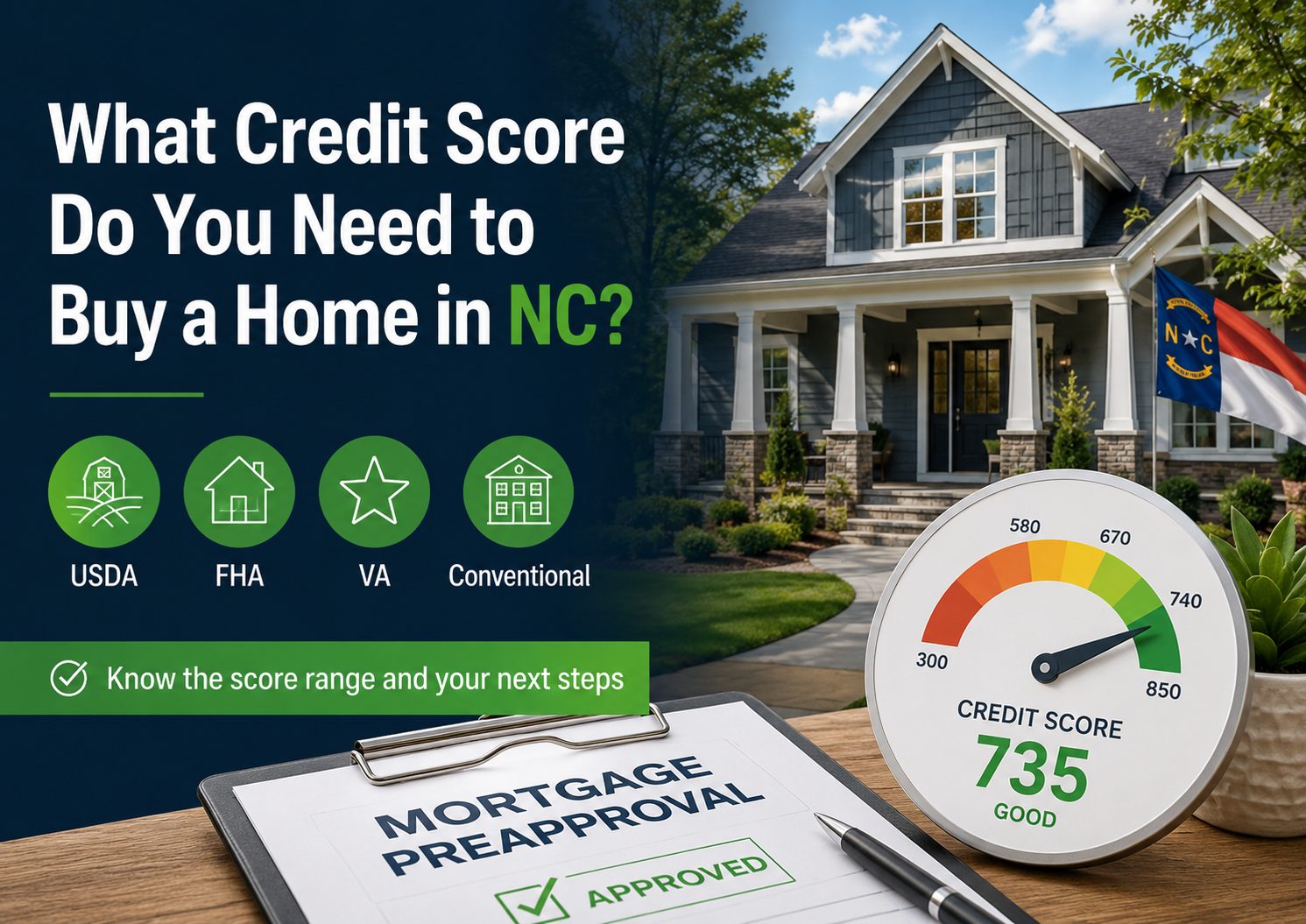
"Is my credit good enough to buy a house?" It is one of the first questions I get from almost every first time buyer I work with in Western NC. The honest answer is: it depends on the loan type. And in many cases, buyers are closer than they think, or just a few focused months away from qualifying for a program that changes everything, like a USDA zero down loan or NC down payment assistance. This guide breaks it all down, specific to North Carolina buyers.
1.First: Understand the Credit Score Ranges
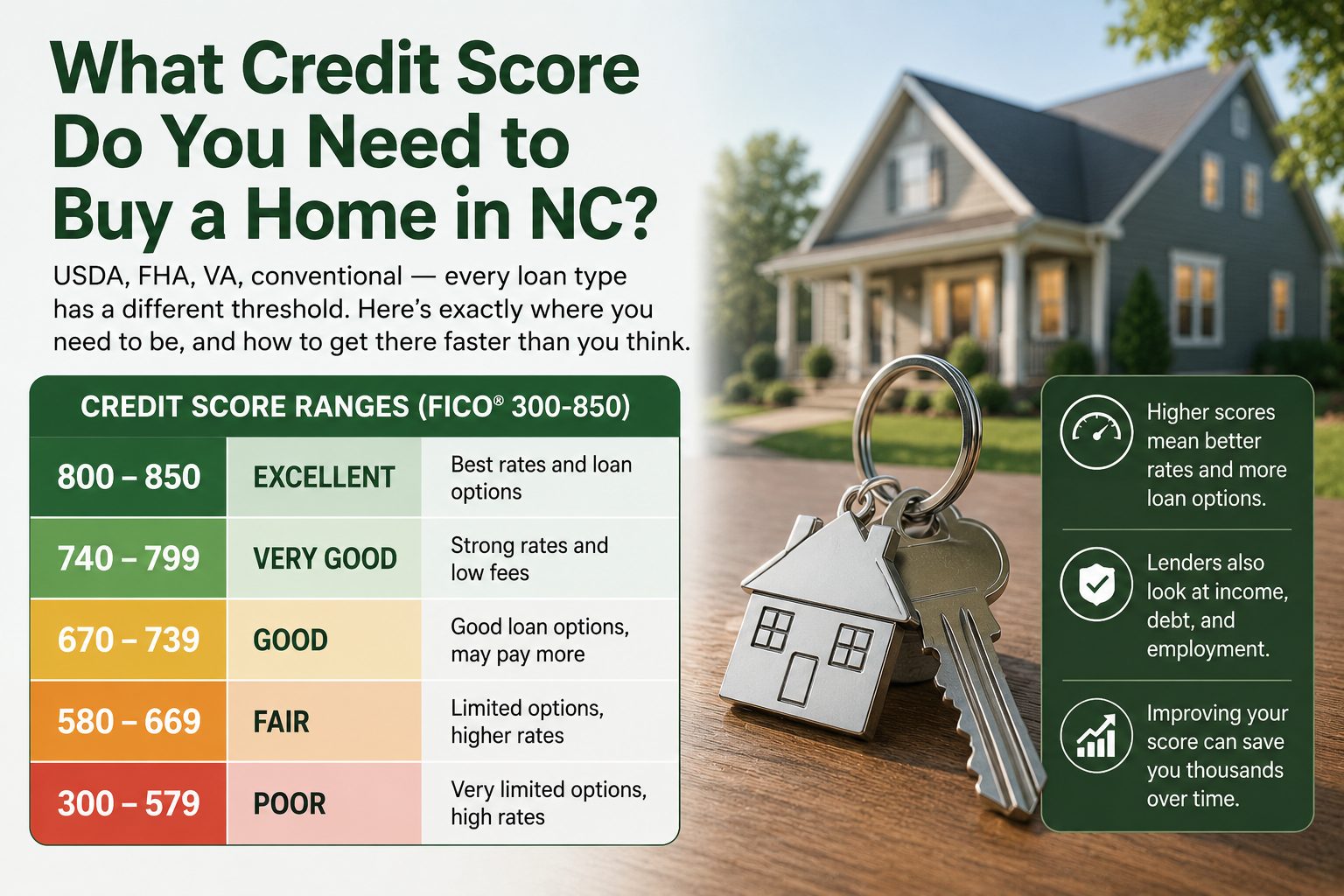
Credit scores in the U.S. are most commonly measured using the FICO® scoring model, which runs from 300 to 850. Lenders use your score, along with income, debt, and employment history, to decide whether to lend to you and at what interest rate.
Here's what each score range generally means for home buyers:
★ Real Talk
Your credit score is not a fixed number. It changes every month based on your behavior. I have watched buyers go from 608 to 645 in 60 days with the right moves, and that 37 point jump unlocked a USDA loan that saved them $40,000 in down payment they did not have.
2.Minimum Credit Scores by Loan Type in NC
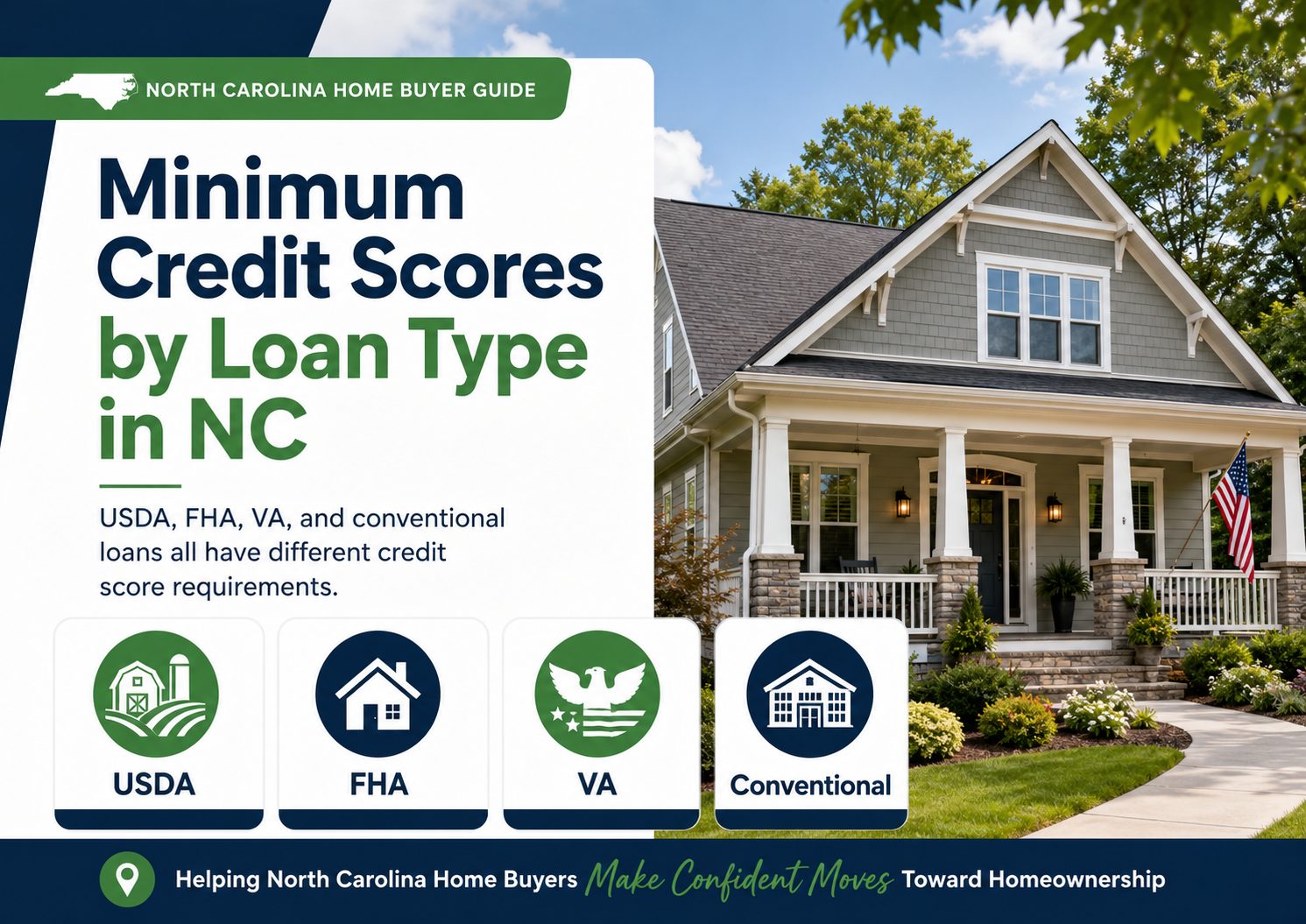
Different loan programs have different minimum requirements. Here's the full picture for North Carolina buyers:
| Loan Type | Min. Credit Score | Down Payment | NC Availability |
|---|---|---|---|
| USDA Guaranteed | 640 most lenders | 0% | Rural eligible areas, Haywood County, Western NC |
| FHA Loan | 580 with 3.5% down 500 with 10% down |
3.5% or 10% | Statewide, no location restriction |
| VA Loan | No official min. 620+ typical lender req. |
0% | Eligible veterans, active duty, surviving spouses |
| Conventional 3% | 620 to 640 | 3% | Statewide, Fannie Freddie backed |
| NC Home Advantage Mortgage | 640 | As low as 3% plus DPA |
Statewide via NCHFA approved lenders |
| USDA Direct | No official min. typically 640+ |
0% | Very low income buyers in eligible rural areas |
| Conventional 20%+ | 620+ | 20%+ | Best rates, no PMI, statewide |
💡 Pro Tip
The 640 threshold is the most important number for buyers in Western NC. It unlocks USDA zero down, the NC Home Advantage Mortgage DPA, and most conventional options. If you are at 630, you are one focused month away from a completely different set of options.
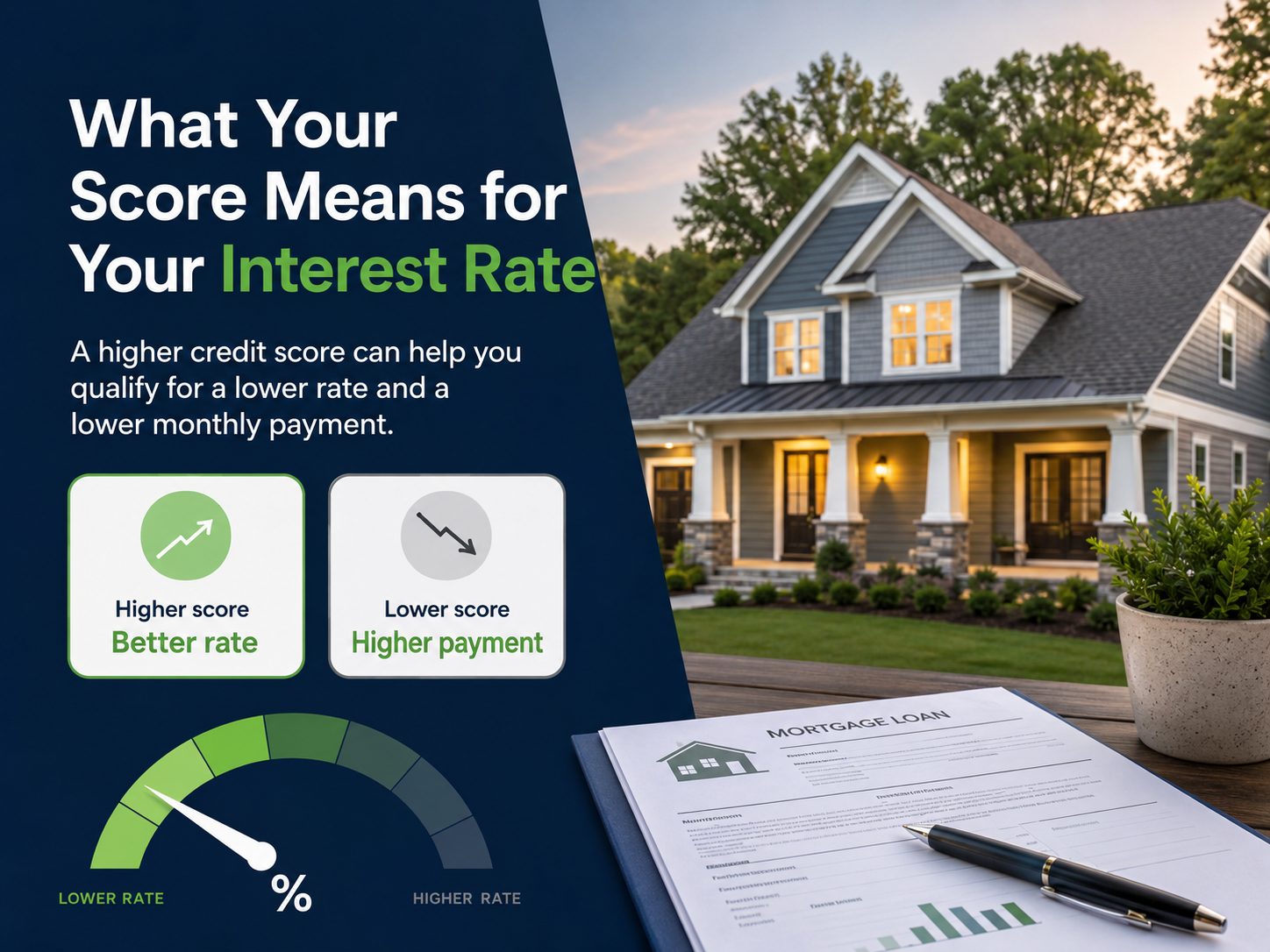
3.What Your Score Means for Your Interest Rate
| Credit Score Range | Estimated Rate Impact | Monthly Payment on $350K | 30 Year Extra Cost |
|---|---|---|---|
| 760 to 850 | Best available rate | About $2,090 | Baseline |
| 700 to 759 | +0.25 to 0.50% | About $2,140 | About $18,000 more |
| 640 to 699 | +0.50 to 1.00% | About $2,190 to $2,240 | About $36,000 to $54,000 more |
| 580 to 639 | +1.25 to 1.75% | About $2,290 to $2,350 | About $72,000 to $93,000 more |
"I always tell buyers: spending 90 days improving your credit before you buy is not a delay, it is an investment. Going from 620 to 680 on a $350,000 loan can save you more than $50,000 over 30 years. That is real money." Ginny Mosteller
4.What Actually Makes Up Your Credit Score
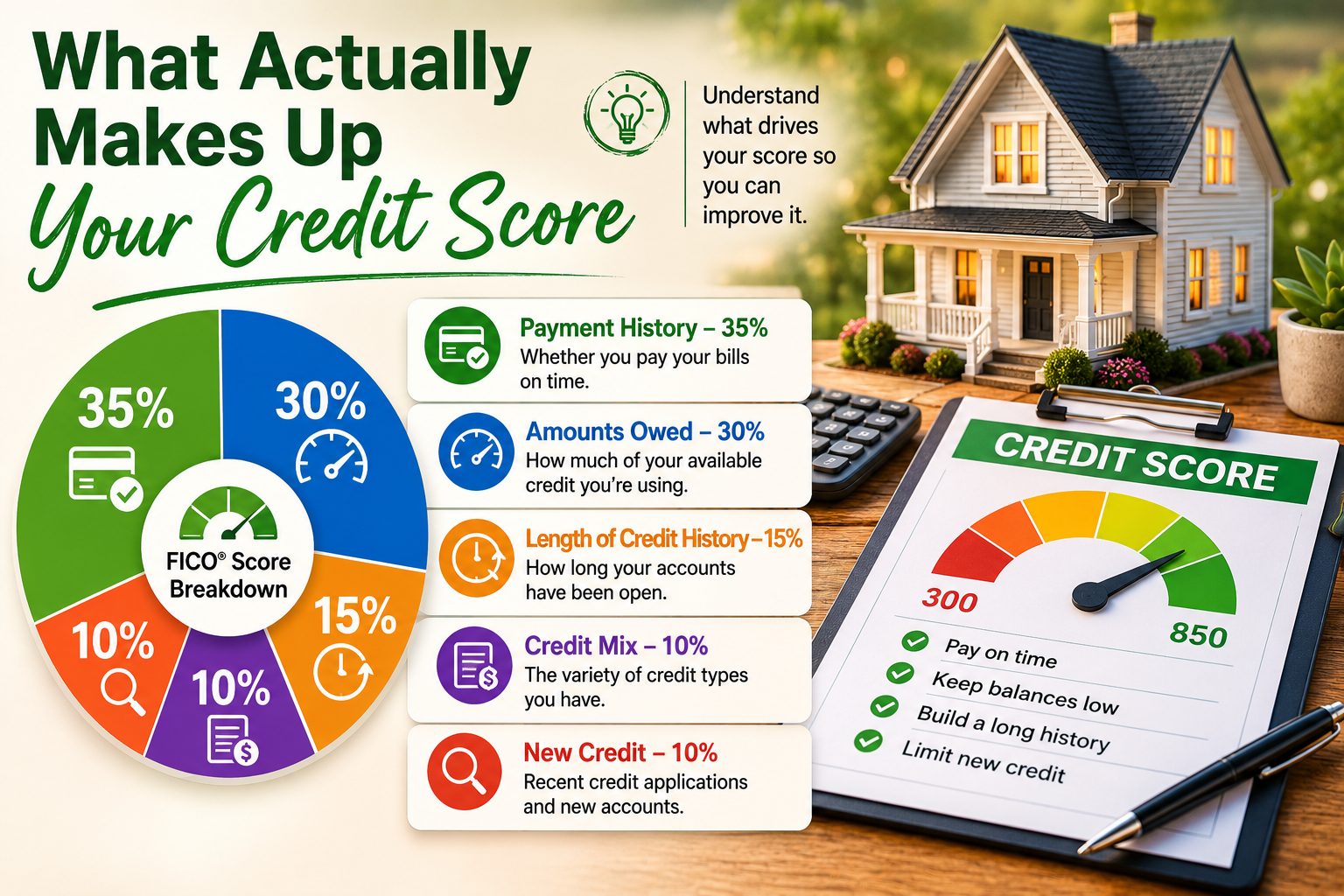
Before you can improve your score, you need to understand what drives it. FICO® scores are calculated using five factors, and knowing their weight helps you prioritize what to fix first:
- Payment History 35% The single biggest factor. One missed payment can drop your score significantly. Pay everything on time, every time.
- Credit Utilization 30% How much of your available revolving credit you are using. Aim to keep each card below 30%, ideally below 10%.
- Length of Credit History 15% Older accounts help. Do not close old credit cards you are not using, the age helps your score.
- Credit Mix 10% Having both revolving credit cards and installment loans, car or student loans, helps. Do not open new accounts just for this.
- New Credit Inquiries 10% Hard pulls from new credit applications temporarily lower your score. Avoid applying for new credit in the 6 to 12 months before buying a home.
⚠ Watch Out
The top credit mistake I see buyers make before closing is opening a new credit card or taking out a car loan to build credit right before applying for a mortgage. New inquiries and new accounts can drop your score and trigger a lender review that delays or stops your closing. Freeze all new credit activity 6 months before you plan to apply.
5.How to Improve Your Credit Score Before Buying in NC
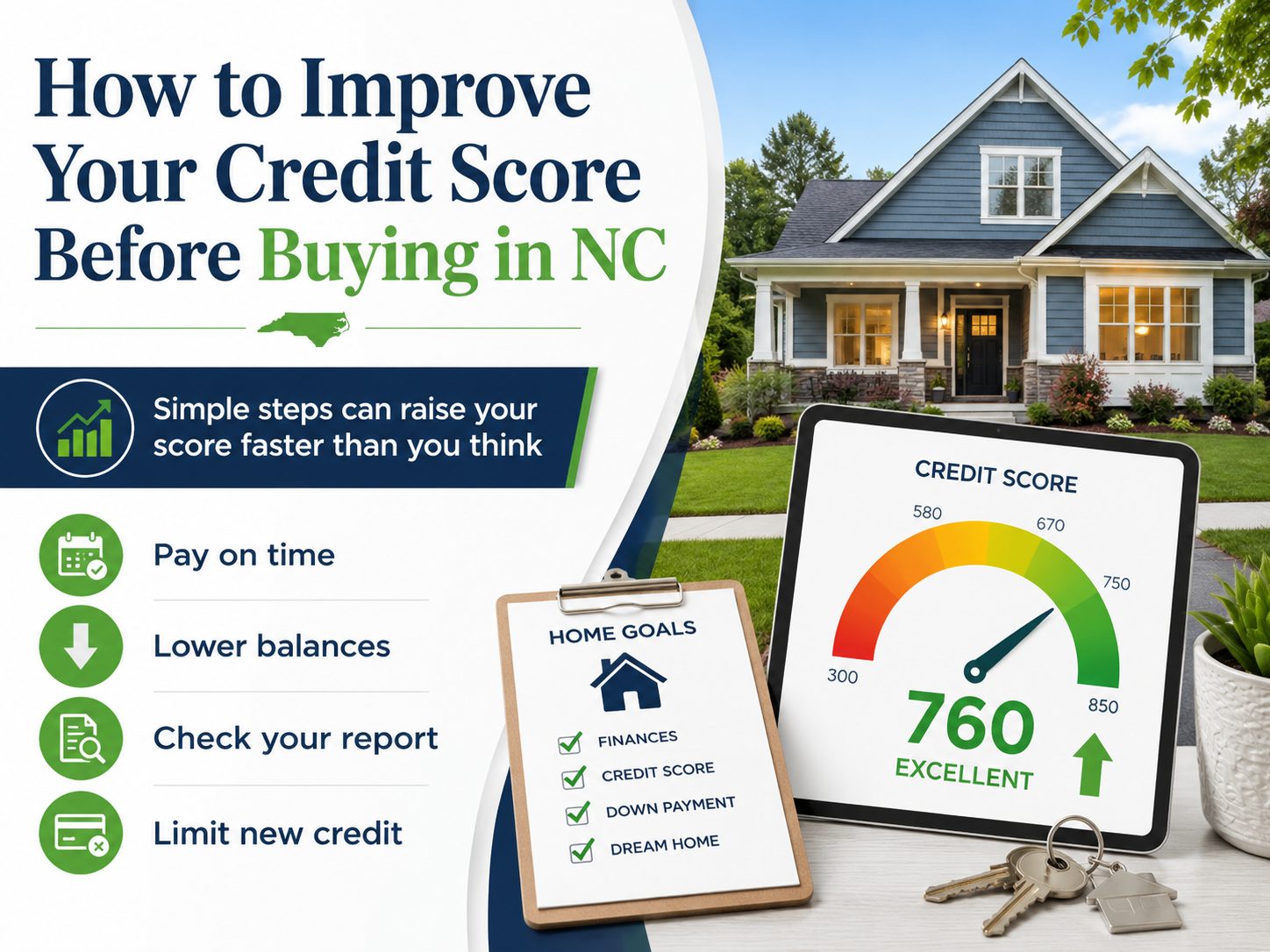
The good news: credit scores respond faster than most people expect when you take the right targeted actions. Here's the exact playbook I share with buyers who need a score boost before they're ready:
- Pull Your Free Credit Reports First Get your reports from all three bureaus, Equifax, Experian, and TransUnion, free at AnnualCreditReport.com. You are looking for errors, incorrect late payments, accounts you do not recognize, or collections that may be outdated.
- Dispute Any Errors Immediately You have the legal right to dispute inaccurate items on your credit report. Bureaus must investigate and respond within 30 days. Removing a false derogatory mark can raise your score 20 to 50 points. Use the dispute process at each bureau's website directly.
- Pay Down Credit Card Balances Aggressively This is the fastest lever available. If your cards are above 30% utilization, paying them down to below 10% can add 20 to 40 points to your score within one billing cycle. If you have $5,000 saved, it may serve you better as credit payoff than a down payment, especially if you are targeting a USDA loan.
- Do Not Close Old Accounts Closing a credit card reduces your available credit, raises utilization, and shortens your credit history. Keep old cards open and use them occasionally for small purchases you pay off immediately.
- Ask for a Credit Limit Increase If your card balances are fixed but your limits go up, your utilization ratio drops, which helps your score. Call your card issuer and request an increase. Most issuers will do this without a hard pull if you have been a good customer.
- Become an Authorized User Ask a family member with a long, clean credit history and low utilization to add you as an authorized user on one of their oldest cards. Their positive history can transfer to your report, sometimes adding 20 to 30 points within weeks.
- Set Up Autopay for Everything A single 30 day late payment can drop your score 60 to 100 points and stay on your report for 7 years. Set up autopay for the minimum on every account, then pay more manually. Never miss a due date again from this point forward.
- Freeze New Credit Applications Every hard inquiry from a new credit application can knock 5 to 10 points off your score. Stop applying for anything, new cards, car loans, or store credit, at least 6 months before your mortgage application.
6.Realistic Credit Score Improvement Timeline
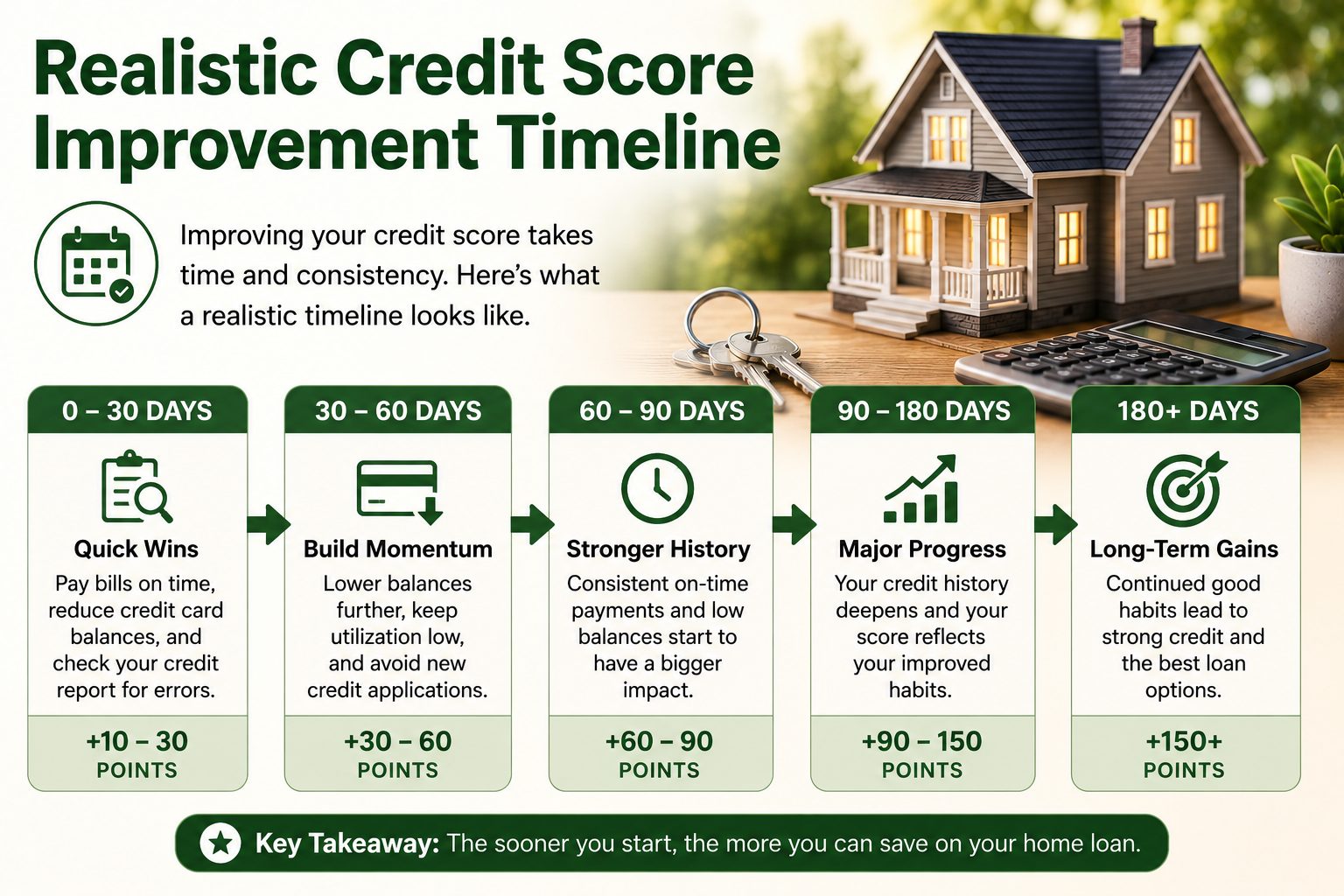
Here's a realistic picture of what you can achieve in different timeframes with consistent effort:
Pay down high utilization cards. Results show up within one billing cycle. Dispute obvious errors. Can gain 15 to 40 points depending on starting point.
Dispute resolutions complete. Authorized user additions register. Limit increases approved. Most buyers see a 30 to 60 point improvement with the full playbook applied.
Consistent on time payments compound. Old negative marks matter less as positive history builds. Buyers starting at 580 frequently reach 640+ with focused effort over 6 months.
For buyers recovering from major events, collection accounts, a missed payment, or high debt, a full 12 month rebuild plan can move scores from the 500s into qualifying range for USDA and FHA.
★ Real Talk
Six months of intentional credit work before buying a home is one of the most financially impactful things you can do. I regularly connect buyers with HUD approved housing counselors in NC who offer free one on one credit coaching for homebuyers, no cost, no catch.
7.How Credit Score Connects to Every Other Loan Program
Your credit score is the gateway to every program we've covered in this series. Here's how it all connects:
- 640+ USDA Loan eligible Zero down payment on homes in Western NC's rural eligible areas. Read: USDA Loans in Western NC, The 0% Down Option Most Buyers Miss
- 640+ NC Home Advantage Mortgage eligible State backed mortgage with built in down payment assistance up to 3% of the loan.
- 640+ NC 1st Home Advantage DPA eligible Up to $15,000 in down payment or closing cost help. Read: NC Down Payment Assistance for First Time Buyers
- 580 to 639 FHA Loan eligible 3.5% down, statewide, while you continue improving toward 640.
- 620+ Most conventional loans eligible Wider lender choice, PMI cancelable once you reach 20% equity.
💡 Pro Tip
Use the free mortgage calculators at Ginny Real Estate to model your estimated payment at different credit score tiers and loan types, so you can see exactly what is at stake and set a specific target to work toward.
What is the minimum credit score to buy a home in North Carolina?
It depends on the loan. FHA allows as low as 580 with 3.5% down. USDA and most conventional loans require 640. VA loans have no official minimum but most lenders want 620+. The NC Home Advantage Mortgage requires 640. Most buyers in Western NC will aim for 640 as their key threshold.
Can I buy a home in NC with a 580 credit score?
Yes, with an FHA loan. A 580 score qualifies you for 3.5% down FHA financing. USDA and most NC assistance programs require 640, so if you are between 580 to 639, FHA is your best immediate path while you build toward 640.
What credit score do I need for a USDA loan in NC?
Most USDA approved lenders in NC require a minimum of 640 for streamlined underwriting. Below 640 may qualify through manual review but requires a stronger overall profile. Since USDA is the most powerful zero down loan available in Western NC, reaching 640 is worth prioritizing.
How fast can I improve my credit score to buy a home?
Paying down high utilization credit card balances can show results within one billing cycle, usually around 30 days. Disputing errors, becoming an authorized user, and requesting limit increases can produce meaningful changes within 60 to 90 days. A committed 6 month effort can move most buyers from the 580s to 640+.
Does checking my credit score hurt it?
No. Checking your own credit, also called a soft pull, has zero impact on your score. Only hard inquiries from new credit applications cause a small temporary dip. You can and should monitor your score regularly, especially in the months leading up to a home purchase.
Should I pay off debt or save for a down payment?
In most cases in Western NC, paying down revolving debt is the better move, especially if you are targeting a USDA loan, which needs no down payment, or trying to cross the 640 threshold. Lower utilization raises your score and reduces your debt to income ratio, both of which help your application.
Ready to Talk Real Estate?
Have questions about what credit score you need to buy a home in North Carolina? Reach out anytime. I would be happy to help you understand which loan options may fit your situation, review how your credit score connects to USDA, FHA, VA, conventional financing, and NC down payment assistance, and connect you with a trusted local lender. From credit score thresholds and payment estimates to zero down options, buyer timelines, and homes in Western NC that may fit your budget, I can help you move forward with a clearer plan and more confidence.


© 2026 MoxiWorks
© Better Homes and Gardens Real Estate 2023 – 2026. All rights reserved. Better Homes and Gardens®, BHGRE® and the Better Homes and Gardens Real Estate Logo are registered service marks owned by Meredith Operations Corporation and licensed to Better Homes and Gardens Real Estate LLC. Franchisee Legal Entity Name (not the dba) fully supports the principles of the Fair Housing Act and the Equal Opportunity Act. Each franchise is independently owned and operated. Any services or products provided by independently owned and operated franchisees are not provided by, affiliated with, or related to Better Homes and Gardens Real Estate LLC nor any of its affiliated companies.
