

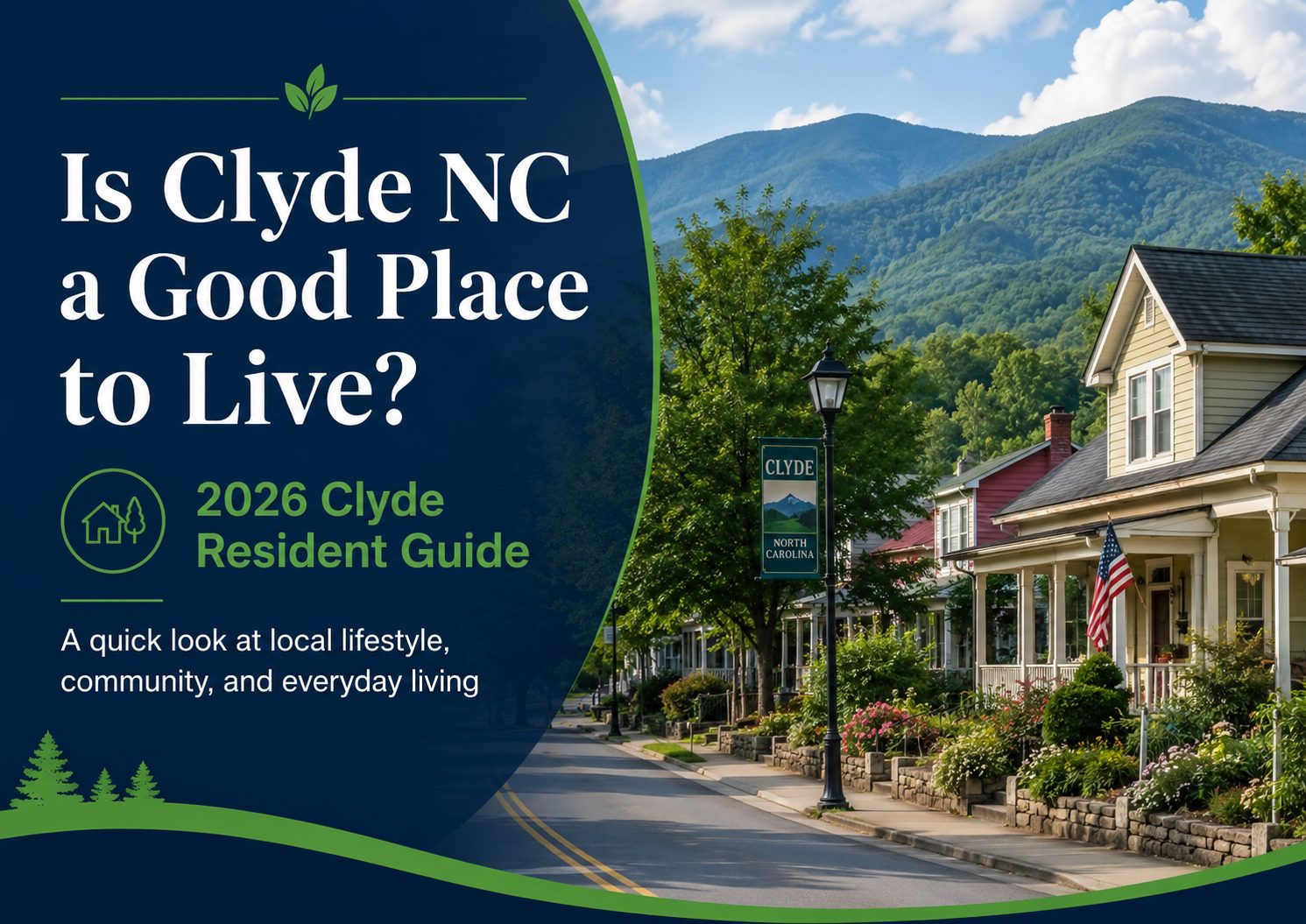
The Short Answer: Is Clyde NC A Good Place To Live?
Clyde is the town that rewards people who have done their homework. It's not flashy. It doesn't try to be. But the families who move here and stay here tend to become its most passionate advocates, because what they find is exactly what they were looking for, and more community than they expected.
Cost of Living in Clyde NC
Clyde NC has one of the most favorable cost of living profiles in all of Western North Carolina. It sits measurably below the state average on the metrics that matter most to families making a relocation decision, particularly housing, property taxes, and the everyday costs of running a household in a mountain community.
Of Living
Housing Costs
Property Tax Rate
NC Flat Rate
Housing
Housing is where Clyde’s cost of living advantage is most dramatic. While Asheville median home prices have pushed well above $400,000 and even neighboring Waynesville has crept upward, Clyde maintains entry level pricing starting around $175,000 to $230,000 for in town properties. That gap is real money, often the difference between homeownership being possible or not for a first time buyer or relocating family on a fixed income.
Property Taxes
Haywood County’s property tax rate is among the most competitive in Western NC. For a home purchased at $230,000, annual property taxes typically land well under $1,500 per year, a meaningful advantage over more urbanized areas of the state. Use the financial calculators at Ginny Real Estate to model your full monthly cost for any property you are considering.
Utilities & Everyday Costs
Utility costs in Clyde are generally in line with or below the NC state average. Natural gas and propane are common heating fuels in the mountains, so expect slightly higher winter heating costs than the NC Piedmont, offset by dramatically cooler summers that can reduce air conditioning costs. Groceries and everyday retail are accessible by way of Waynesville, 7 miles away, and Canton, 3 miles away.
Mountain living often means slightly higher heating costs in winter and dramatically lower cooling costs in summer. At 2,000+ feet elevation, Clyde averages 10 to 15°F cooler than Charlotte or Raleigh on summer afternoons, a real quality of life and utility cost advantage for families relocating from the piedmont or coastal plain.
Real Estate & Housing Market in Clyde NC 2026
The Clyde NC real estate market in 2026 sits at a fascinating intersection: prices have risen with the broader Western NC mountain market, yet Clyde still offers some of the most accessible entry points for buyers anywhere in Haywood County. If you're looking for mountain homes for sale in Western North Carolina at a price point that's actually achievable, Clyde deserves your serious attention.
Town
$290K
$420K+
Rural
Areas
Clyde’s housing inventory spans from historic craftsman bungalows in the in town core, to riverside properties along the Pigeon River corridor, to rural mountain acreage with long range WNC mountain views that define what people imagine when they dream about Western NC living. Each has its own price range, lifestyle fit, and due diligence requirements.
For buyers relocating to Western North Carolina, Clyde’s location near I 40 makes it especially attractive. You can have genuine mountain property while remaining accessible to Asheville, Waynesville, and the broader region without being locked into Asheville’s price market.
- Lowest median prices in Haywood County
- Strong USDA 0% down eligibility
- Authentic inventory: bungalows to mountain acreage
- Stackable NC down payment assistance available
- Growing equity, rising market with room to run
- Limited inventory, good homes move quickly
- Flood zone properties require careful due diligence
- Rural properties: well and septic inspections add cost
- Post Helene perception affecting some riverfront values
Community, Culture & What Nobody Tells You
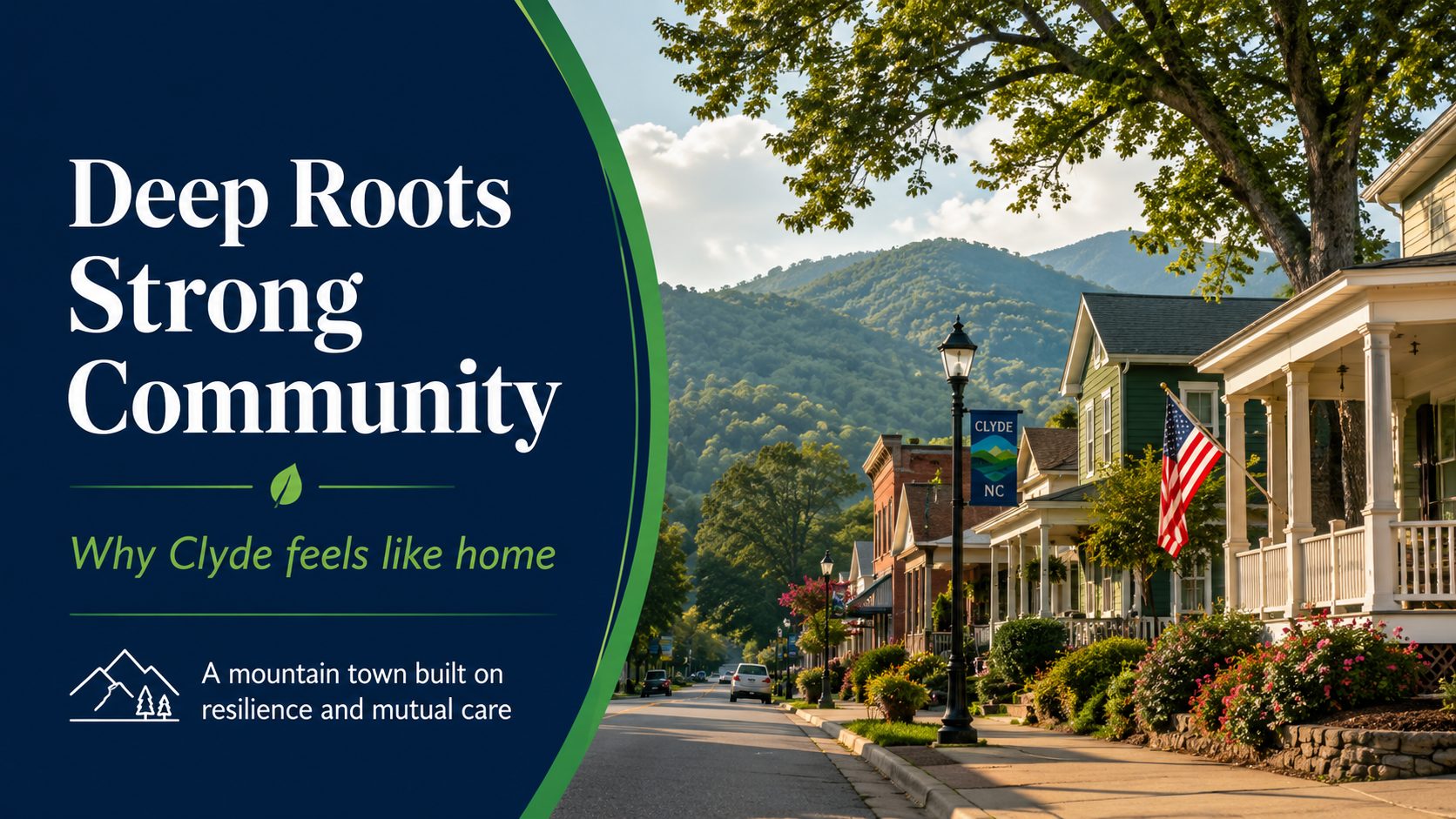
Clyde is a working class mountain town with deep roots and a genuine sense of mutual care that has been tested and proven in extraordinary circumstances. When Hurricane Helene came through Haywood County in September 2024, Clyde’s residents did not wait for instructions. They showed up. They cleared roads. They checked on neighbors. They fed each other. The recovery that followed was not performed. It was organic, neighbor to neighbor, and utterly characteristic of who this community has always been.
That is not something you can manufacture. You either have it or you do not. Clyde has it.
"Within three weeks of moving in, my neighbor brought over tomatoes from her garden. Within three months, I knew the names of every family on my street. I lived in Charlotte for eight years and didn't know my neighbors' last names. Clyde changed how I understand what a neighborhood is."Clyde NC resident, relocated from Charlotte, NC, name withheld
The cultural character of Clyde reflects its Appalachian heritage, hardworking, self reliant, unpretentious, and deeply loyal. Long time residents are generally welcoming to newcomers who respect the community rather than trying to change it. The influx of remote workers and retirees since 2020 has brought new energy and some rising prices, but Clyde has retained its character in ways that nearby towns with more commercial development have not.
Haywood Community College serves as a genuine community anchor, bringing arts programming, workforce development, continuing education, and community events to residents of all ages. The HCC Arts program in particular draws talent and audiences from across Western NC, and is a legitimate cultural asset for anyone living in the Clyde area.
Schools in Clyde NC
Clyde is served by Haywood County Schools, a district that covers the full county including Canton, Waynesville, and the surrounding mountain communities. For families with school age children making a relocation decision, here is what you need to know.
Minutes Away
University
Clyde Elementary has earned a reputation as a warm, community rooted school where families feel genuinely known, a reflection of Clyde’s broader community character. Pisgah High School serves the greater area and has solid athletic programs, career and technical education pathways, and the kind of school spirit that reflects a tight knit mountain community.
For families with post secondary aspirations, Haywood Community College sits minutes from downtown Clyde and offers associate degrees, workforce credentials, and transfer pathways at remarkably low tuition. Western Carolina University in Cullowhee is approximately 25 minutes away, giving families access to a legitimate four year university with strong programs in education, business, and the sciences.
Families evaluating Haywood County Schools should also check district boundaries for specific addresses, because school assignments can vary within Clyde depending on property location. Always verify your specific address assignment before purchasing. Your agent should be able to help with this, reach out to Ginny Real Estate if you have questions.
Weather & Seasons in Clyde NC
Clyde’s weather is one of its most genuine quality of life advantages, particularly for families relocating from the NC Piedmont, the Southeast, or out of state. Situated at approximately 2,200 feet elevation in a protected mountain valley, Clyde experiences four distinct seasons that feel genuinely seasonal, a rarity in much of the American South.
Spring & Summer
Clyde summers are the headline feature for relocators from hotter climates. Average July highs hover around 74°F, roughly 10 to 15°F cooler than Charlotte or Asheville’s lower elevation zones. Humidity is noticeably lower than the Piedmont. Afternoon thunderstorms are common and dramatic, moving through the mountain ridges and clearing quickly. This is the season that makes people fall in love with Western NC and start looking at real estate.
Fall
Haywood County fall color is widely considered among the best in the entire Blue Ridge region. Peak color typically arrives in mid to late October. For residents, not tourists, this means the extraordinary luxury of watching the ridgelines shift color from your own front porch over several weeks. It does not get old.
Winter
"Nobody warned me how good the fall would be. Or how different the quiet of a winter morning with snow on the Balsams looks from my porch. I came for the summers. I stayed for all four seasons."Clyde NC resident, relocated from Florida, name withheld
Flooding, Hurricane Helene & What Every Buyer Must Know
Clyde sits in the Pigeon River Valley. The Pigeon River is a living, seasonal river that has flooded in modern memory, most significantly during Hurricane Helene in September 2024 and Tropical Storm Fred in August 2021. These were not minor events. Real properties were affected. Real families were impacted. The community’s response was extraordinary, but the events were real and they will be part of Haywood County’s history and risk profile going forward.
What this means for prospective buyers and residents is not “Clyde is dangerous, avoid it.” It means location within Clyde matters enormously.
Always check the FEMA Flood Map Service Center for any specific Clyde NC property address before touring or making an offer. Flood zone designation varies significantly from property to property, elevation and setback from the river make a major difference. Mandatory flood insurance for Special Flood Hazard Area SFHA properties adds meaningfully to monthly costs and must be budgeted from day one.
Properties on higher ground, on ridge adjacent lots, or set back from the river and its tributaries are frequently not in flood zones at all, and these properties represent the majority of Clyde’s housing market. The in town core, the HCC corridor, and rural hillside properties are generally at low flood risk. The honest takeaway: flood zone awareness is essential due diligence in Clyde, but it does not disqualify Clyde as a place to live.
- Community rallied faster than most expected
- Local government response improved flood preparedness
- Most of Clyde was not directly flood affected
- Flood impacted property values create buying opportunities for prepared buyers
- Check FEMA flood map for every address before offering
- Budget flood insurance before going under contract
- Ask sellers specifically about flood history
- Rural creeks and tributaries, not just the main river
Outdoor Life & Recreation in Clyde NC
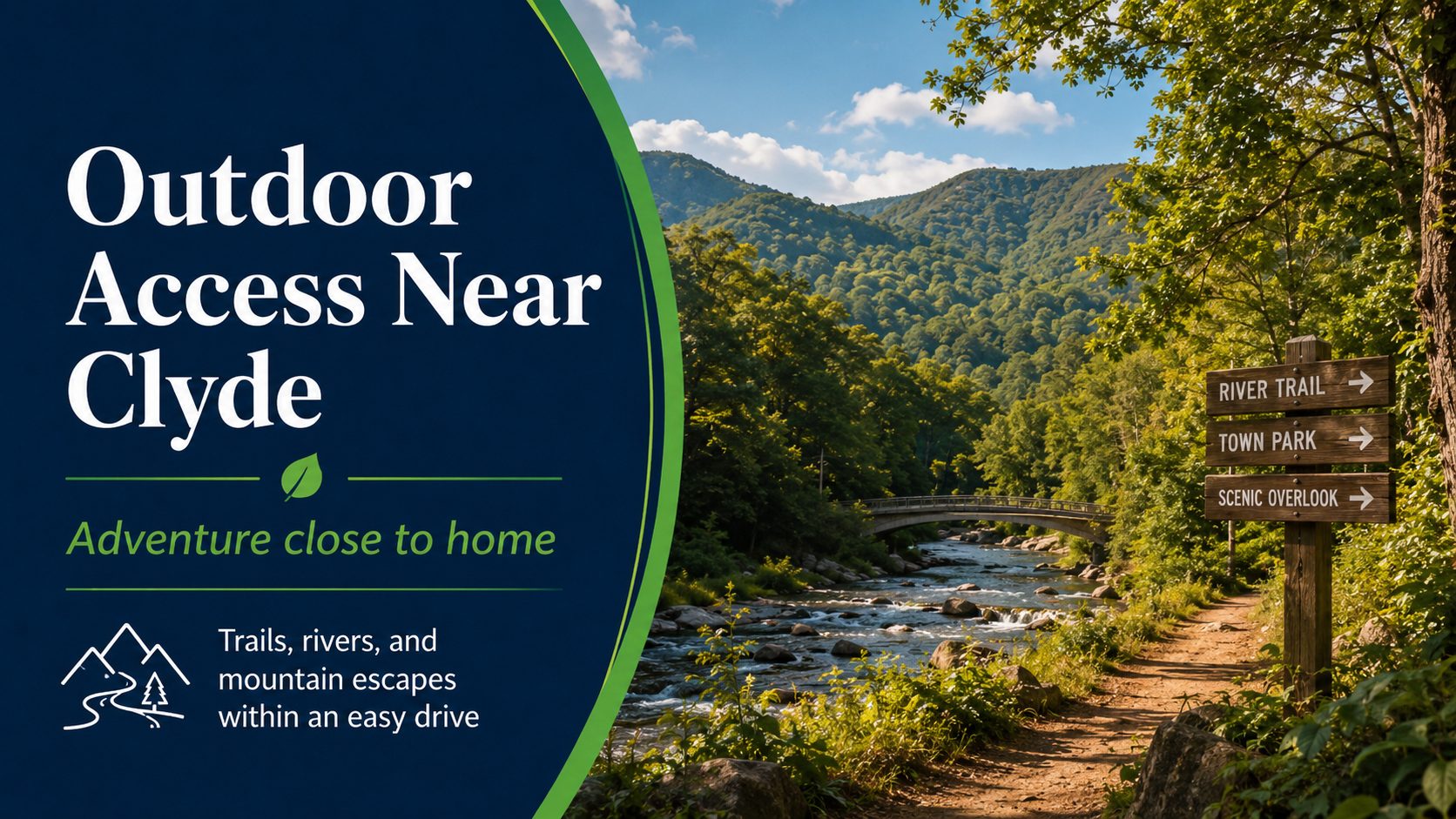
If outdoor access is on your list of reasons to move, and for most people relocating to Western NC it is, Clyde’s location gives you access to one of the most extraordinary outdoor recreation ecosystems in the Eastern United States, all within an easy drive from your front door.
Forest
Parkway
Access
Mountains
Day to day outdoor access from Clyde includes Pigeon River fishing and kayaking, hiking in Pisgah National Forest, Blue Ridge Parkway drives and trailheads, mountain biking at the Watershed trails near Brevard, and the full cultural and outdoor calendar of Haywood County’s NC Smokies region. In the other direction, Great Smoky Mountains National Park is less than 45 minutes away.
For residents who garden, raise chickens, keep bees, or run small homesteads, the rural properties surrounding Clyde support all of this naturally, with the acreage, elevation, and climate to make it genuinely productive rather than a hobby that fights its environment.
Amenities, Dining & Everyday Life in Clyde NC
Let me be straightforward: Clyde is a small town, and its in town amenity base reflects that. If you are moving from a suburban environment with a grocery store on every corner, a Target nearby, and fifteen restaurant options within a mile, you will notice the difference.
What Clyde itself offers is the essentials: a post office, local businesses, community gathering spaces, and the bones of a real small town. For everything else, including groceries, healthcare, dining, and retail, the access picture looks like this:
Dining
Full Retail
Urban Amenities
Regional Medical
Waynesville, 7 miles east, has a genuinely charming downtown with local restaurants, boutiques, and a growing arts scene that serves as Clyde’s de facto town center for dining and shopping. Asheville, 25 to 28 miles by way of I 40, provides every urban amenity, including major grocery chains, specialty retail, a nationally acclaimed restaurant scene, airport access, and cultural programming.
For healthcare, Haywood Regional Medical Center in Clyde is a genuine full service hospital with emergency care, surgical services, and a wide range of specialty clinics. For a town of Clyde’s size, having a hospital minutes from home is an underrated asset, particularly for retirees and families.
The honest Clyde amenity calculus: you trade convenience density for space, quiet, community, and cost. For the right buyer, that's not a sacrifice, it's exactly the point. But it's worth being honest with yourself about which kind of person you actually are before you buy.
Jobs & Economy Near Clyde NC
The employment landscape in and around Clyde reflects the broader Haywood County economy, a mix of healthcare, education, manufacturing, hospitality, small business, and a growing remote work population that has changed the demographic profile of mountain towns significantly since 2020.
Medical
Schools
2020
Market Access
Major local employers include Haywood Regional Medical Center, Haywood County Schools, Haywood Community College, and a range of manufacturing and service businesses throughout the county. For professional roles, Asheville’s job market, 25 minutes by way of I 40, provides access to a much broader employment base including Mission Health, the UNCA campus, tourism, tech, and the region’s growing entrepreneurial economy.
Remote workers have found Clyde to be a genuinely workable mountain base, with reliable fiber internet increasingly available throughout the town core and many surrounding areas. For buyers who work remotely, Clyde’s cost of living advantage over Asheville can translate into a material improvement in financial quality of life, often $800 to $1,200 per month in housing cost savings alone.
If remote work is part of your plan, always verify internet service availability and speed for any specific property address before purchasing, especially on rural roads. Fiber availability in Haywood County has expanded significantly since 2022, but coverage is not universal. Your agent can help you verify this during due diligence.
Who Is Clyde NC Actually For?
The most honest thing I can tell you about Clyde NC is this: it is not the right place for everyone. And the families who thrive here are usually the ones who were honest with themselves about that before they moved.
- You genuinely value community over amenity density
- You want the lowest housing costs in Haywood County
- You need I40 access for Asheville commuting
- Outdoor life, hiking, fishing, gardening, homesteading, drives your lifestyle
- You want a real town, not a curated mountain experience
- You're a remote worker seeking mountain lifestyle on a budget
- You want proximity to HCC or Haywood Regional Medical
- You value quiet, space, and four real seasons
- You need walkable restaurants and nightlife daily
- A diverse shopping scene within 5 minutes is non negotiable
- You're not prepared to do flood zone due diligence
- Mountain road driving in winter conditions isn't for you
- You need a major airport closer than 30 to 40 minutes
- You want a larger school district with more program variety
- Urban energy and density are genuinely what recharge you
Clyde vs. Canton vs. Waynesville: Which Is Right for You?
| Factor | Clyde NC | Canton NC | Waynesville NC |
|---|---|---|---|
| Entry level home price | ~$175K | ~$180K | ~$210K |
| Median home price | ~$250K | ~$270K | ~$320K |
| Downtown amenities | Small, quiet | Working class, growing |
Developed, arts focused |
| USDA loan eligibility | Very strong | Strong rural areas | Limited in town |
| I40 Asheville access | Excellent, ~25 min | Good, ~30 min | Good, ~30 min |
| HCC proximity | Minutes away | ~10 min | ~10 min |
| Haywood Regional Medical |
In Clyde | ~5 min | ~10 min |
| Community vibe | Tight knit, quiet | Working class, loyal | Retirees, arts, tourism |
| Best for | Budget, USDA, commuters, HCC |
Budget + more inventory |
Amenities + culture |
Many buyers searching Haywood County NC real estate seriously consider all three towns before deciding. Search current listings in Clyde, Canton, and Waynesville simultaneously at the Ginny Real Estate property search. Also read: Best Neighborhoods in Canton NC and Best Neighborhoods in Waynesville NC.
Frequently Asked Questions About Living in Clyde NC
Is Clyde NC a good place to live in 2026?
Yes, for the right person, Clyde NC is one of the best places to live in Western North Carolina. It offers authentic mountain community, some of the lowest housing costs in Haywood County, excellent I 40 access to Asheville, strong outdoor recreation access, and a genuine neighbor knows neighbor culture. The main tradeoffs are limited local amenities and the need for flood zone awareness near the Pigeon River.
What is the cost of living in Clyde NC?
Clyde NC is consistently 8 to 12% below the North Carolina state average cost of living, with home prices starting around $175,000 for in town properties, roughly 30 to 35% below comparable Asheville properties. Haywood County property taxes are among the most competitive in Western NC. Utilities and daily costs are generally in line with or below state averages.
What are the schools like in Clyde NC?
Clyde is served by Haywood County Schools, including Clyde Elementary and Pisgah High School. Haywood Community College is minutes from downtown Clyde and offers associate degrees, workforce credentials, and transfer pathways. Western Carolina University in Cullowhee is approximately 25 minutes away.
How far is Clyde NC from Asheville?
Clyde is approximately 25–28 miles from downtown Asheville, a drive of roughly 25–30 minutes via I-40 West in normal conditions. It's one of the closest Haywood County communities to Asheville by interstate highway.
Did Clyde NC flood during Hurricane Helene?
Yes, portions of Clyde near the Pigeon River corridor experienced significant flooding during Hurricane Helene in September 2024. The community responded with extraordinary resilience during the 2024 to 2025 recovery. Prospective buyers should always check the FEMA Flood Map for any specific property address and factor flood insurance costs into their budget for properties near the river or its tributaries.
Are there USDA loans available for homes in Clyde NC?
Yes, many properties in and around Clyde NC qualify for USDA Rural Development loans offering 0% down payment for eligible buyers who meet income limits. Check any specific address at eligibility.sc.egov.usda.gov.
See the full USDA Loans in Western NC guide for details.
How does Clyde NC compare to Waynesville for living?
Clyde offers lower home prices, stronger USDA eligibility, and a quieter community feel. Waynesville has a more developed downtown with restaurants, arts, and retail, and draws more retirees and tourism. Many buyers tour both before deciding. The right fit depends on whether amenity access or price and community quiet matter more to you.
Ready to Talk Real Estate?
Have questions about living in Clyde NC or deciding whether it is the right fit for you? Reach out anytime. I would be happy to help you look beyond the listing photos and understand what daily life here really feels like, from affordability and school options to flood zone awareness, commute times, mountain roads, local amenities, and neighborhood fit. Whether you are comparing Clyde, Canton, Waynesville, Maggie Valley, or another Haywood County community, I can help you move forward with a clearer plan, stronger local insight, and more confidence before you make your next move.


© 2026 MoxiWorks
© Better Homes and Gardens Real Estate 2023 – 2026. All rights reserved. Better Homes and Gardens®, BHGRE® and the Better Homes and Gardens Real Estate Logo are registered service marks owned by Meredith Operations Corporation and licensed to Better Homes and Gardens Real Estate LLC. Franchisee Legal Entity Name (not the dba) fully supports the principles of the Fair Housing Act and the Equal Opportunity Act. Each franchise is independently owned and operated. Any services or products provided by independently owned and operated franchisees are not provided by, affiliated with, or related to Better Homes and Gardens Real Estate LLC nor any of its affiliated companies.
